Rental Comps by ZIP Code: How Real Estate Investors Should Estimate Market Rent
Rental comps by ZIP code are a useful starting point, but the best rent estimate comes from comparing similar properties nearby. Learn how to choose strong comps, adjust for condition and amenities, compare asking vs. effective rent, and build a rent range you can actually underwrite.

Rental comps by ZIP code are useful when you need to estimate rent, but a ZIP code should be the start of the analysis, not the answer. One ZIP can contain new apartments, older duplexes, renovated single-family homes, and dated rentals that compete at very different price points.
A better approach is simple: start broad, then narrow the comp set to properties that actually resemble yours. Match property type, bedrooms, bathrooms, size, condition, amenities, location, and timing as closely as you can. The goal is not one perfect rent price. It is a realistic range you can defend before you make an offer.
What Is a Rental Comp?
A rental comp is a comparable rental property that helps you estimate what another property could rent for. Real estate investors, landlords, and property managers use rental comps much like appraisers use sales comps: to anchor an estimate in evidence from the local market rather than in the number they hope to achieve.
A useful comp should be similar on the features renters actually compare, including location, property type, bedroom and bathroom count, square footage, condition, parking, laundry, outdoor space, and which utilities are included.
You rarely find an exact twin. A good comp set usually includes several properties that bracket the subject—some a little better and some a little worse—so you can judge where your property belongs.
Can You Estimate Market Rent From a ZIP Code Alone?
Not reliably. ZIP codes are mailing areas, not true rental submarkets. The same ZIP code can cross neighborhood boundaries, school districts, major roads, or pockets with very different housing stock.
ZIP-level information is still useful as a first screen. It can show the general level of rental rates and help you catch an estimate that is clearly out of line.
HUD also publishes Small Area Fair Market Rents for ZIP-code areas in many metropolitan markets. HUD's Fair Market Rent framework uses gross rent, which includes contract rent plus applicable tenant-paid utilities, and the figures are designed for housing-program purposes. They are useful context, but they are not a prediction of what a specific private-market rental will lease for.
How to Build a Useful Rental Comp Set
The quality of your analysis depends less on how many listings you collect and more on how well you remove bad comps.
Match the Property Type First
Compare single-family homes with single-family homes, townhouses with similar townhouses, and apartment units with apartments in comparable buildings.
A three-bedroom apartment in a large complex is not automatically a good comp for a detached three-bedroom house with a yard, even if the two are on the same street. Property type changes privacy, parking, amenities, maintenance expectations, and the renter pool.
Match Bedrooms, Bathrooms, and Size
Start with the same bedroom count whenever possible. A two-bedroom rental usually tells you very little about a three-bedroom property because renters often search by bedroom count first.
Bathrooms matter too. A three-bedroom, one-bath home can compete differently from an otherwise similar three-bedroom, two-bath home.
As a practical starting point, look first for comps within roughly 10% to 20% of the subject's square footage, then widen the range if the local market gives you too few options. That is a screening rule, not a valuation standard.
Rent per square foot can be a useful secondary check, especially for apartment analysis, but tenants do not price every extra square foot equally. Layout, bedrooms, location, and condition often matter more.
Adjust for Condition and Amenities
Condition is one of the easiest ways to overstate rent. If the subject is dated, do not underwrite it using only newly renovated rental comps unless your rehab plan will genuinely bring it to that level.
New flooring, updated kitchens, bathrooms, appliances, HVAC, parking, laundry, outdoor space, storage, pet policies, and included utilities can all affect the rent price.
You do not need to pretend these differences have one universal dollar adjustment. Recognize the difference and use local evidence whenever possible.
Keep the Geography Tight
Start close to the property and widen only when necessary. In a dense urban market, useful comps may be within a few blocks or half a mile. In suburban or rural areas, a wider search can be reasonable.
Pay attention to boundaries that renters care about: school districts, major roads, transit, neighborhood reputation, employment centers, and physical barriers. Two rentals one mile apart in the same competitive area may be better comps than two properties a quarter-mile apart on opposite sides of a major boundary.
Where to Find Rental Comp Data
No single source gives you everything. Good rental analysis usually combines current rental listings, automated estimates, local knowledge, and—when available—recently signed lease information.
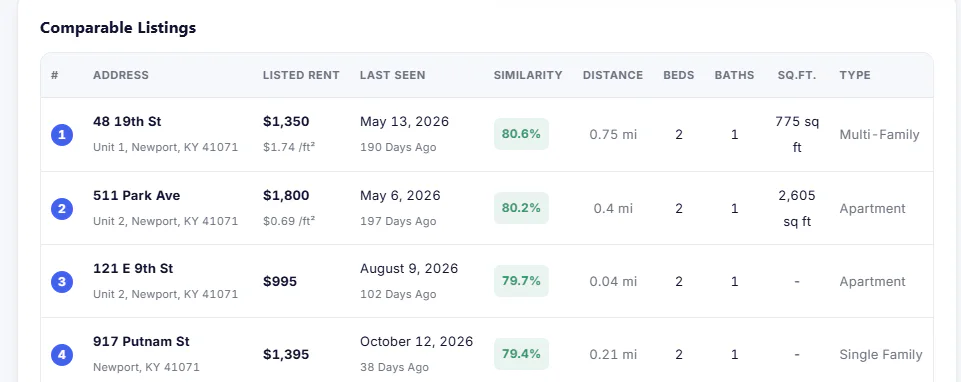
Zillow, Realtor.com, and Apartments.com are useful for seeing what landlords are asking today. They can show price, photos, property features, and current competition. The limitation is important: an active listing shows asking rent, not necessarily the final amount a tenant agrees to pay.
Automated tools can provide a fast second opinion. Zillow describes its Rent Zestimate as a starting point based on public property information and similar local listings, and it recommends supplementing the estimate with additional research.
Rentometer and Navikoo provide rent ranges and comparable rental context using a large database of rental information. It also states that its data primarily reflects advertised asking rents, which is important when you are trying to estimate achievable rent rather than listing price.
Local property managers and leasing agents can add another layer of information because they may know how fast similar units are leasing, what concessions landlords are using, and how renewals are behaving. Where a local MLS records rental transactions, an agent may also be able to provide leased data.
Smaller landlords may advertise through Craigslist, Facebook groups, local classifieds, or neighborhood networks. These resources can help fill gaps, especially in smaller markets.
The goal is not to collect every available data source. It is to cross-check enough information that one unusual listing or one automated rent estimate does not control the analysis.
Asking Rent Is Not the Same as Achievable Rent
Asking rent is what a landlord wants. Achievable rent is what the market is willing to pay.
A property listed at $2,400 for 60 days is weak evidence that $2,400 is the right rent. A similar unit that recently signed near $2,200 may be more useful.
Concessions can hide the difference. Suppose a landlord signs a 12-month lease at $2,200 but gives one month free. Total scheduled collections are $24,200 over the year, which equals about $2,017 per month in effective rent.
For underwriting, that effective rent may be more useful than the headline monthly rent.
How Recent Should Rental Comps Be?
Use the most recent relevant comps you can find. Rental conditions and seasonality vary by city, neighborhood, and property type, so an older comp deserves less weight when current competition has changed.
Favor comps from the last few months when possible. If you need older information, compare it with newer listings and local rental market trends before making an adjustment.
Avoid applying a broad market percentage mechanically. A metro-wide change in rents does not mean every neighborhood and property type moved by the same amount.
How Many Rental Comps Should You Use?
There is no universal minimum. For many small residential rentals, three to six strong comps are more useful than fifteen weak ones.
Once several closely matched properties point to a similar range, adding unrelated listings can create more noise than information.
If you can find only one or two strong rental comps, that is useful information too. It means the estimate carries more uncertainty, so your underwriting should leave a wider margin for error.
What If You Can't Find Comparable Rentals Near You?
This is common with unusual properties, small towns, rural areas, and low-turnover neighborhoods.
Widen the search in stages. Expand the time window first, then the radius, then the square footage or bathroom range while keeping property type and bedroom count as close as possible.
You can also look at nearby communities with similar schools, employment access, housing stock, and renter demand. A nearby town with similar fundamentals may be more useful than a closer area serving a different renter.
When rental comp data is thin, stay conservative. A sparse market is not a reason to use the highest price you can find.
Example: Estimating Rent From Rental Comps
Assume you are analyzing a three-bedroom, two-bath single-family rental with 1,450 square feet, a one-car garage, and a clean but dated interior.
After filtering by ZIP code, property type, bedroom count, location, and recent activity, you find four usable comps.
Comp | Details | Status | Rent | Illustrative adjustment | Adjusted indication |
|---|---|---|---|---|---|
A | 3/2, 1,400 sq ft, renovated kitchen, 0.4 mi | Leased 3 weeks ago | $2,150 | Down for superior renovation | $2,075 |
B | 3/2, 1,500 sq ft, similar condition, 0.6 mi | Listed 45 days | $2,350 asking | Long marketing time suggests optimistic price | ~$2,250 |
C | 3/1, 1,300 sq ft, no garage, 0.8 mi | Leased 2 months ago | $1,950 | Up for extra bath and garage | $2,075 |
D | 3/2, 1,550 sq ft, similar condition, 1.0 mi | Listed 10 days | $2,200 asking | Slightly superior size | $2,150 |
These adjustments are illustrative, not standardized appraisal adjustments. In a real analysis, any dollar adjustment should be supported by local evidence whenever possible.
Two other properties appear in the search but should be excluded: a new 1,800-square-foot townhouse asking $2,650 and a four-bedroom house. Both are nearby, but neither is a clean comparison.
The resulting comp set points roughly to $2,075 to $2,250. The recently signed leases support the lower end, while the long marketing time on Comp B makes its asking price less convincing.
A reasonable underwriting range might be $2,075 to $2,150, with $2,100 used as the base case.
That choice matters. Underwriting at $2,350 instead of $2,100 would add $3,000 of annual rental income that the comps do not clearly support.
Do Short-Term Rental Comps Work the Same Way?
No. Short-term rental analysis uses nightly rate, occupancy, seasonality, stay length, cleaning costs, and booking patterns rather than one monthly rent price.
Location can become even more granular. Two properties in the same ZIP code may perform differently because of walkability, proximity to attractions, views, design, reviews, and local short-term rental rules.
Use short-term-rental-specific data and confirm local regulations before underwriting that strategy. Long-term rental comps are not a substitute.
Common Rental Comp Mistakes
The most common mistakes are straightforward:
Using the highest comp. A higher number improves the spreadsheet, not necessarily the property.
Mixing property types. Apartments and single-family homes can serve different renters.
Treating asking rent as signed rent. Rental listings show what landlords want, not always what tenants pay.
Ignoring condition. Renovated comps can overstate rent for a dated property.
Using stale data. Old comps deserve less weight when the rental market has moved.
Trusting one source. Listing sites, automated estimates, and local professionals each see different parts of the market.
How Rental Comps Flow Into Property Underwriting
Your rent estimate sits near the top of the investment model. It affects rental income, vacancy, NOI, cash flow, DSCR, valuation, and the amount of debt the property may comfortably support.
A rent estimate that is $150 too high does not stay isolated. It flows through nearly every return metric below it.
Use a realistic range, include a vacancy assumption, and test what happens if rent comes in $100 or $200 below your base case. If a rental property only works at the highest rent in the comp set, the deal is fragile.
Once you have a defensible rent estimate, Navikoo's Rental Property Calculator is a natural next step: plug in the rent alongside vacancy, operating expenses, and financing to see how the full deal performs. The rent estimate should still come from your market work; the calculator helps you understand what that assumption does to the investment.
Final Takeaway
Rental comps by ZIP code are a useful starting point, but ZIP-level averages do not replace property-level analysis.
Start broad, then narrow aggressively. Match property type, bedrooms, bathrooms, square footage, condition, amenities, location, and timing. Favor recent signed leases when you can get them, treat asking rents with appropriate skepticism, and account for concessions.
Most importantly, build a range instead of chasing one perfect number. A conservative estimate will not make every deal work. That is exactly why it is useful.