Rental Yield in Real Estate: What the Percentage Tells You and What It Hides
Discover the truth behind rental yield in real estate! Learn what the percentage really means and uncover hidden insights. Click here to maximize your investment potential!

Rental yield expresses the income a property produces relative to its value. It is quick to calculate and makes properties at very different price points easier to compare than raw monthly rent ever could.
The problem is that investors frequently quote “the yield” without saying which version they calculated, which property value they used, or which expenses they included.
Those details can materially change the answer. Two investors can analyze the same rental property and report different yields without either calculation being mathematically wrong.
What Rental Yield Actually Measures
Rental yield answers a narrow question: how much annual rental income does this property produce relative to its value?
That makes it useful primarily as a comparison tool.
A property renting for $1,950 a month tells an investor relatively little on its own. Put that income against a $320,000 purchase price, then compare it with another property using the same assumptions, and the number becomes useful.
What rental yield does not measure is just as important.
It does not capture:
financing
income taxes
appreciation
principal paydown
major future capital expenditures
eventual selling costs
the full return across the investment's holding period
Rental yield measures one part of the investment: income relative to value at a particular point in time.
That limitation is not a flaw. Problems begin when investors ask the metric to answer questions it was never designed to answer.
Gross Rental Yield vs. Net Rental Yield
There are two useful versions, and the gap between them often says more about the property than the headline figure.
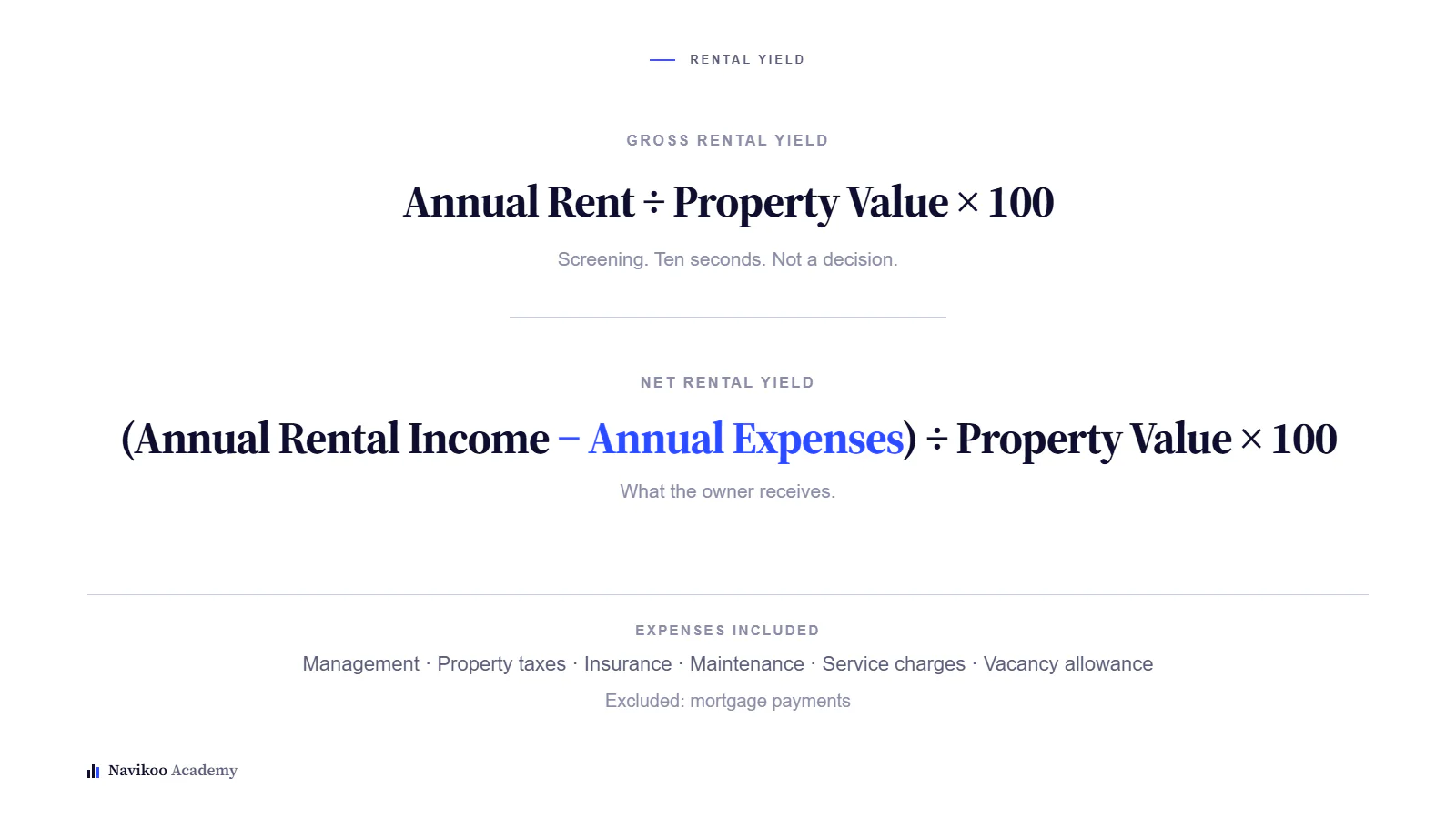
Gross Rental Yield
Gross Rental Yield = Annual Gross Rent ÷ Property Value × 100
Suppose a rental produces $1,950 per month:
$1,950 × 12 = $23,400 annual gross rent
If the property costs $320,000:
$23,400 ÷ $320,000 = 7.31% gross rental yield
The calculation takes seconds.
That makes gross yield useful for screening listings quickly. What it does not reveal is how much of the rent survives after operating the property.
Net Rental Yield
A more informative calculation subtracts property-level operating expenses before comparing the remaining income with the property's value.
Net Rental Yield = Net Operating Income ÷ Property Value × 100
Operating expenses can include:
vacancy rate
property taxes
insurance
property management fees
maintenance
fees and expenses
HOA or condo fees
landlord-paid utilities
recurring administrative expenses
Mortgage payments stay outside the calculation because financing depends on the investor, not only on the property.
In U.S. real estate, this calculation is closely related to capitalization rate when the same definition of net operating income and property value is used.
Net rental yield therefore estimates the property's income after operating expenses but before financing and investor-level taxes. It should not be confused with the cash an investor ultimately pockets.
Where a Rental Yield Calculator Helps
A calculator handles the arithmetic instantly. Arithmetic is rarely where rental analysis goes wrong.
Its real value is consistency.
Running twenty listings through the same calculation with the same treatment of vacancy, management, maintenance, and other expenses creates a far better comparison than eyeballing rent-to-price ratios.
What a calculator cannot determine is whether:
the projected rent is realistic
the expense list is complete
the vacancy assumption fits the property
HOA costs are likely to rise
the denominator should be purchase price or current market value
A precise calculation built on weak assumptions is still a weak calculation.
A Rental Yield Example
Consider a hypothetical two-bedroom condo purchased for $320,000.
Acquisition costs add another $12,000, bringing total cash committed to the acquisition itself to $332,000 before financing.
The property rents for $1,950 per month, or:
$23,400 per year
These figures are illustrative teaching assumptions rather than current market data.
Starting With Gross Yield
Using purchase price:
$23,400 ÷ $320,000 = 7.31%
Using purchase price plus the $12,000 of acquisition costs:
$23,400 ÷ $332,000 = 7.05%
Same property. Same rent. Two percentages.
The difference comes entirely from the denominator.
That is why an unlabeled yield percentage is less informative than it appears.
Working Down to Net Operating Income
Item | Annual Amount |
|---|---|
Gross rental income | $23,400 |
Vacancy allowance at 5% | −$1,170 |
Expected collected rent | $22,230 |
Property management at 8% | −$1,780 |
Property taxes | −$3,400 |
Insurance | −$1,250 |
Maintenance | −$1,800 |
HOA / condo fees | −$2,400 |
Accounting and miscellaneous | −$400 |
Operating expenses excluding vacancy | −$11,030 |
Net operating income | $11,200 |
Net rental yield using the purchase price:
$11,200 ÷ $320,000 = 3.50%

The Gross-to-Net Gap Is Useful Information
The property screens at a 7.31% gross yield and falls to a 3.50% net yield after the assumptions above are applied.
In this hypothetical example, vacancy and operating costs absorb roughly half of gross rent.
That should not be interpreted as a universal expense ratio. Actual operating costs vary materially with:
property taxes
property age
insurance
utilities
HOA fees
management structure
maintenance requirements
local vacancy
Some investors use the so-called 50% rule as a rough screening shortcut for rental expenses, but it is a heuristic rather than an underwriting standard.
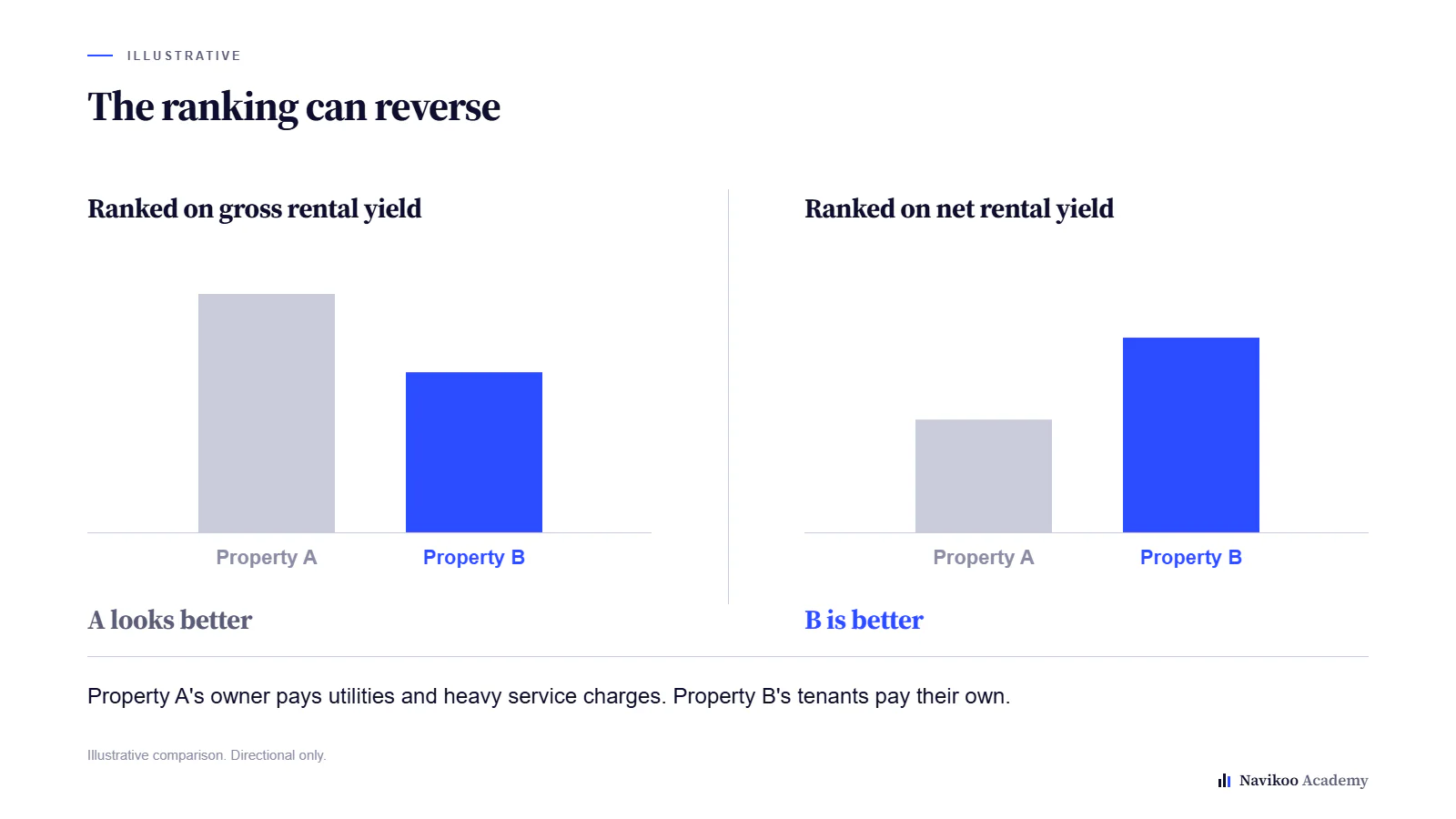
The more important lesson is that two properties with similar gross yields can produce very different net results.
A condo with substantial HOA fees may lose far more between gross and net than a single-family rental where tenants pay their own utilities and recurring property expenses are lighter.
Gross yield helps identify candidates.
The expense structure decides whether the candidate survives closer inspection.
Which Property Value Should You Use?
The denominator deserves more attention than it usually receives.
An investor can calculate yield against:
original purchase price
total acquisition basis
current market value
Each calculation answers a different question.
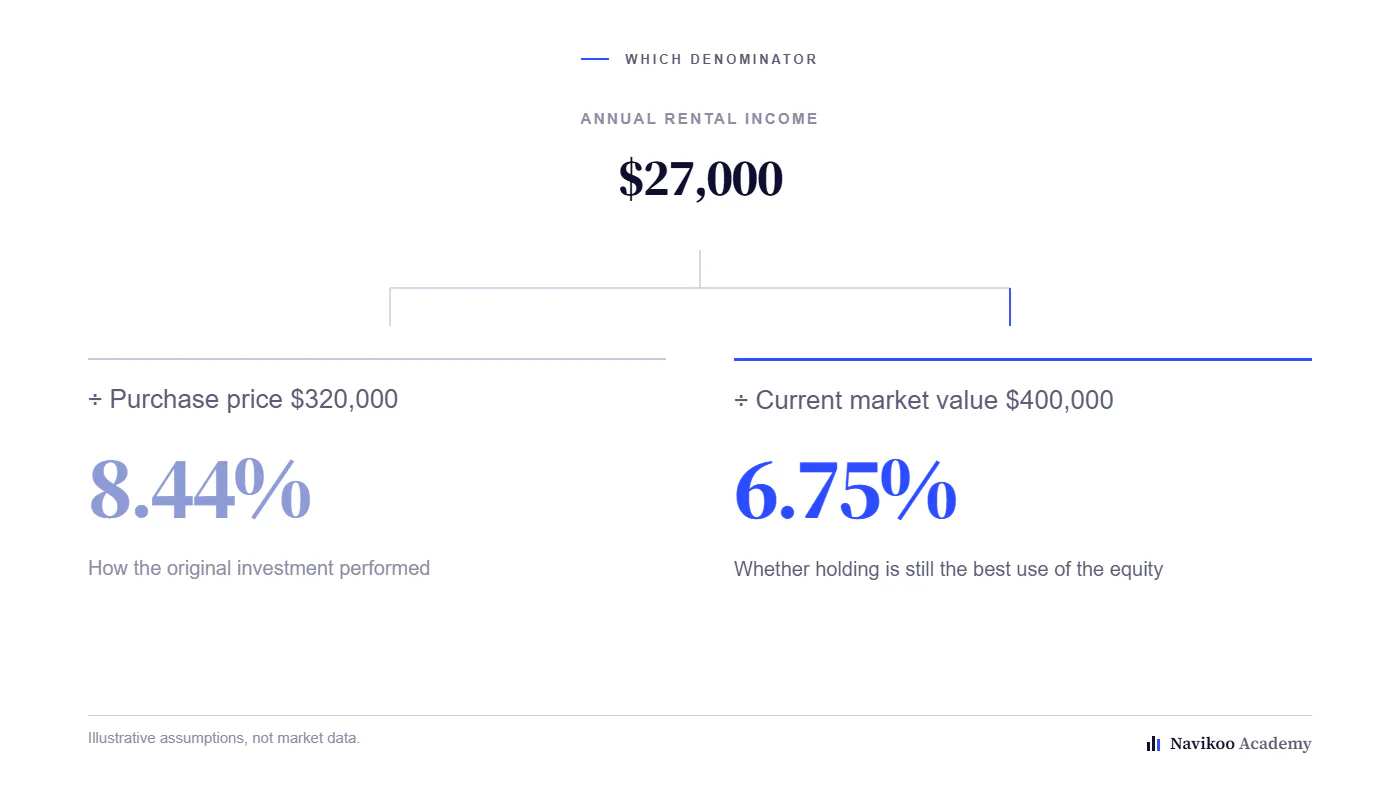
Suppose the condo purchased for $320,000 is worth $400,000 five years later.
Rent has increased to $2,250 per month, or $27,000 annually.
Denominator | Gross Rental Yield |
|---|---|
Original purchase price: $320,000 | 8.44% |
Current market value: $400,000 | 6.75% |
Rent increased materially.
Yet yield measured against current value fell.
Nothing is wrong with the property. Its market value simply increased faster than its rental income.
Yield on Original Cost
Using the original purchase price helps show how the income produced by an existing investment has changed relative to what the investor originally paid.
Yield on Current Value
Using current market value asks a different question:
What income is the property producing relative to the equity value tied up in it today?
That can be useful when deciding whether to:
continue holding
refinance
sell
redeploy equity elsewhere
Yield on current value does not answer that decision alone, but it provides a more relevant comparison than historical purchase price when evaluating the opportunity cost of equity already accumulated in the property.
The important rule is consistency.
Never compare two yield figures until confirming that both use the same denominator.
What the 1%, 2%, and 50% Rules Are Really Measuring
Rules of thumb become more useful once translated back into the mathematics behind them.
The 2% Rule
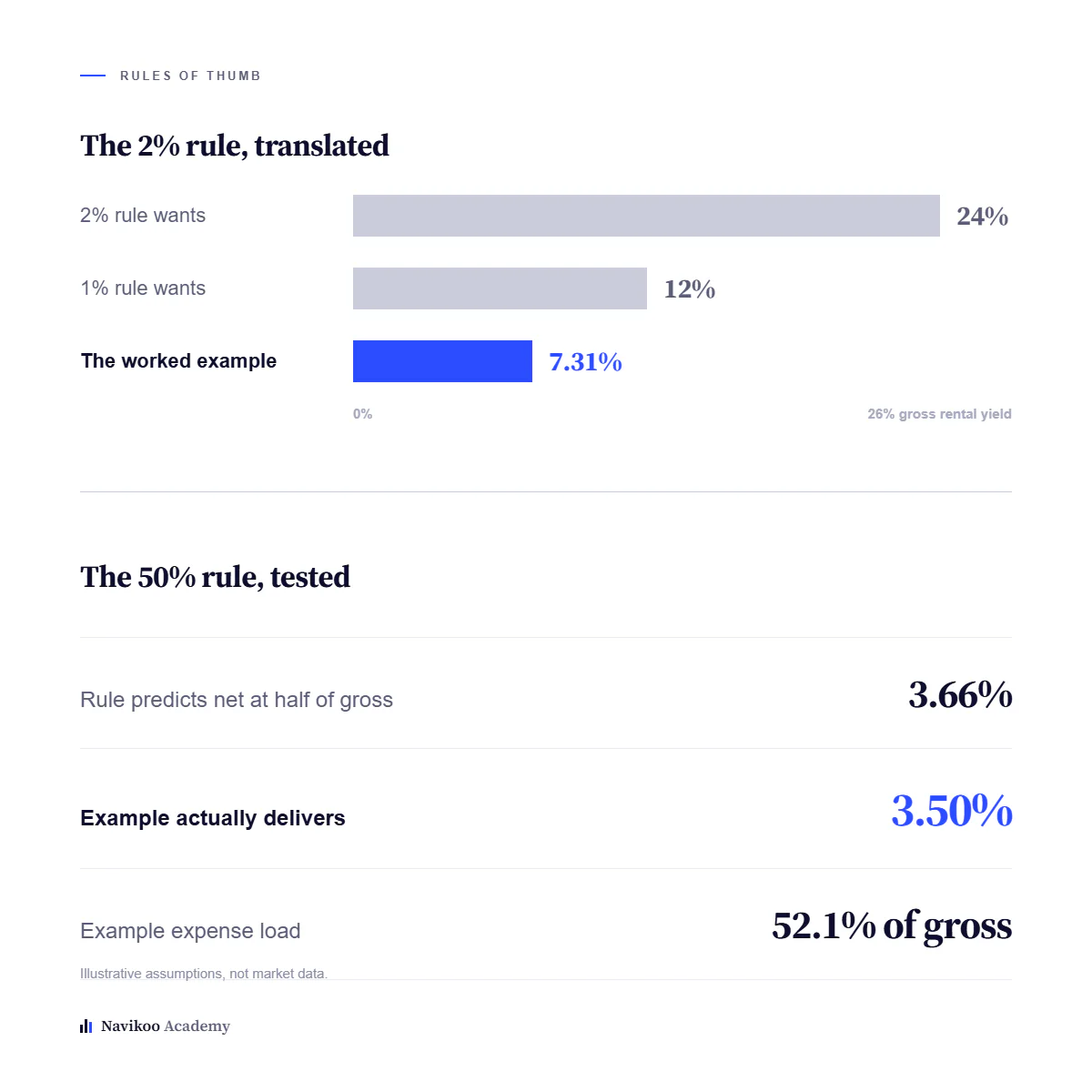
The 2% rule says monthly rent should equal at least 2% of purchase price.
If monthly rent equals 2% of price, annual rent equals:
2% × 12 = 24% gross rental yield
The related 1% rule implies a 12% annual gross rental yield.
The hypothetical condo in this article produces monthly rent equal to:
$1,950 ÷ $320,000 = 0.61%
Annualized, that becomes the same 7.31% gross yield calculated earlier.
Seen this way, the percentage rules are simply rent-to-price screening tools expressed monthly instead of annually.
They can help eliminate obviously poor rent-to-price relationships quickly, but they should not be treated as universal standards across different markets, property types, tax environments, or interest-rate conditions.
The 50% Rule
The 50% rule assumes roughly half of gross rent may eventually be consumed by vacancy and operating expenses before mortgage payments.
Applied mechanically to the hypothetical property:
7.31% gross yield ÷ 2 ≈ 3.66%
The fully modeled result was 3.50%.
The shortcut happens to come reasonably close in this example. That does not make it a substitute for underwriting.
A property with unusually high taxes, HOA fees, insurance, landlord-paid utilities, or maintenance requirements can deviate substantially.
The rule is useful when the goal is speed.
It becomes dangerous when a screening assumption quietly becomes the final budget.
A Yield Percentage Needs a Benchmark
Asking whether 4%, 6%, or 8% is a “good rental yield” cannot be answered from the percentage alone.
The relevant comparison depends on:
similar properties in the same market
the property's condition and risk
alternative uses of the investor's capital
expected appreciation
financing costs
the investor's objective
A 4% unleveraged yield from one asset is not economically equivalent to another 4% yield carrying very different maintenance risk, appreciation prospects, or financing.
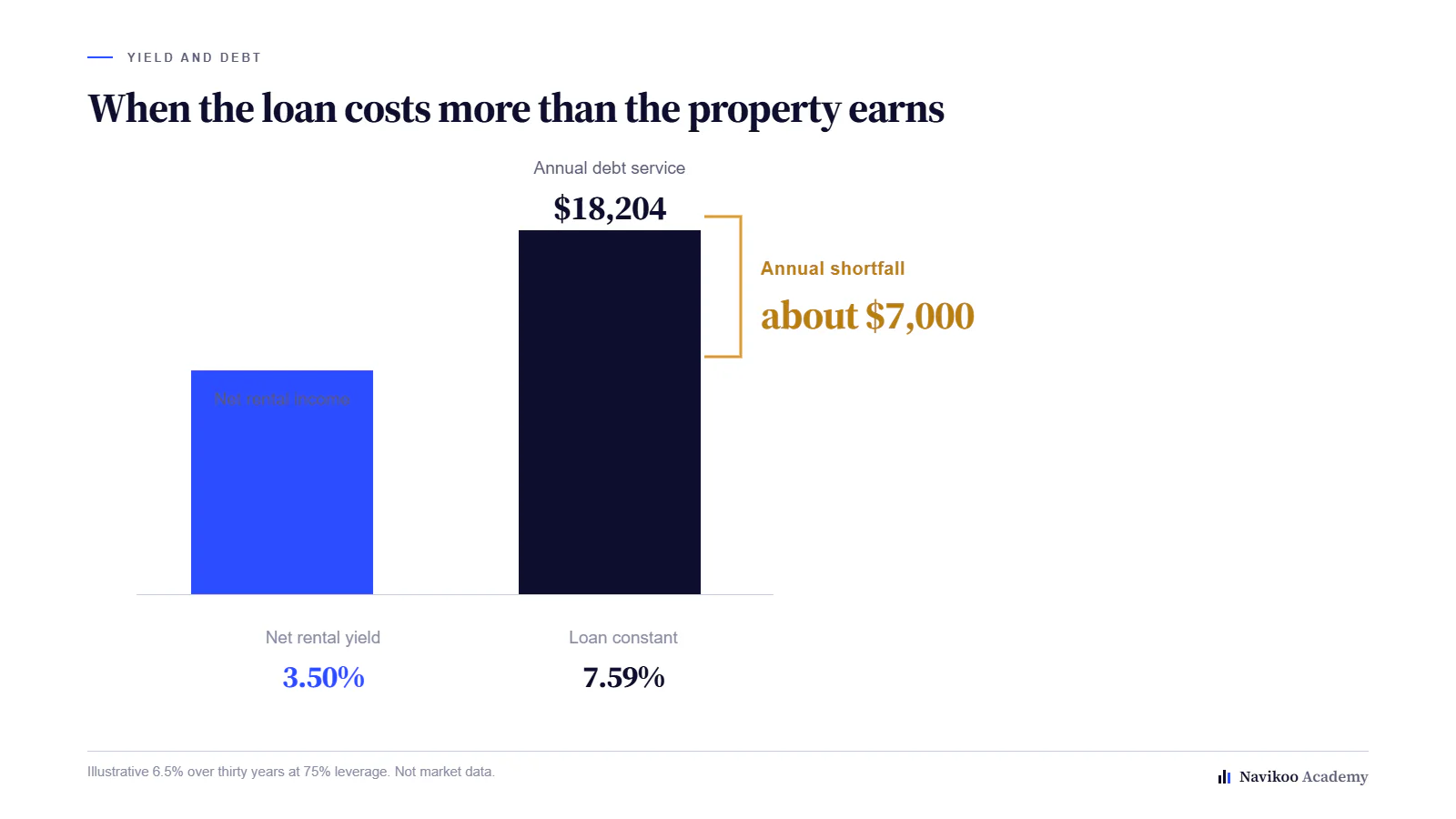
One comparison deserves particular attention: the relationship between property income and the cost of debt.
Rental Yield Against the Cost of Debt
Return to the hypothetical $320,000 condo.
Suppose an investor finances 75% of the purchase price:
Loan amount: $240,000
At an illustrative 6.5% interest rate with 30-year amortization, annual principal and interest payments are approximately:
$18,204
The property produces approximately:
$11,200 of NOI
The difference is roughly:
$11,200 − $18,204 = −$7,004
Before considering investor-level taxes or other financing details, property income does not cover the annual mortgage payment.
This does not automatically make the investment bad.
It does mean the investor needs other sources of return to compensate for the cash shortfall, such as:
future rent growth
appreciation
mortgage principal paydown
operational improvements
a different financing structure
A property producing thin income while using expensive debt is a very different investment from the same property purchased with more equity or financed at a substantially lower cost.
The yield percentage cannot show that distinction by itself.
Rental Yield and Appreciation Can Pull in Opposite Directions
Property return generally comes from more than one source.
Two important components are:
income generated during ownership
appreciation realized through increasing property value
Rental yield measures the first.
It does not measure the second.
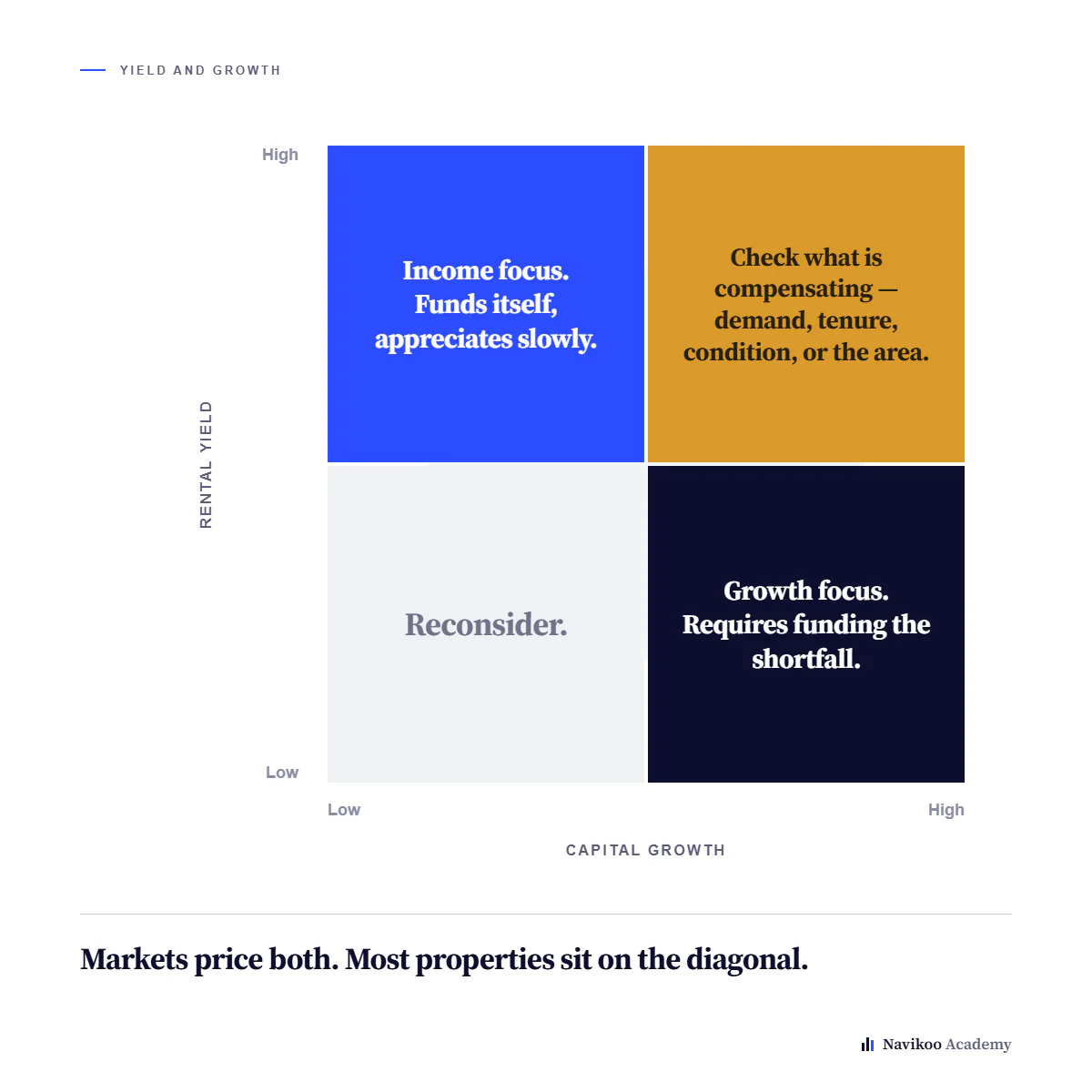
In markets where buyers are willing to pay higher prices relative to current rents—often because they expect strong long-term demand or appreciation—rental yields can compress.
In other markets, property prices may remain lower relative to rents, producing stronger current yields.
This does not create a universal rule that high-yield properties cannot appreciate or that low-yield properties always grow faster.
It does explain why investors frequently face a tradeoff between current income and expected growth.
Turning Negative Cash Flow Into an Appreciation Question
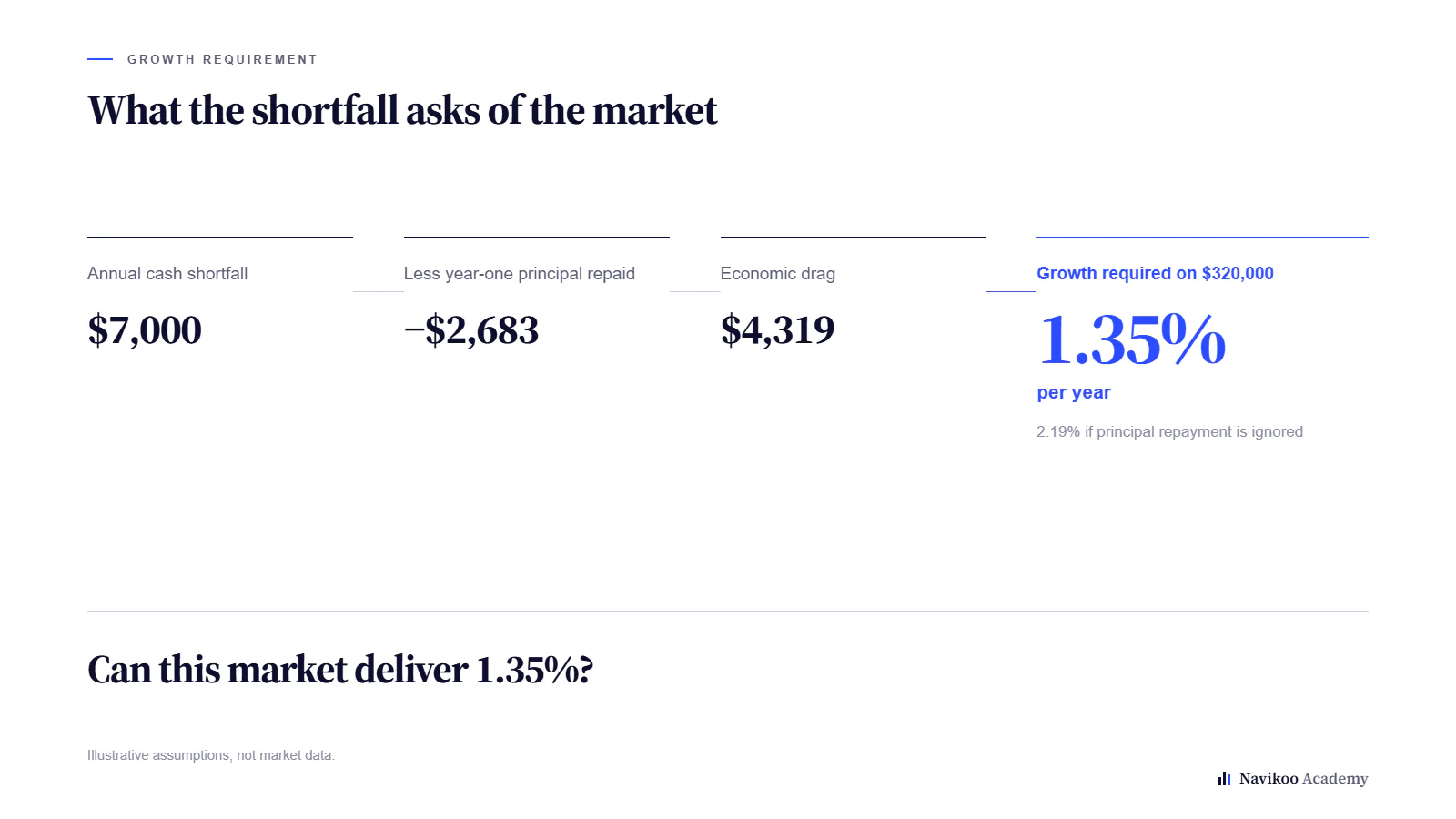
The hypothetical condo produces an annual financing shortfall of roughly:
$7,004
Relative to the $320,000 purchase price:
$7,004 ÷ $320,000 = 2.19%
If nothing else changed, appreciation of about 2.19% annually would offset that cash deficit on an economic basis before selling costs and taxes.
But mortgage payments also reduce principal.
During the first year of the illustrative loan, approximately $2,683 of principal is repaid.
That reduces the economic shortfall to roughly:
$7,004 − $2,683 = $4,321
Relative to purchase price:
$4,321 ÷ $320,000 ≈ 1.35%
Now the question is more specific.
Instead of asking:
“Is a 3.50% yield good?”
the investor can ask:
“Do my assumptions about appreciation, rent growth and the holding period reasonably compensate for the property's current cash shortfall?”
That is a much more useful underwriting question.
Where Rental Yield Fits in an Investment Strategy
Rental yield matters differently depending on what the investor wants the property to accomplish.
Income-Focused Investors
An investor prioritizing monthly cash flow will place significant weight on net rental yield and financing coverage.
A property with durable tenant demand, manageable expenses and limited monthly volatility may fit that strategy even if appreciation expectations are modest.
Growth-Focused Investors
An investor focused on long-term equity growth may accept a lower current yield if the property is in a market where the investment thesis rests more heavily on:
future rent growth
supply constraints
population or employment growth
redevelopment
long-term appreciation
That does not mean negative cash flow should be ignored.
It means the investor is deliberately accepting a lower current income return in exchange for another expected source of return.
Why Yield Is Not Total Return
Rental yield measures income.
Total investment return can also include:
appreciation
mortgage principal reduction
tax effects
value created through improvements
proceeds realized at sale
That is why a property can have a mediocre rental yield and still produce a strong full-period return—or post a strong gross yield while ultimately producing disappointing economics.
The metric should be treated as one lens, not the investment itself.
Comparing Rental Yields Across Markets
Rental yield is particularly useful when comparing markets because it puts rent and property value on the same scale.
A $1,800 rent means something very different in a market where comparable properties cost $180,000 than in one where they cost $450,000.
Yield reveals that difference immediately.
But cross-market comparisons create another problem: the variables that are easiest to measure can receive too much attention.
Gross yield is easy to calculate.
Future appreciation is uncertain.
Property taxes vary.
Insurance can vary dramatically.
Maintenance needs differ with building age and climate.
HOA expenses can alter the economics of condos.
Tenant demand can be stable in one neighborhood and seasonal in another.
A market should not win an investment comparison simply because its most convenient metric is higher.
Rental yield is a useful starting point for comparing metros. The underlying drivers of that yield still need to be understood.
How Sensitive Is Net Rental Yield?
A yield calculation represents a set of assumptions, not a permanent characteristic of the property.
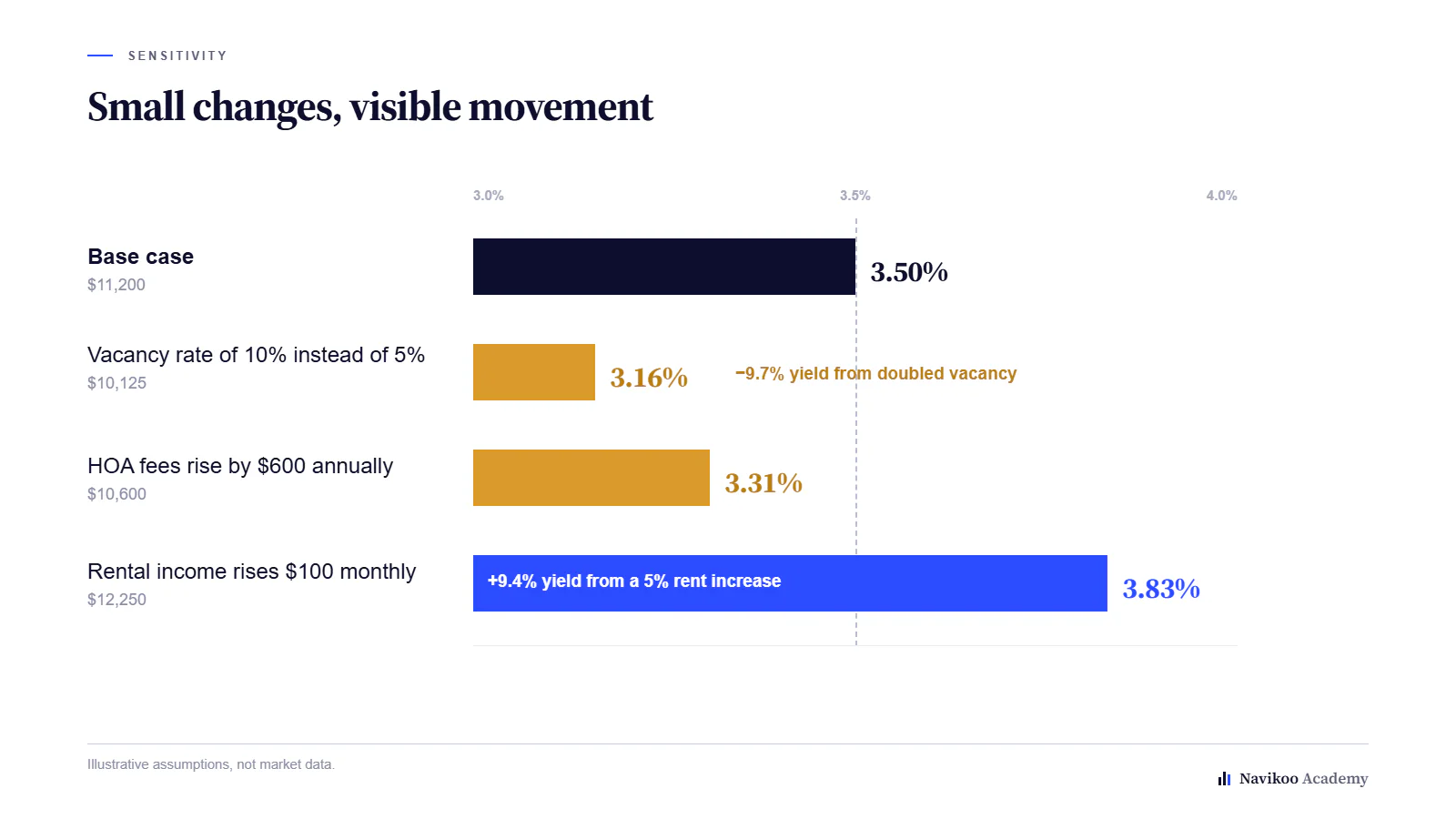
Holding purchase price constant at $320,000:
Scenario | Net Operating Income | Net Rental Yield |
|---|---|---|
Base case | $11,200 | 3.50% |
Vacancy increases from 5% to 10% | $10,125 | 3.16% |
HOA fees rise by $600 annually | $10,600 | 3.31% |
Rent increases by $100 per month | $12,250 | 3.83% |
None of these changes is enormous.
Yet the net yield moves enough to alter a comparison between otherwise similar investments.
The reason is straightforward: many operating expenses do not fall when occupancy or rent declines.
A rental yield calculated using optimistic rent and minimal vacancy can therefore overstate the property's income performance meaningfully.
The assumptions deserve more attention than the division.
What to Verify Before Comparing Rental Properties
Rental yield deserves a place in almost every rental analysis. It deserves trust only after the assumptions behind it are made comparable.
Start with four checks.
Use the same definition.
Gross yield and net yield cannot be compared directly. An unlabeled listing yield should be reconstructed before relying on it.
Use the same denominator.
Purchase price, total acquisition cost and current market value answer different questions.
Verify the rent.
Do not rely only on a broad ZIP-code average or the seller's projection. Compare the specific property with realistic competing rentals of similar size, condition and location.
You can verify comparable rents using Navikoo’s Rent Estimate tool.
Rebuild the expenses.
Property taxes, insurance, HOA fees, management, maintenance, vacancy and landlord-paid utilities can materially change the result.
Then decide what the yield is being asked to do.
If the objective is quick screening, gross rental yield may be enough.
If the objective is comparing property-level income, net yield or cap rate is more useful.
If financing matters, calculate cash flow, cash-on-cash return and debt coverage as well.
If the decision is whether to hold a property already owned, compare its income against current market value and the equity that could potentially be deployed elsewhere.
Investors who want to test rent, vacancy, operating expenses, financing and appreciation together can model those assumptions with Navikoo's analysis tools rather than treating any one percentage as the final answer.
A rental yield is most useful when it leads to the next question. The percentage can identify where to look; the assumptions underneath it determine whether the property actually deserves the capital.