DSCR in Real Estate: Formula, Example, Loan Requirements & How to Calculate It
Discover what lenders truly consider when evaluating Debt Service Coverage Ratio (DSCR) in real estate. Maximize your loan opportunities today with expert insights.

A building can produce healthy rental income, sit in a strong market, and still fail to qualify for the loan an investor wants. The number that usually explains why is the debt service coverage ratio, and real estate investors who understand it early avoid wasted diligence.
DSCR = Net Operating Income ÷ Annual Debt Service
The DSCR formula asks one question: does the property generate enough income to cover its own debt obligations? A result of 1.00 means income exactly equals the payment. Above 1.00 there is a surplus. Below 1.00 the building cannot pay its own mortgage, and someone else has to.
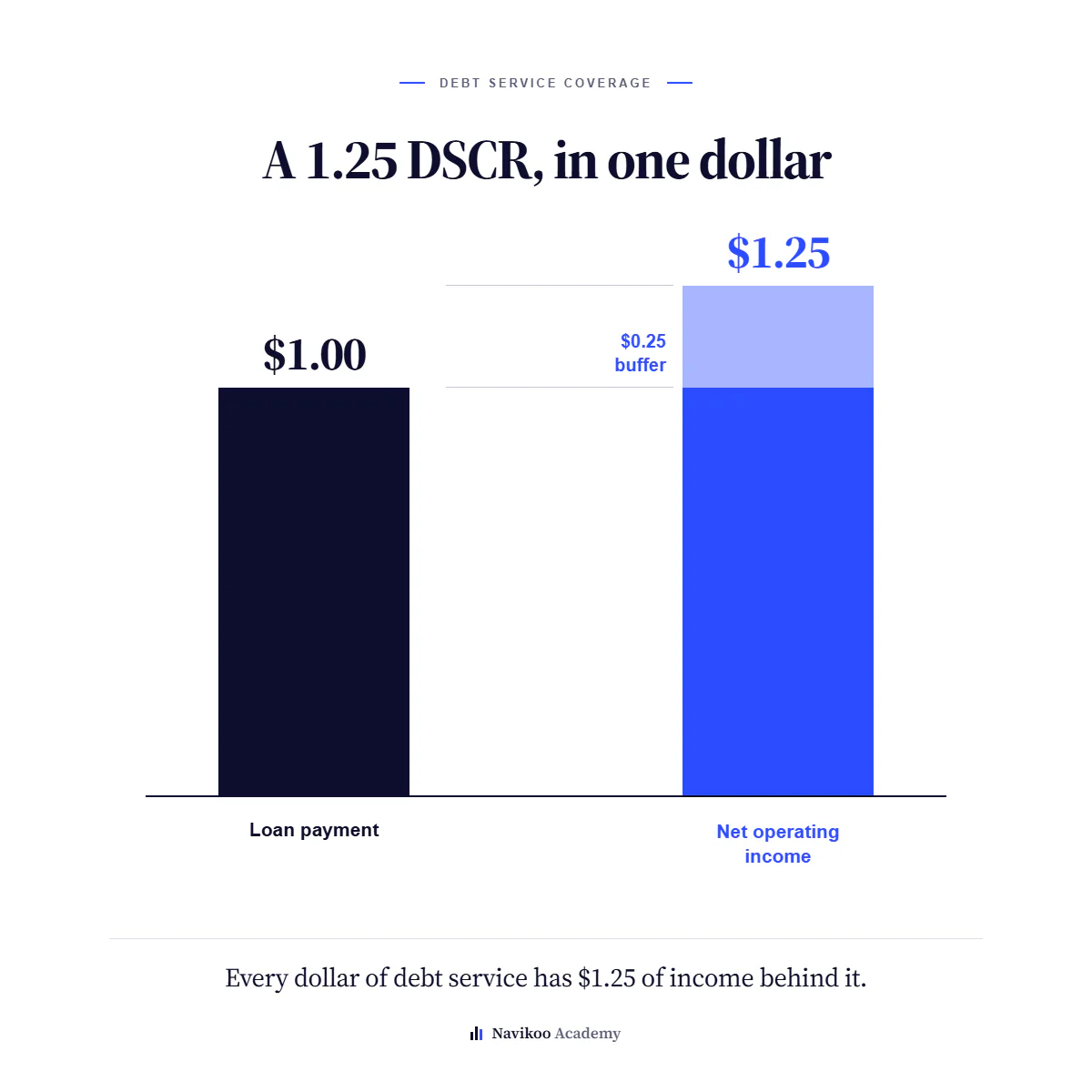
A DSCR of 1.25 means the property generates $1.25 of NOI for every $1.00 of annual debt service.
That definition appears on every page covering this subject. What gets less attention is that the DSCR a borrower calculates and the DSCR a lender calculates are frequently different numbers for the same property, and that gap decides deals.
How Do You Calculate DSCR in Real Estate?
The debt service coverage ratio has two inputs. Both deserve scrutiny, and they fail in different ways.
Step 1: Calculate Net Operating Income
Net operating income is rental income minus vacancy minus operating expenses, before any debt payments.
Step 2: Calculate Annual Debt Service
Total debt service is twelve months of principal and interest payments on the proposed financing.
Step 3: Divide NOI by Debt Service
Divide the first by the second and the calculation is complete.
PropertyMetrics maintains a useful technical walkthrough in How to Calculate the Debt Service Coverage Ratio (DSCR) for readers wanting more depth.
The arithmetic is trivial. The inputs decide deals.
The Lender's NOI Is Not Your NOI
Here is the distinction most articles skip. When a bank underwrites an income property, it normalizes expenses rather than accepting the borrower's actual spending.
An investor self-managing six units genuinely spends nothing on property management. Their real costs are lower, their NOI is higher, and their DSCR looks stronger. Most commercial lenders add a management fee back anyway, reasoning that the loan will outlive the borrower's enthusiasm for collecting rents. Banks writing DSCR loans apply this as policy, not a judgment about the borrower. Vacancy gets normalized to market vacancy rates rather than the borrower's occupancy. Replacement reserves get included even when the borrower does not budget for them.
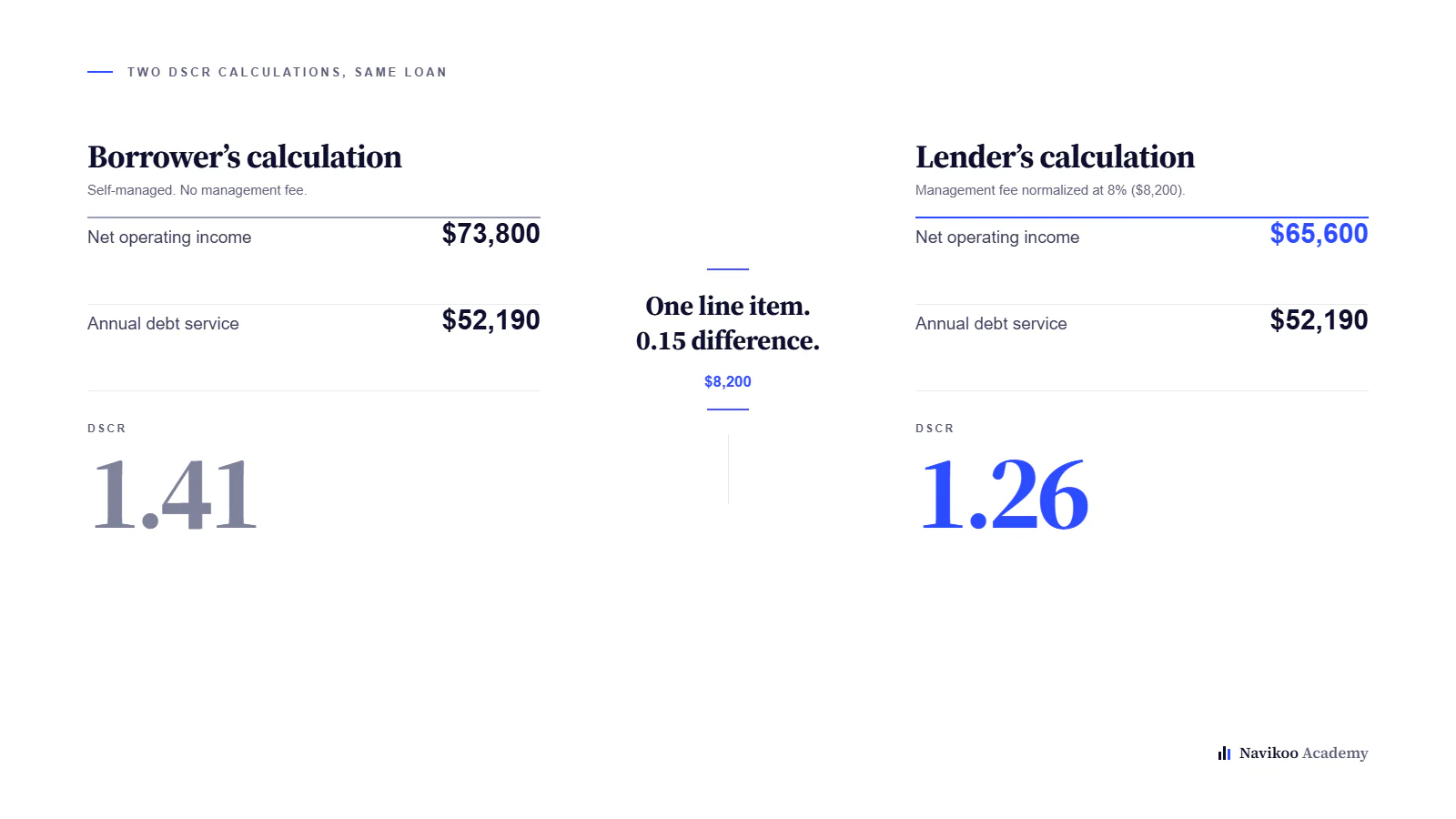
An investor confident in a 1.41 DSCR can reach a loan application and find the bank calculated 1.26 on the same property. Neither party made an error. They used different definitions of operating expenses.
DSCR Calculation Example
The figures below describe a hypothetical six-unit building used throughout this article, as illustrative teaching assumptions rather than current market data.
Line item | Annual |
|---|---|
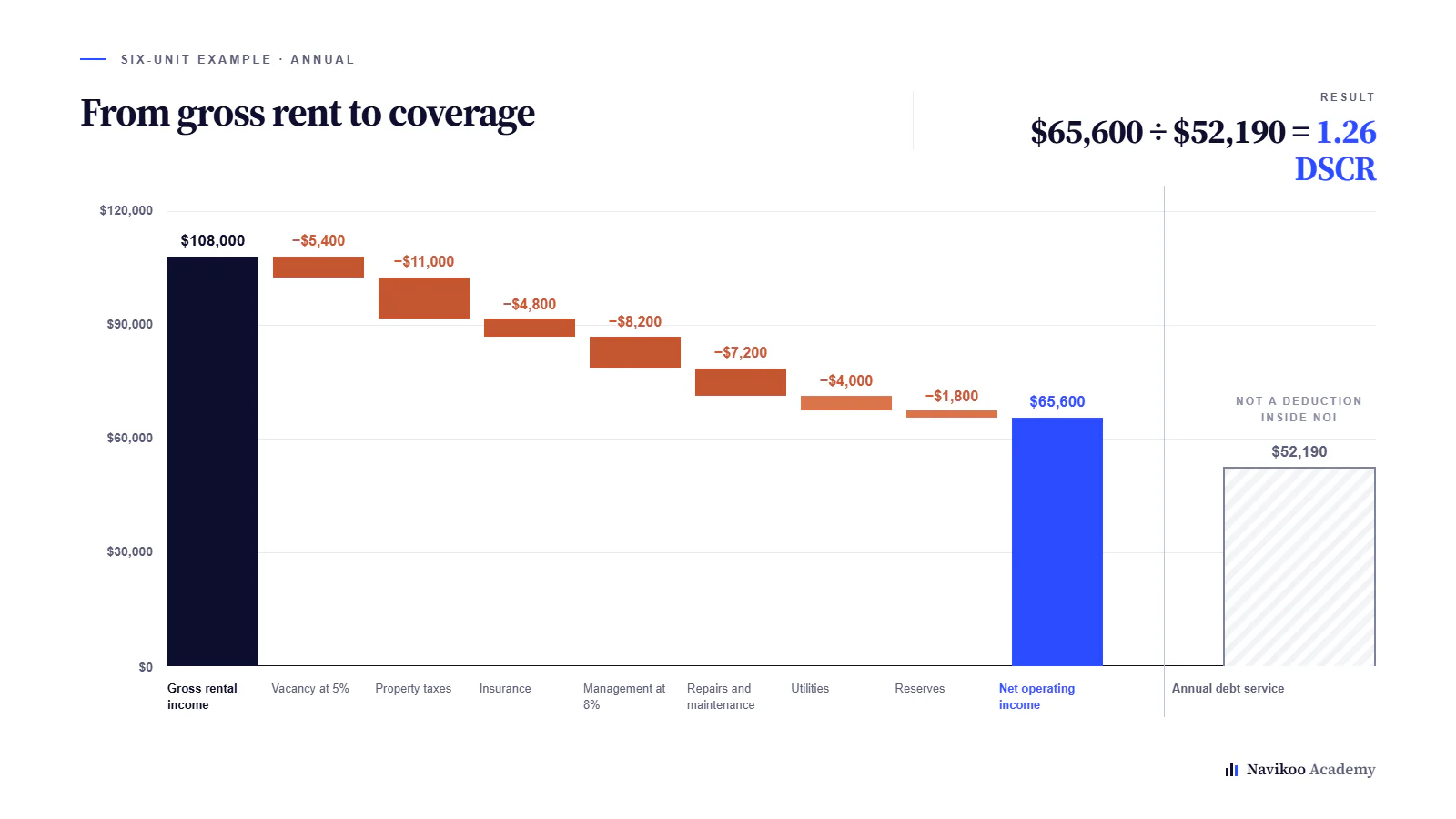
Gross rental income (6 × $1,500 × 12) | $108,000 |
Vacancy at 5% | −$5,400 |
Effective gross income | $102,600 |
Property taxes | −$11,000 |
Insurance | −$4,800 |
Management at 8% | −$8,200 |
Repairs and maintenance | −$7,200 |
Utilities | −$4,000 |
Reserves | −$1,800 |
Total operating expenses | −$37,000 |
Net operating income | $65,600 |
At a purchase price of $850,000 with 75% financing, the loan is $637,500. At an illustrative 7.25% over a 30-year amortization, annual debt service comes to roughly $52,190.
$65,600 ÷ $52,190 = 1.26
The self-managing borrower above runs the same building without the $8,200 management line, reaches an NOI of $73,800, and calculates a DSCR of 1.41. Same units, same rents, same loan. The 0.15 difference lives inside one assumption.
What Does a DSCR of 1.25 Mean?
A 1.25 result means the property produces 25% more income than its annual debt obligations require. For every dollar of loan payments, $1.25 of net operating income arrives to cover it.
Lenders think in terms of the buffer that surplus provides. The threshold answers one question: how far can performance deteriorate before this loan stops paying itself?
The Cushion Illusion
This is where a technically correct number creates a misleading impression, and it deserves attention.
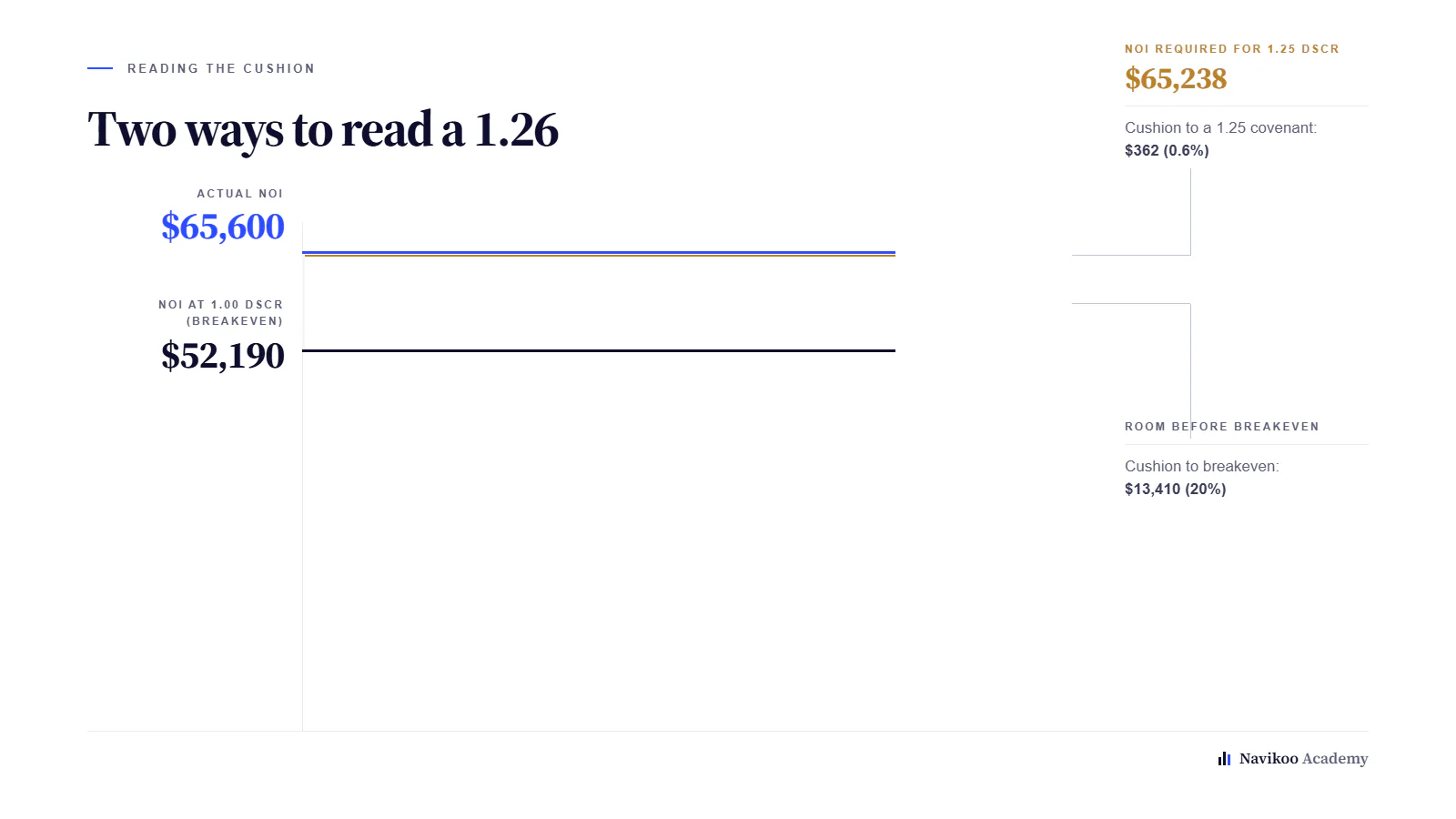
The example produced a DSCR of 1.26. That sounds like meaningful headroom, and against default risk it is. NOI would have to fall from $65,600 to $52,190 before the property stopped covering its own debt payments, a decline of $13,410 or roughly 20%.
Measured against a 1.25 minimum DSCR requirement, the picture inverts. Holding 1.25 requires NOI of at least $65,238. The actual figure is $65,600. The cushion is $362, or about half a percent.
Two readings of one number. The first says the building absorbs a 20% income decline; the second says it absorbs almost nothing before breaching a covenant or failing a refinance test. Both are correct, and investors who internalize only the first get surprised at renewal.
A single insurance renewal, one extended vacancy, or a reassessment in a market with high property taxes moves a 1.26 building below 1.25. Experienced borrowers underwrite to a figure comfortably above the stated DSCR requirements rather than to the requirement.
What Is a Good DSCR Ratio?
A good debt service coverage ratio is set by whoever is lending, and standards vary by lender, property type, market, and program. Published thresholds move over time, and lenders revise them, so any figure quoted as universal deserves skepticism.
What holds regardless is the interpretation:
Below 1.00 — operations do not cover the debt payments, so cash flow is negative before a single repair.
At 1.00 — income exactly matches the payment, with no margin for a vacancy or a repair.
Between 1.00 and 1.20 — coverage exists but thin. Small changes in expenses or occupancy consume it, leaving little cash flow behind.
1.25 and above — the range most commercial mortgage programs are built around.
Well above 1.40 — comfortable coverage, often achieved through a larger down payment rather than better performance.
That last point matters more than it appears. A high DSCR is not evidence of a better property. Putting more cash into a deal mechanically raises the coverage ratio by shrinking the denominator, so two real estate investors buying identical rental properties can report very different results purely through leverage choice.
When DSCR Decides Loan Size, Not LTV
Most borrowers assume the down payment is set by a loan-to-value cap. Often it is. In higher-rate conditions it frequently is not, and knowing which constraint binds is among the more useful things this metric teaches.
Two ceilings apply to any income property loan. The first is the LTV limit. The second is the largest loan whose debt service the building's NOI can cover at the lender's required DSCR. The binding one is whichever produces the smaller loan.
The Same Building at Three Interest Rates
Holding NOI constant at $65,600 and testing a 1.25 requirement against a 75% LTV cap on the $850,000 purchase:
Rate | Loan at 75% LTV | Debt service | DSCR | Max loan at 1.25 | Binding constraint |
|---|---|---|---|---|---|
6.50% | $637,500 | $48,350 | 1.36 | $691,900 | LTV |
7.25% | $637,500 | $52,190 | 1.26 | $641,100 | Effectively tied |
8.50% | $637,500 | $58,820 | 1.12 | $568,800 | DSCR |
At 6.50% the property supports more debt than the LTV cap permits, so leverage is limited by policy rather than performance. At 8.50% the same six units support only $568,800, which is 66.9% of the price. Required cash at closing rises from $212,500 to $281,200, roughly $68,700 more for a building whose rents never changed.
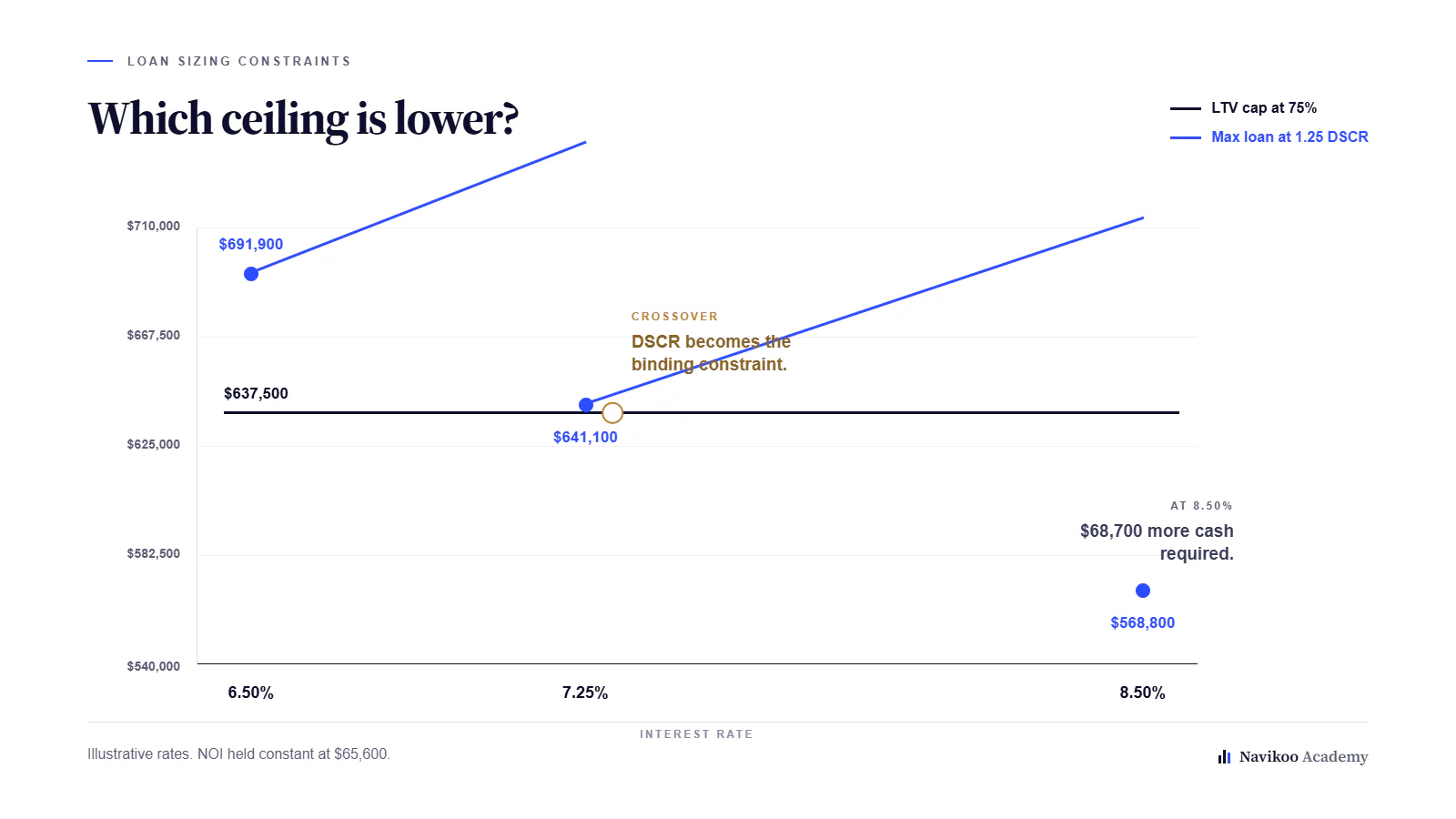
This explains a pattern investors notice without always naming it. When interest rates rise, deals do not merely become more expensive to carry. They become harder to finance at all, because the same rental income supports a smaller loan.
Are All DSCR Loans 20% Down?
No, and the framing is the problem. Minimums are not standardized across DSCR loans, and they are not the only thing setting how much cash a deal requires.
A borrower can satisfy every stated LTV and credit score threshold on most DSCR loans and still be told the loan must shrink, because the property's income will not cover the payment at the lender's DSCR. There, the equity requirement is set by coverage rather than by a published percentage. DSCR loan requirements vary by program, so the real figures come from the term sheet.
What Is a DSCR Loan?
The metric also names a category of loans. A DSCR loan is one of several investment property loans underwritten primarily against the property's income rather than the borrower's personal income.
Conventional mortgage underwriting examines tax returns, W-2s, and personal debt-to-income. A mortgage underwritten as a DSCR loan sets personal finances aside and asks whether the property services its own debt obligations. For investors whose returns show heavy depreciation, or whose real estate portfolio has outgrown conventional debt-to-income math, this is often the practical path to keep borrowing.
What Lenders Evaluate Instead of Personal Income
Personal income moves out of the center of the file, but nothing else disappears. Underwriting still covers DSCR, credit history, the property appraisal, reserves, and experience with similar assets. The emphasis shifts; the standard does not loosen.
These loans generally price above conventional financing, since the bank accepts property performance in place of documented earnings. DSCR rate sheets and requirements differ between programs, so two mortgage brokers or loan officers can source materially different loans for one file. A mortgage broker with real estate lending experience knows which lenders normalize expenses aggressively, and good mortgage brokers say so before an application is filed.
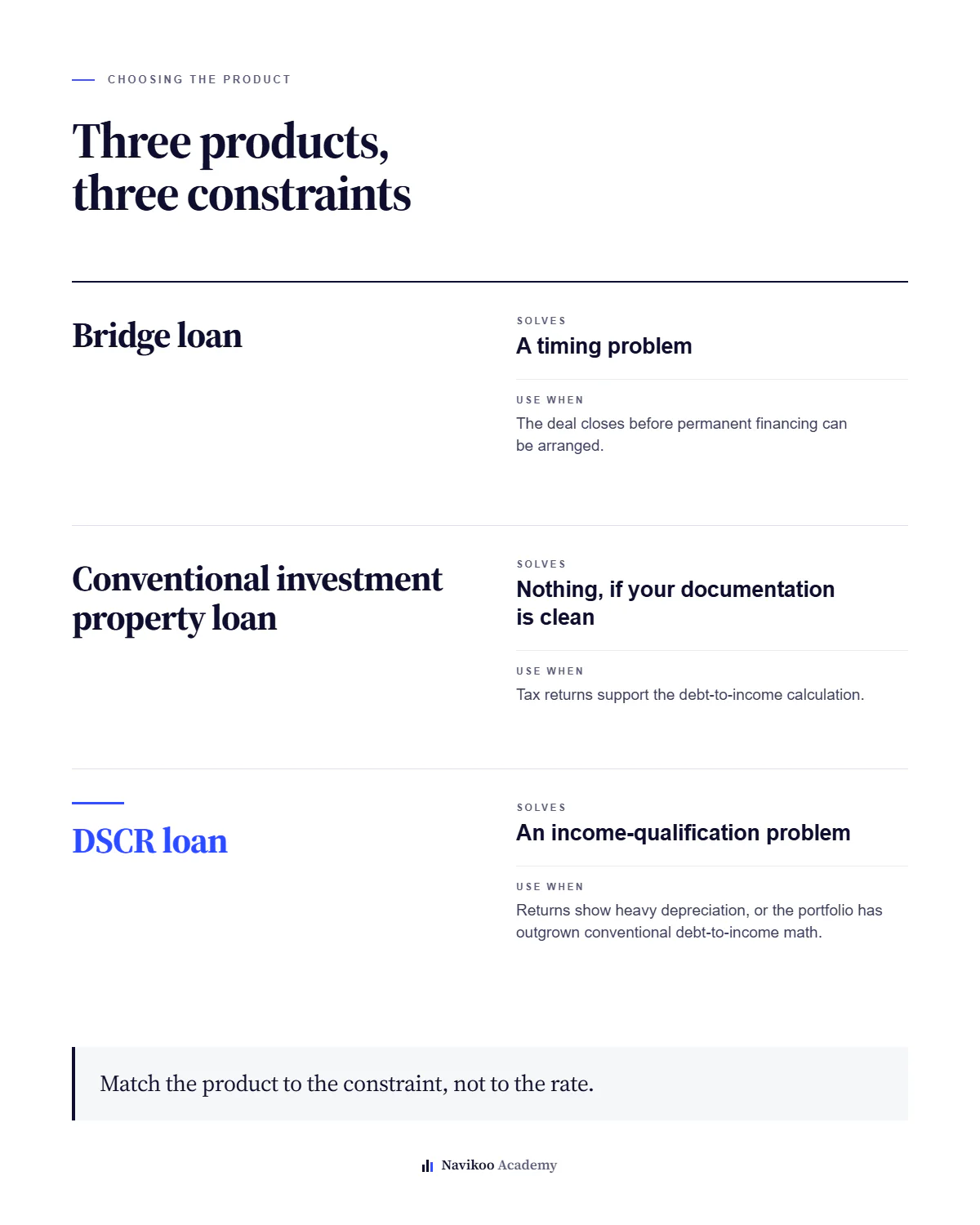
DSCR loans sit among other financing options worth distinguishing. Bridge loans solve a timing problem. A conventional real estate loan solves a documentation problem for borrowers whose returns are clean. DSCR lending solves an income-qualification problem. Different types of loans exist because different constraints bind, and experienced real estate investors match the product to the constraint rather than to the rate alone.
Can You Live in a Property Bought With a DSCR Loan?
These are business-purpose loans made against investment properties, and occupying the building generally conflicts with the terms of the note. The specific language, and the consequences of violating it, live in the loan documents, so the agreement itself is the authority.
Investors who want a home they will occupy need a different category of real estate financing, and lenders treat the business purpose of these loans as a condition, not a formality.
Can You Refinance a DSCR Loan?
Yes, though two details matter more than borrowers expect.
Prepayment penalties appear more often in DSCR loans than in conventional residential lending, and their structure varies widely. A penalty that steps down over several years changes the math on an early payoff, especially once interest costs have fallen.
The second follows from the cushion problem. A refinance is a fresh underwrite, so the property must satisfy the debt service coverage ratio again at whatever rate is available then. A property that qualified at 1.26 in a lower-rate environment may not clear the same threshold years later, which is why some investors treat their current DSCR as a forward-looking constraint rather than a closing-day formality.
How Sensitive Is DSCR to Small Changes?
Because the denominator is fixed by the loan while the numerator moves with operations, DSCR responds sharply to modest shifts in income or expenses. Holding debt service at $52,190:
Scenario | NOI | DSCR |
|---|---|---|
Base case | $65,600 | 1.26 |
Insurance rises $2,400 | $63,200 | 1.21 |
Rents fall 5% | $60,870 | 1.17 |
Vacancy runs 10% instead of 5% | $60,620 | 1.16 |
None is dramatic. An insurance increase of $2,400 on six units is unremarkable. Yet each moves the building below a 1.25 threshold, and two approach the range a lender would call thinly covered.
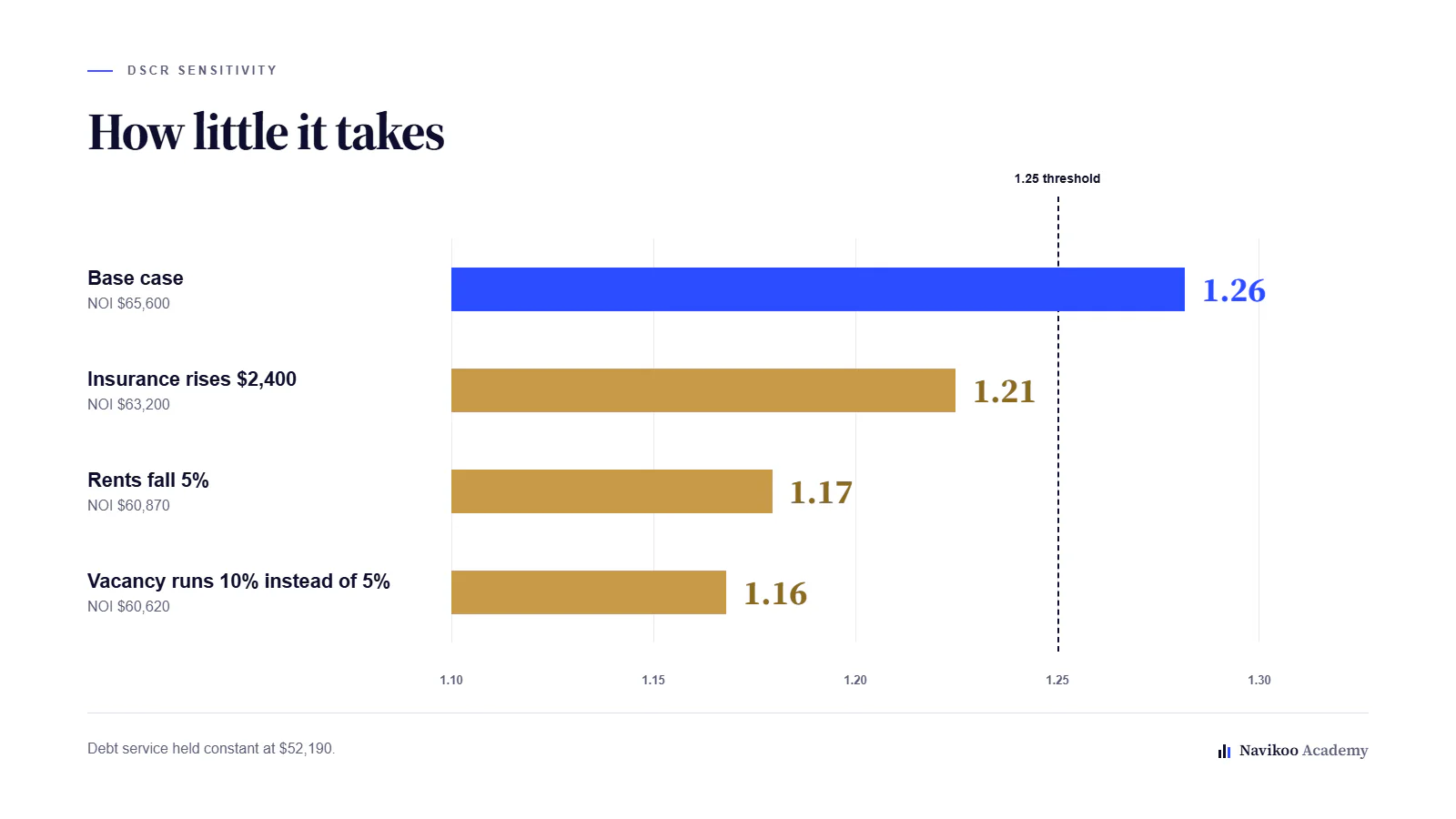
The lesson is not fragility. A DSCR calculated once, at purchase, on optimistic assumptions describes a moment rather than a condition, so it deserves running at several plausible expense levels.
Two Buildings, the Same DSCR, Different Risk
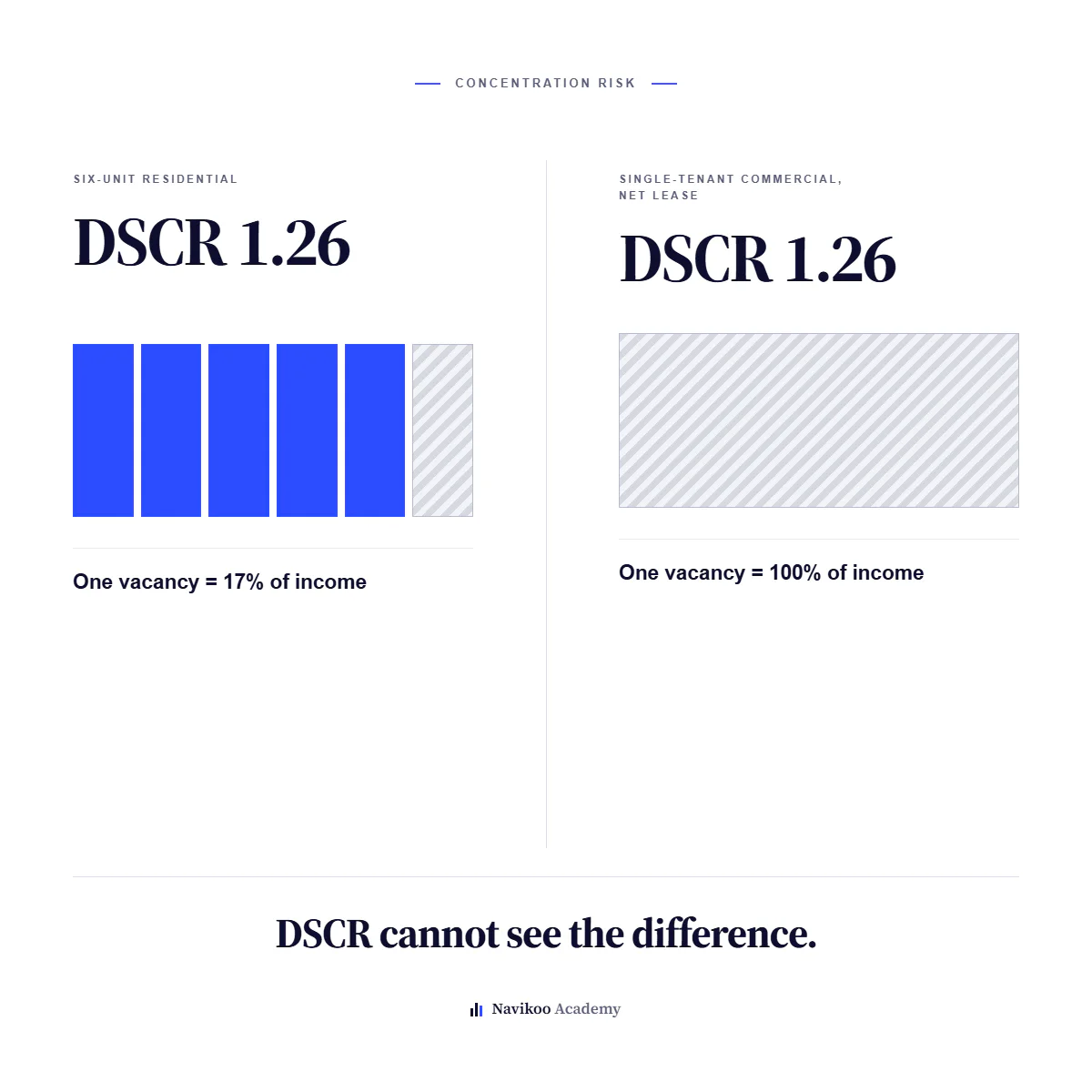
Consider two properties that both underwrite to exactly 1.26.
The first is the six-unit above. Income arrives from six households, and one vacancy costs roughly 17% of gross rental income for its duration.
The second is a small commercial property on a net lease to one tenant. Operating costs are minimal because the tenant carries them, and the DSCR is identical. But one vacancy removes 100% of the revenue, and re-tenanting commercial properties takes months.
DSCR cannot distinguish between these. It compresses income quality, tenant concentration, lease duration, and market depth into a single financial ratio that treats a dollar of rent from six tenants like a dollar from one. Anyone comparing deals on coverage alone misses what determines whether that income survives.
What DSCR Leaves Out
Three blind spots deserve naming.
Capital expenditures. The calculation includes reserves only if the underwriter adds them. A roof replacement never appears in NOI or DSCR, though it very much appears in the bank account.
Loan structure beyond the payment. A balloon mortgage in year five and a fully amortizing thirty-year loan can produce identical coverage while carrying very different refinancing risk.
Everything after debt service. A building covering its payments 1.26 times over is not necessarily a good investment. It is a business that pays its lender first. Whether the remaining cash flow justifies the equity committed is a question for cash-on-cash return, not a lending metric. In the example, cash flow after debt service runs about $13,410 against $212,500 invested, a different conversation entirely.
Where Debt Yield Fits
Some lenders pair the debt coverage ratio with debt yield, NOI divided by the loan amount. In the example, $65,600 ÷ $637,500 gives roughly 10.3%.
It ignores the interest rate and amortization schedule, so it cannot be flattered by longer terms the way DSCR can. Borrowers rarely calculate it, but knowing that some lenders size loans against it explains why two banks quoting similar programs reach different conclusions on the same file.
DSCR is a corporate finance concept that real estate borrowed. It answers the lender's question well and was never designed to answer the investor's.
Reverse-Engineering DSCR Before Making an Offer
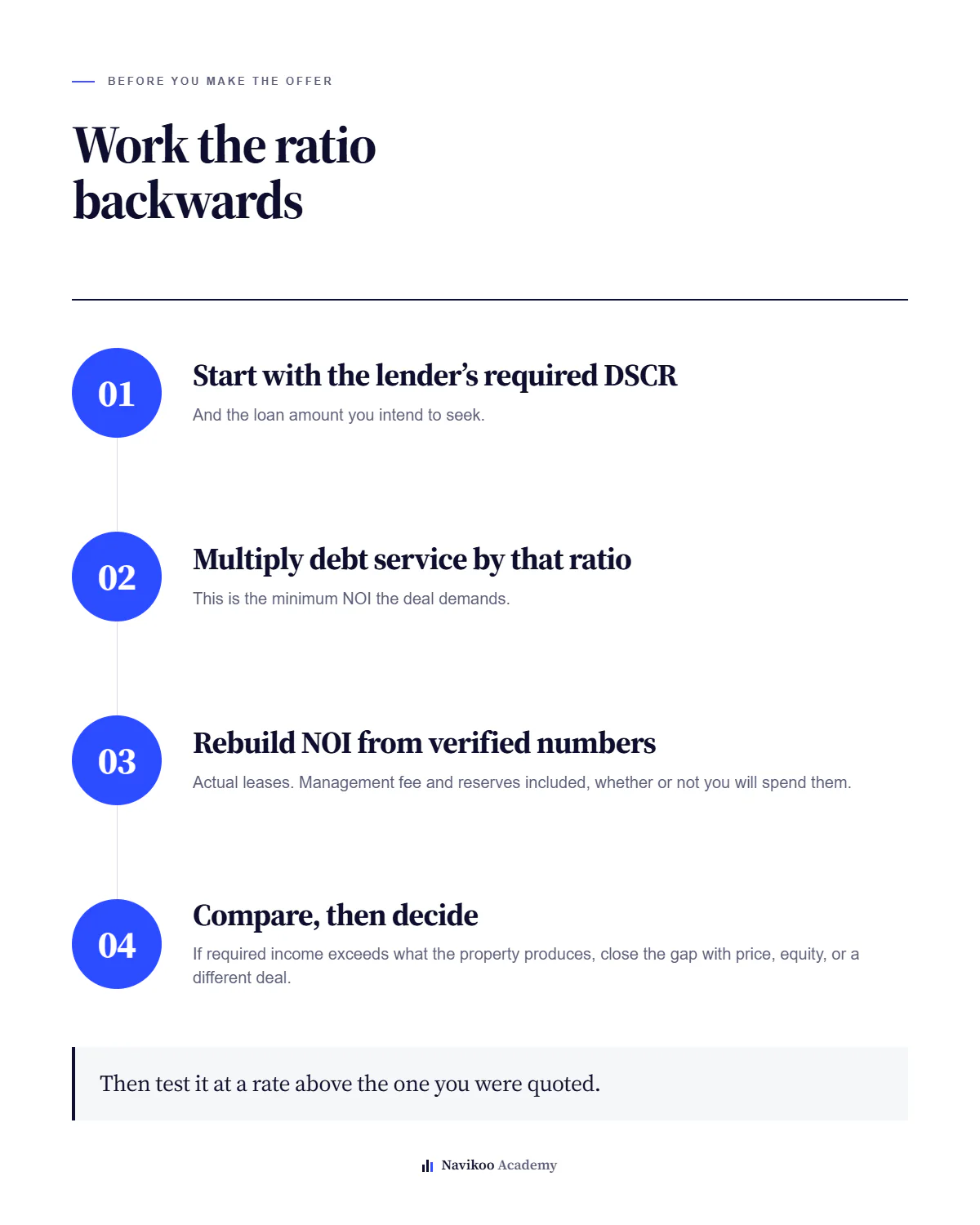
The most useful application of the formula runs backward. Rather than computing coverage after agreeing on a price, solve for what the building must produce to support the loan being sought.
Start with the lender's required debt service coverage ratio and the intended debt. Multiply the debt service by that figure to find the minimum NOI the deal demands, then compare it against a normalized NOI built from verified numbers rather than the seller's. If the required income exceeds what the property realistically produces, the gap closes through a lower price, more equity, or a different investment.
Three inputs deserve verification first. Confirm rental income against actual leases rather than a rent roll. Rebuild operating costs with a management fee and reserves included, because lenders will include them. And test the result at a rate above the one quoted, since rate locks expire and refinances arrive on someone else's schedule.
Investors who want to see how rents, vacancy, costs, and financing move both DSCR and the cash flow underneath it can model those assumptions in Navikoo's Rental Property Calculator, which makes the interaction visible in a way that changing one variable at a time does not.
The number most deserving of distrust in any coverage calculation is the expense figure supplied by whoever wants the deal to close. Rebuild it, and everything downstream becomes more reliable.
Frequently Asked Questions About DSCR
What does DSCR stand for in real estate?
DSCR stands for debt service coverage ratio. It compares a property's net operating income with its annual debt service to measure whether the property generates enough income to cover its loan payments.
What is the formula for DSCR?
DSCR = Net Operating Income ÷ Annual Debt Service
For example, if a property produces $90,000 in NOI and annual debt service is $72,000, the DSCR is 1.25.
What is a good DSCR in real estate?
There is no single universal DSCR requirement. The acceptable level depends on the lender, property type, market, and loan program. A higher DSCR provides more income coverage, but it can also result simply from using less leverage.
What does a DSCR of 1.25 mean?
A DSCR of 1.25 means the property generates $1.25 of net operating income for every $1.00 of annual debt service. In other words, NOI exceeds debt payments by 25%.
Can a DSCR be below 1.00?
Yes. A DSCR below 1.00 means the property does not generate enough NOI to cover its annual debt service. The shortfall must be funded from another source.
Does DSCR include mortgage payments?
Yes, indirectly. Mortgage principal and interest are included in the denominator as part of annual debt service. They are not included in NOI.
What is the difference between DSCR and LTV?
DSCR measures whether property income can support the debt payment. Loan-to-value measures the loan amount relative to property value. A deal can satisfy one requirement and still fail the other.
What is a DSCR loan?
A DSCR loan is an investment-property loan underwritten primarily using the property's income and debt-service coverage rather than relying mainly on the borrower's personal income.
Can you refinance a DSCR loan?
Yes. But the property is generally underwritten again at the refinance date, so the new interest rate, NOI, lender requirements, and prepayment terms can materially affect whether the refinance works.
How does interest rate affect DSCR?
If NOI stays constant, a higher interest rate usually increases debt service and lowers DSCR. That can reduce the maximum loan amount a property supports.
