Renovation Costs: How to Build a Rehab Budget You Can Defend
Learn how to budget for your renovation and defend your costs effectively. Get expert advice on managing renovation costs now!

Ask what a home renovation costs and the internet answers with a national average. That figure is worse than useless for an investor, because average cost data blends projects sharing nothing except the word renovation.
A rehab budget is not a number to look up. It is a scope of work, priced by people who will perform it, in the market where the house sits. Everything else is a placeholder.
The distinction has consequences. A budget assembled from average home renovation costs tends to be wrong in one direction, and the errors cluster in the line items hardest to see before demolition begins.
Why Average Renovation Costs Fail Investors
Published averages blend a gut renovation with a cosmetic refresh, high-end cabinets with stock, and expensive coastal markets with inexpensive inland ones. Reported home remodeling costs carry the same problem. NerdWallet's overview of pricing makes the point plainly: what a project costs depends on scope and quality of the work more than on any characteristic of the home itself.
For an investor, a wrong renovation budget is not an inconvenience. It flows directly into the maximum purchase price, so an average-based estimate produces an offer that was never defensible.
Cost Factors That Actually Move the Number
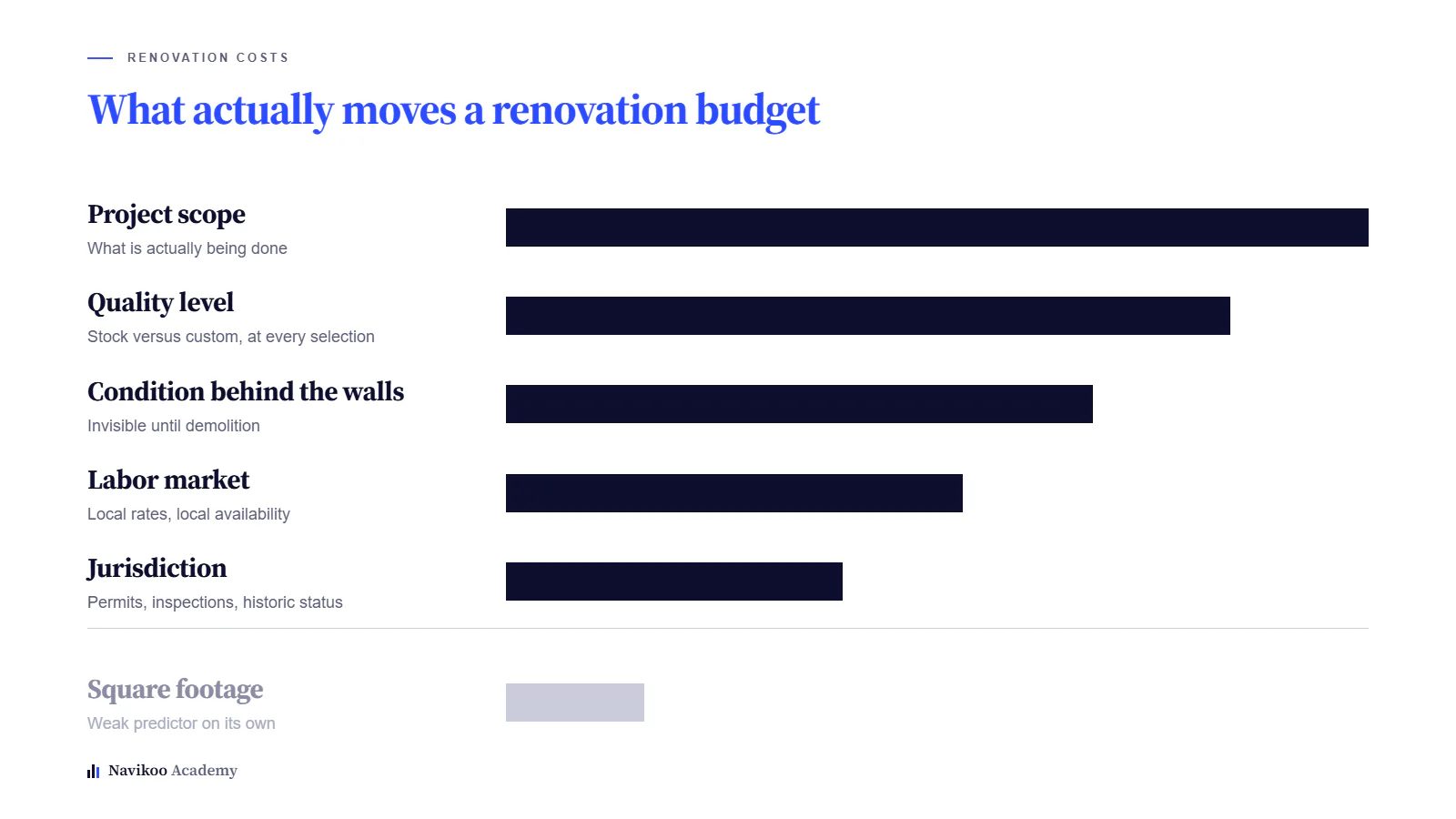
Five variables matter far more than the size of the home.
Project scope. Replacing a kitchen and refinishing floors is a different project from moving walls and relocating plumbing, even in the same room.
Quality level. Stock cabinets and custom cabinets perform the same function at prices that are not close. The same holds for flooring, fixtures, and countertops.
Condition behind the walls. Electrical and plumbing systems, framing, and foundation work stay invisible during a walkthrough and become expensive when they surface.
Labor market. Contractor availability and labor costs vary enormously by region, trade availability and season.
Jurisdiction. Permitting requirements, inspection schedules, and whether the property is a historic home change both the cost and the calendar.
The Only Reliable Way to Price a Rehab
Three steps, in order. Reversing them produces numbers no one can defend.
Write the Scope Before Asking for a Price
A scope document lists what will be done, one room at a time, at what quality level. Not "renovate the kitchen" but the specific decisions: cabinet type, countertop material, whether the layout changes, whether plumbing moves.
Vague scopes produce vague bids, and vague bids get revised upward once work begins. Writing the scope first also forces decisions that are cheap on paper and expensive after demolition.
You can easily estimate that using a rehab cost calculator, or try the one we offer for free on Navikoo.
Get Local Bids From People Who Will Do the Work
Renovation pricing is local. The cost of materials moves regionally, labor moves locally, and permit fees are set by the jurisdiction. No national figure captures any of that.
Three bids from a professional remodeler working in the specific market produce a usable number for planning purposes. Anything else is an estimate waiting to be corrected. This single habit separates investors whose projects finish near budget from those whose projects do not.
Sort Line Items by Predictability
Almost everyone skips this step, and it is where the framework later in this article comes from. Some line items are quotable within a few percent. Others are estimates dressed as quotes. Treating them identically is why contingency planning fails.

A Worked Home Renovation Budget
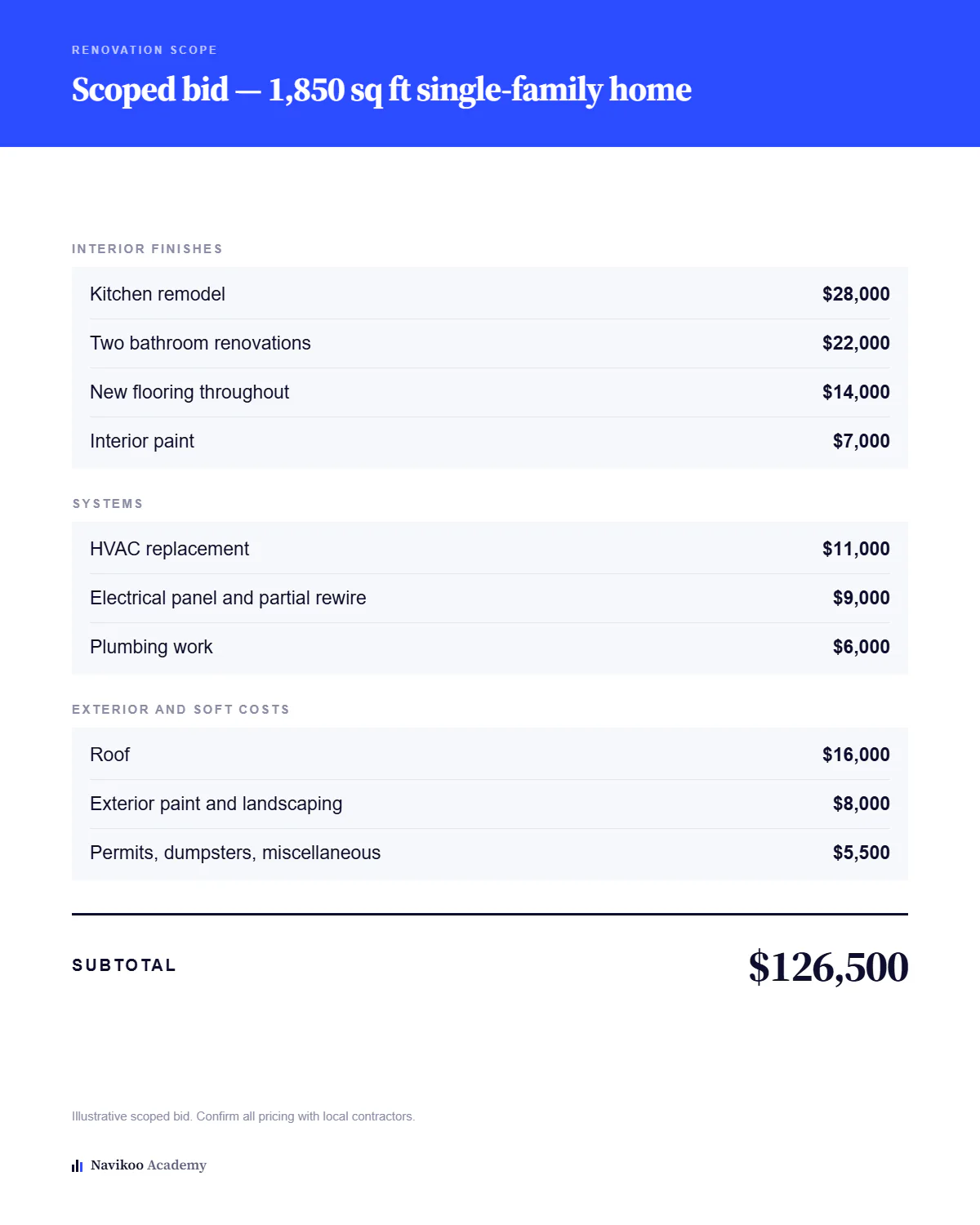
What follows is a hypothetical scoped bid for an 1,850 square foot single-family home. The dollar amounts are illustrative and demonstrate budget structure, not market pricing. Every line must be confirmed with local contractors, because the cost of any of this work varies substantially by city, labor market, material selection, and project type. Treat the structure as transferable and the numbers as not.
The Scoped Bid
Line item | Amount |
|---|---|
Kitchen remodel | $28,000 |
Two bathroom renovations | $22,000 |
New flooring throughout | $14,000 |
Interior paint | $7,000 |
HVAC replacement | $11,000 |
Electrical panel and partial rewire | $9,000 |
Plumbing work | $6,000 |
Roof | $16,000 |
Exterior paint and landscaping | $8,000 |
Permits, dumpsters, and miscellaneous | $5,500 |
Subtotal | $126,500 |
What a Full Breakdown Reveals
Divide the subtotal by floor area and the work prices out near $68 for each foot of the house. Arithmetically correct, analytically empty, for reasons the next section covers.
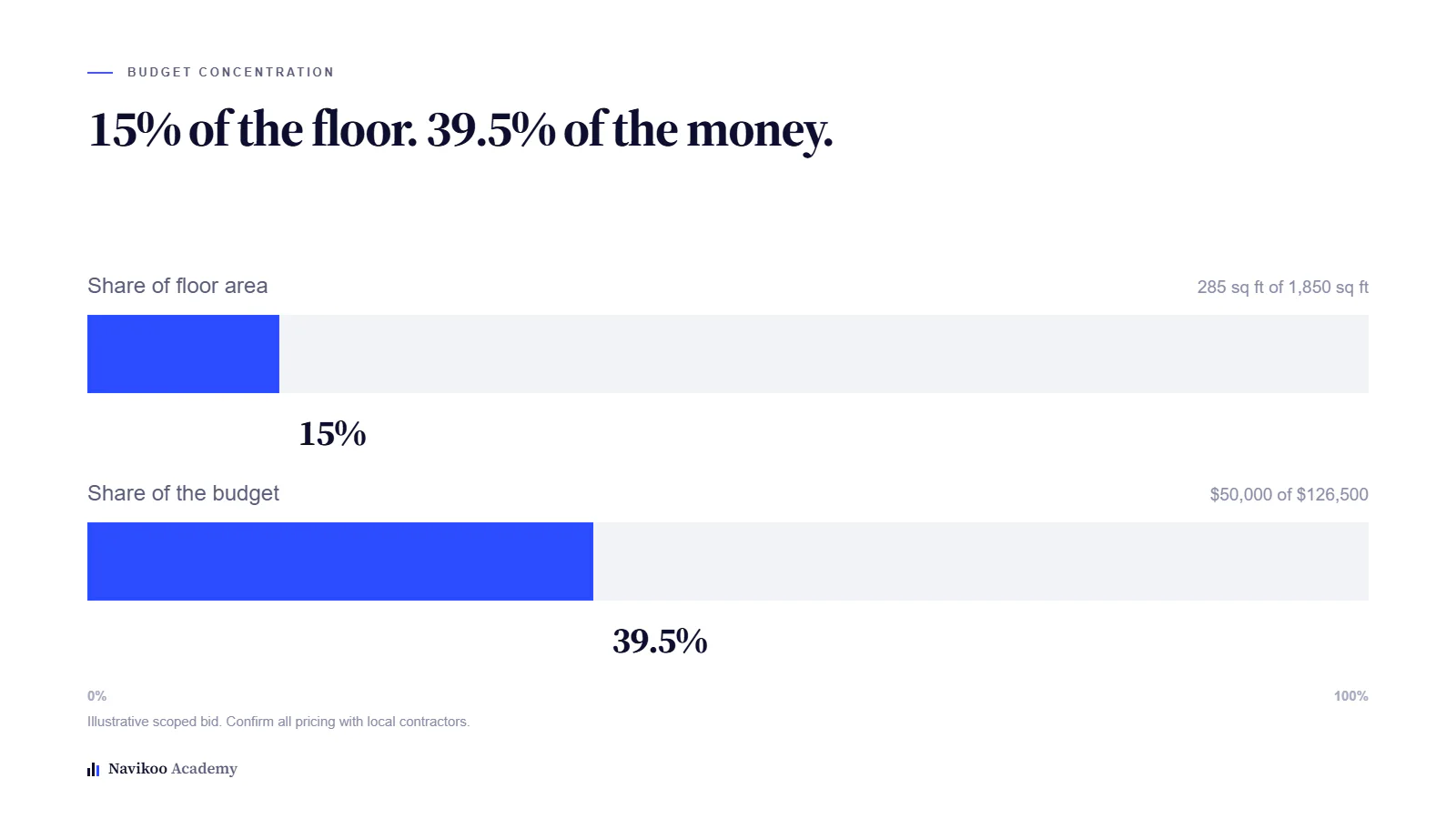
More useful is where the money sits. The kitchen and two bathrooms together consume $50,000, or 39.5% of the total. Those three rooms occupy roughly 285 square feet of an 1,850 square foot home, about 15% of the floor area.
Two and a half times the spending concentration relative to floor space. That ratio, not the total, is what an investor should notice first.
Why Cost Per Square Foot Misleads
Cost per square foot is an output of this exercise, never an input to it. Calculating it afterward describes what happened. Using it beforehand assumes spending distributes evenly across floor area, which it does not.
A bedroom and a living room contain flooring, paint, and lighting, and little else. Kitchens and bathrooms contain cabinets and countertops, tile, fixtures, plumbing, and electrical. A square foot of wet rooms costs multiples of a square foot of dry rooms, so the ratio between them drives the number far more than total area does.
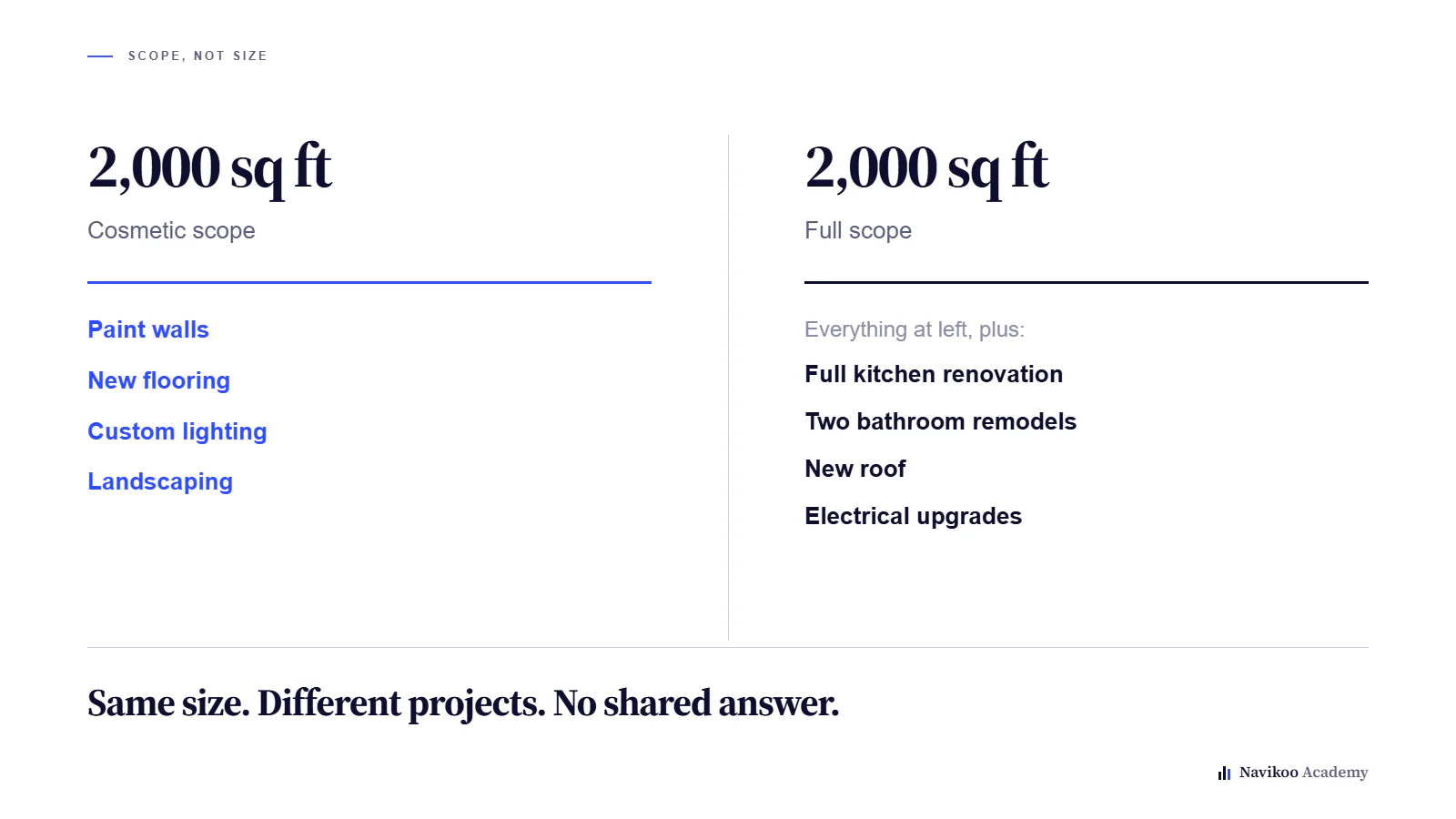
How Much Does It Cost to Renovate a 2,000 Square Foot House?
The question cannot be answered as asked, and understanding why beats any range someone might offer.
Consider two houses of identical size. The first needs cosmetic work: paint walls, new flooring, custom lighting, refreshed landscaping. The second needs all of that plus a full kitchen renovation, two bathroom remodels, a new roof, and electrical upgrades.
Same square footage. The second project might cost several times the first. Any per-square-foot figure covering both describes neither.
Where Renovation Money Concentrates
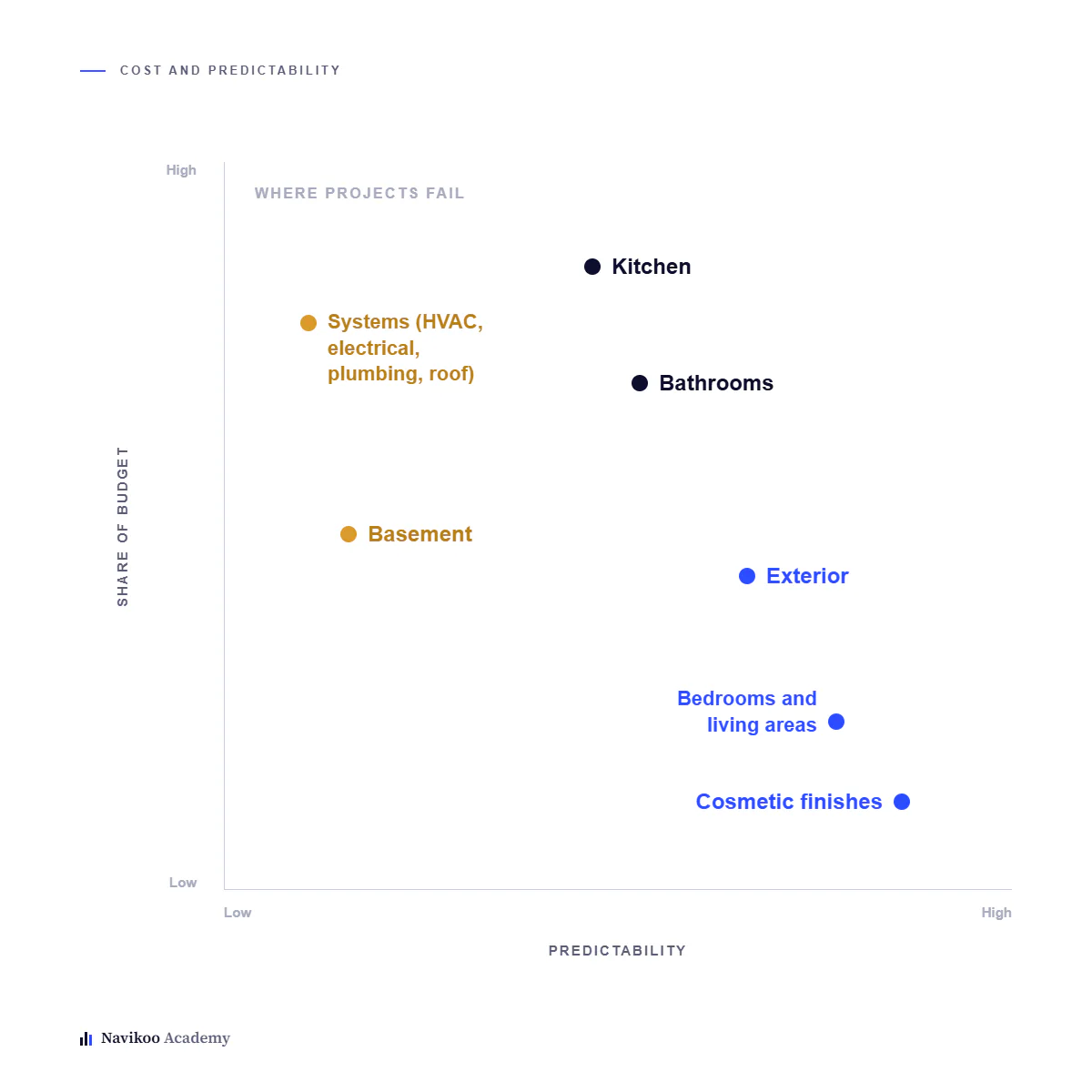
Seven categories behave differently enough to deserve separate treatment in any budget.
Kitchen
The kitchen is usually the largest single line in a home renovation, and the internal range is enormous. Kitchen updates that keep the existing layout, reuse existing water lines, and install stock cabinets sit at one end. A full kitchen remodel that moves walls, relocates fixtures, and adds custom cabinetry sits far from it.
The layout decision drives more cost than the finish decision. Keeping new appliances and fixtures where the old ones sat avoids the work that turns a moderate kitchen remodeling project into a major one.
Bathrooms
A bathroom remodel concentrates spending in a small footprint. Tile, waterproofing, fixtures, and ventilation in a room of 45 square feet can approach what an entire bedroom costs to renovate. Any bathroom renovation cost estimate should be read against that concentration, and the same applies to a kitchen renovation cost quoted without a layout assumption.
A bath remodel preserving the existing layout is a fundamentally different project from one relocating a toilet or converting a tub to a walk-in shower. Investors comparing bids from bathroom remodelers should confirm both remodels are priced on the same layout assumption.
Bedrooms and Living Areas
These rooms are the most forgiving part of most projects. A bedroom remodel typically means flooring, paint, lighting, and closet work. Predictable, quotable, and rarely the source of an overrun.
Their share of the spend is small relative to floor area, which is precisely why per-square-foot thinking distorts the picture. A living room absorbs less money than any wet room in the home.
Basements and Home Additions
A basement remodel introduces variables the rest of the home does not have: moisture management, egress requirements, ceiling height, and sometimes structural work. Basement projects also sit outside the comparisons buyers make room by room. What basement remodels cost depends more on the condition of the foundation and drainage than on the finished square footage.
Additions and garage conversions go further still, since they involve drawings, structural engineering, and plan review before construction starts.
Exterior Work
An exterior remodel covers roofing, siding, windows, paint, and landscaping. Roofing behaves like a systems item, expensive and non-negotiable. The rest behaves cosmetically, and these are among the more predictable home improvement projects an investor will scope.
An exterior renovation carries disproportionate influence on perceived value, which matters for a resale exit and matters less for a tenant. Both bathroom remodel decisions and exterior choices should follow the exit rather than taste.
Systems Behind the Walls
HVAC, electrical, plumbing, and roofing rarely add visible appeal, and they consume money no buyer or tenant will ever see. They are also the least avoidable, since deferred systems become urgent on their own schedule.
In the example above these four lines total $42,000, a third of the project, for work nobody notices.
How to Control Costs Without Gutting the Scope
Three levers reduce home remodel costs on most renovation projects without producing a worse result.
Keep the layout. Moving walls, relocating fixtures, and rerouting drainage account for much of the gap between modest and expensive kitchen and bath work.
Phase the renovations. Extensive renovations completed at once carry the highest holding expense, and a full remodel is the costliest version of that. Splitting the work across a tenancy cycle can lower total remodel costs, though it only works when the home stays habitable throughout. Decide materials during planning rather than mid-project, since change orders priced after mobilization rarely favor the investor.
Cosmetic Work
Paint, flooring, landscaping, and light fixtures are the most predictable lines in any project. They are quotable, they rarely surprise, and they carry the most visible return per dollar spent.
They are also why inexperienced investors underestimate renovations. Cosmetic work is what a walkthrough reveals, so it anchors the mental estimate before anyone examines the systems.
Is $50,000 Enough to Renovate a House?
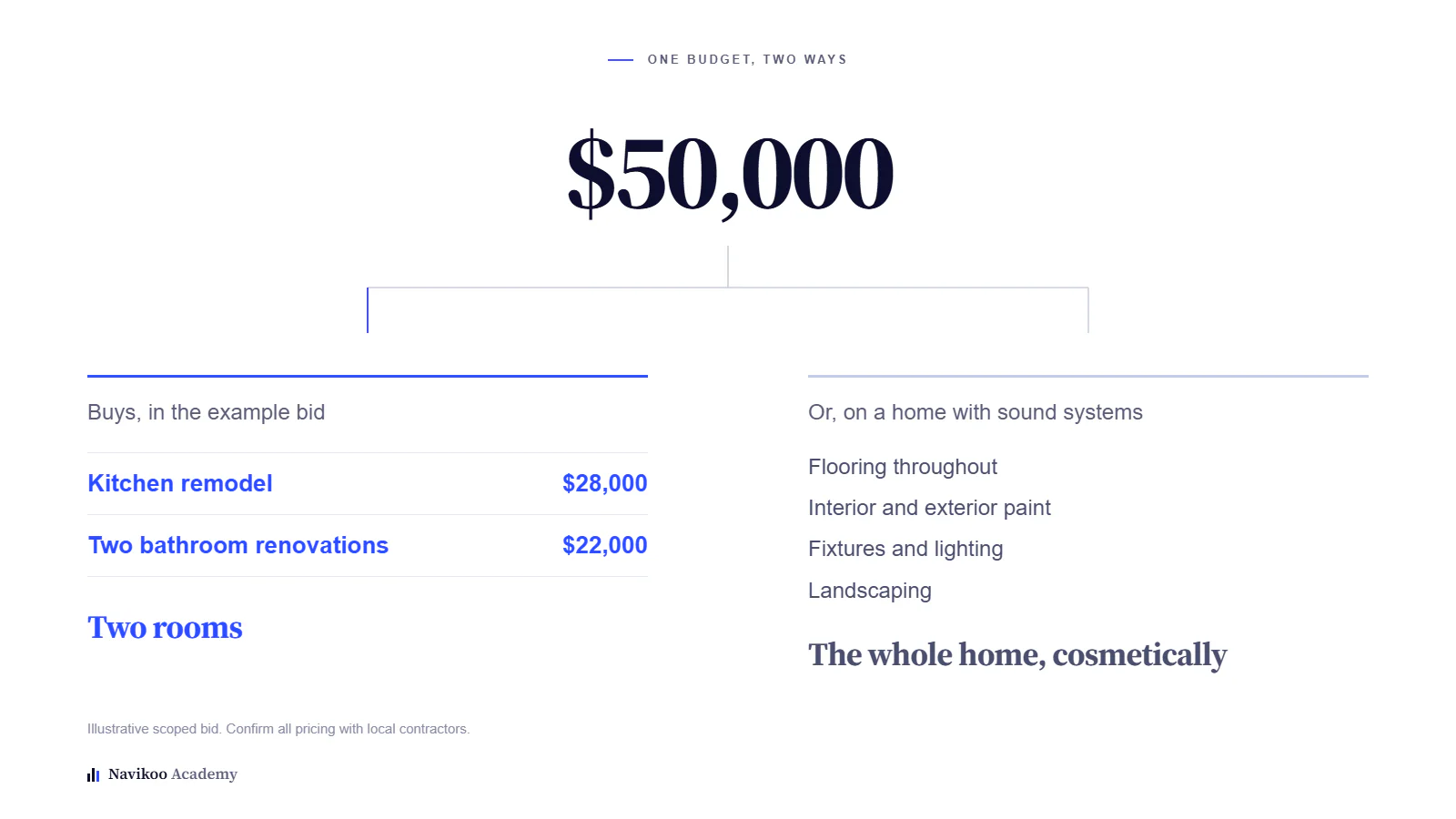
It depends entirely on which home and which scope, and the worked example gives that answer a useful shape.
In the hypothetical above, $50,000 is roughly what the kitchen and two bathrooms consumed alone. The same amount would comfortably fund low-cost renovations across the entire home — flooring, interior and exterior paint, fixtures, landscaping — on a house whose systems are sound. The cost falls entirely on scope.
So $50,000 might represent a complete home remodel or a fraction of one. What determines which is not the budget. It is the condition report.
What Is the Most Expensive Part of a Home Renovation?
By line item, the kitchen and bathroom usually top the list, which is why remodeling discussions concentrate there.
By risk, the answer differs and matters more. The most expensive part of any renovation is whatever was hidden when the bid was written. Foundation repairs, unpermitted prior work, failed subfloors, and old wiring never appear on a walkthrough. They appear during demolition, when the investor has no leverage and no alternative.
Contingency: The Line Investors Get Wrong
Nearly every guide recommends adding 10% for the unexpected. The advice is directionally right and structurally wrong.
Why a Flat Percentage Is the Wrong Shape
A flat contingency assumes uncertainty distributes evenly across a project. It does not.
Interior paint will not surprise anyone. A partial rewire in a house of unknown vintage might. Applying the same 10% to both over-reserves against predictable items and under-reserves against the ones that actually break projects.
A Weighted Contingency Framework
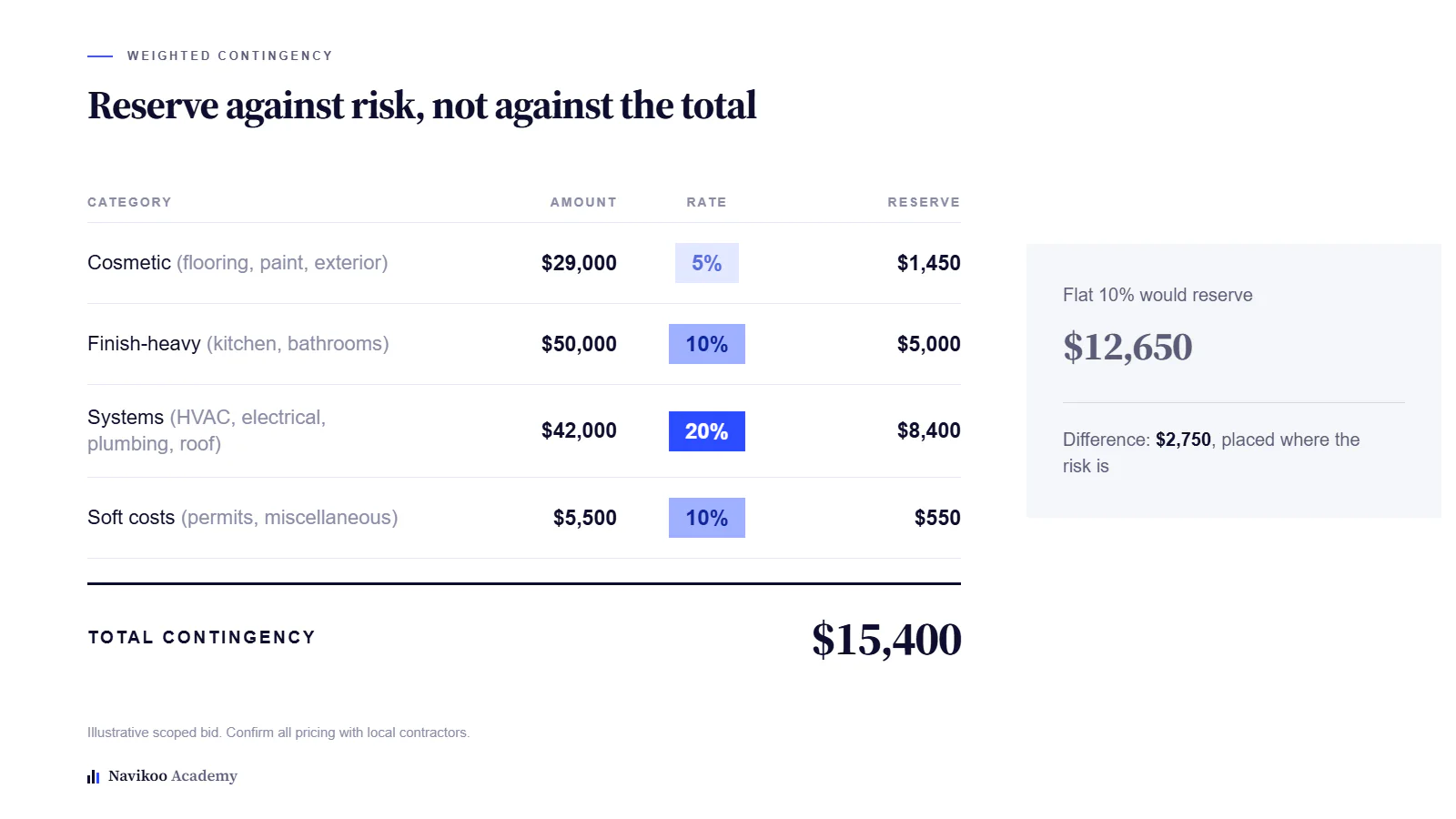
Sorting line items by predictability and applying different reserves produces a more honest total. Using the example:
Category | Amount | Contingency | Reserve |
|---|---|---|---|
Cosmetic (flooring, paint, exterior) | $29,000 | 5% | $1,450 |
Finish-heavy (kitchen, bathrooms) | $50,000 | 10% | $5,000 |
Systems (HVAC, electrical, plumbing, roof) | $42,000 | 20% | $8,400 |
Soft costs (permits, miscellaneous) | $5,500 | 10% | $550 |
Total contingency | $15,400 |
The weighted reserve reaches $15,400, or 12.2% of the bid, against $12,650 at a flat 10%. A difference of $2,750 sitting exactly where the risk sits.
The percentages themselves should shift by property. A 1960s home with original systems deserves a heavier reserve than a building renovated a decade ago. The framework matters more than the specific figures, and both benefit from expert guidance from the contractor who inspected the property.
Testing the Reserve Against a Realistic Overrun
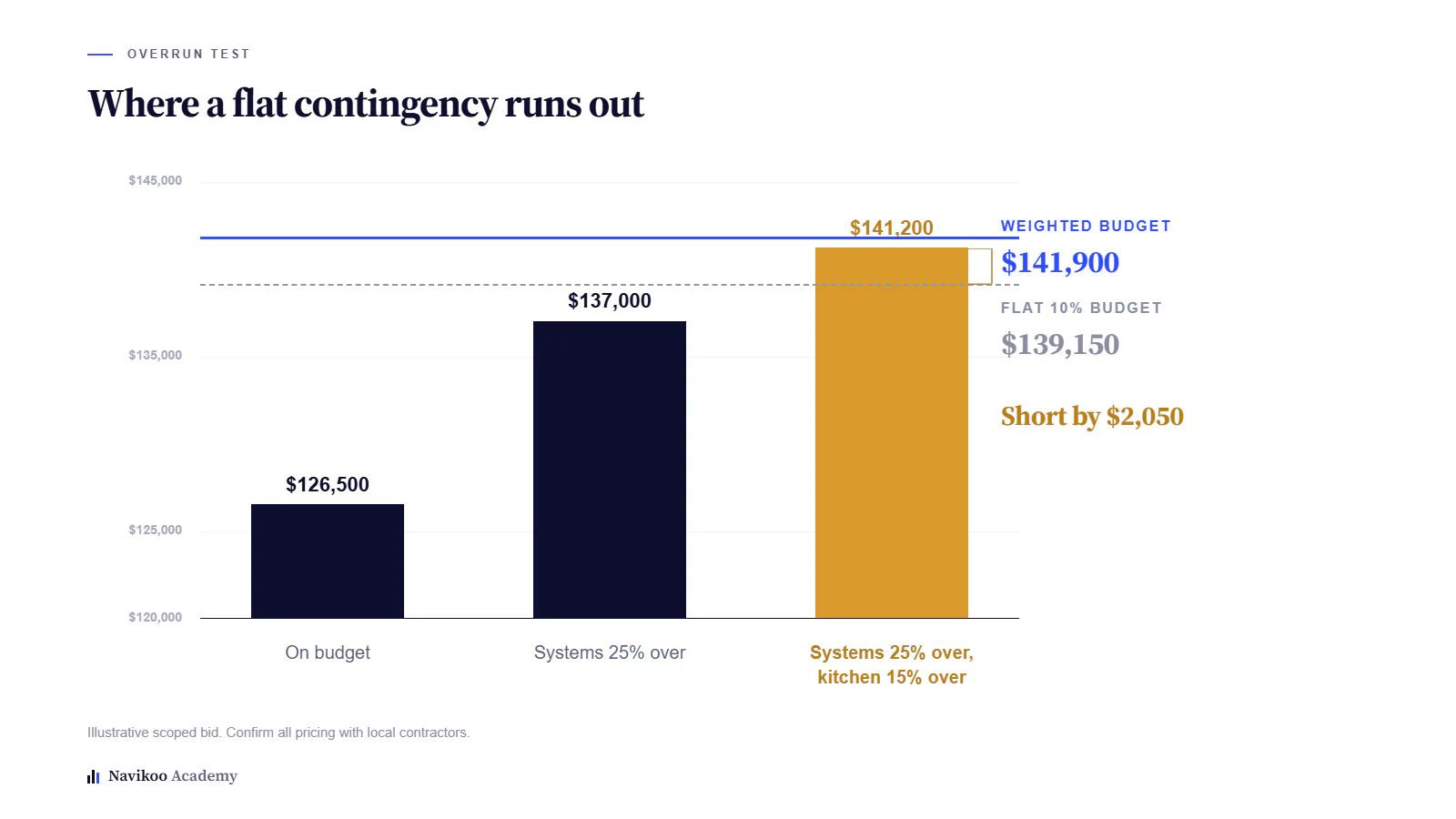
Total cost under the weighted approach: $126,500 plus $15,400, or $141,900. Under a flat 10%: $139,150.
Now suppose systems come in 25% above bid, a plausible stress case for an older property with uncertain electrical and plumbing conditions, and the kitchen runs 15% over after a discovery behind the cabinets.
Scenario | Final rehab cost | Flat 10% reserve | Weighted reserve |
|---|---|---|---|
On budget | $126,500 | Covered | Covered |
Systems 25% over | $137,000 | Covered | Covered |
Systems 25% over, kitchen 15% over | $141,200 | Short by $2,050 | Covered |
The flat reserve fails once multiple high-uncertainty items overrun simultaneously, a scenario worth stress-testing because hidden conditions can affect several trades at once.
How Contingency Changes the Maximum Bid
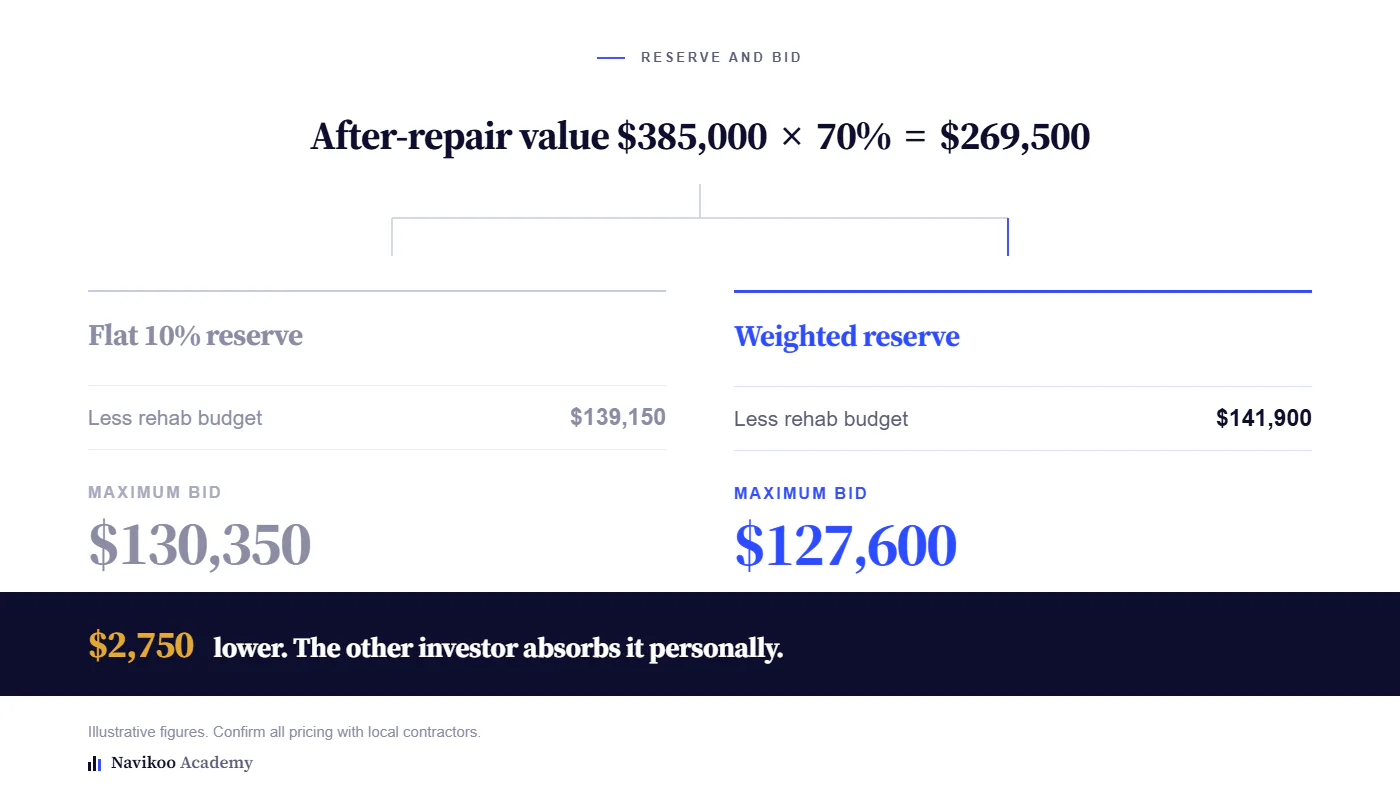
Renovation spending feeds directly into acquisition pricing, which is one of the key factors investors underestimate. Under the common screening rule capping the purchase at 70% of after-repair value minus rehab, a home with a hypothetical $385,000 after-repair value produces:
Flat 10% reserve: $269,500 − $139,150 = $130,350
Weighted reserve: $269,500 − $141,900 = $127,600
The more honest cost analysis produces a lower bid. That feels like a disadvantage in a competitive market and is the reverse. The investor bidding $130,350 wins more deals and absorbs the overrun personally.
How Location Changes Everything
Two identical scopes priced in different cities produce different numbers, and the gap is not marginal. Labor rates, material availability, permit fees, and inspection timelines all vary by market.
City-specific research therefore matters more than any national figure. An investor working in Los Angeles faces a permitting environment, labor market, and cost structure with little relationship to a smaller inland market, where the same house renovation might price very differently. Anyone underwriting there should price the scope with Los Angeles contractors rather than adjusting a national average, and the same discipline applies everywhere.
Permits, Drawings, and Jurisdiction
Building permits cost money and, more consequentially, time. Projects altering structure, moving fixtures, or changing occupancy typically require architectural drawings and plan review before work begins.
Los Angeles investors pursuing an accessory dwelling unit encounter this directly, since those projects involve zoning review, utility considerations, and requirements specific to the residential lot. Any of it can add months, and none of it appears on a contractor's bid for construction.
Soft expenses — permits, drawings, engineering, utility connections — belong in the budget as their own line. Investors leaving them out are not building budgets. They are estimating construction.

Renovation Timelines and the Cost of Delay
Time is a budget line most investors track imprecisely.
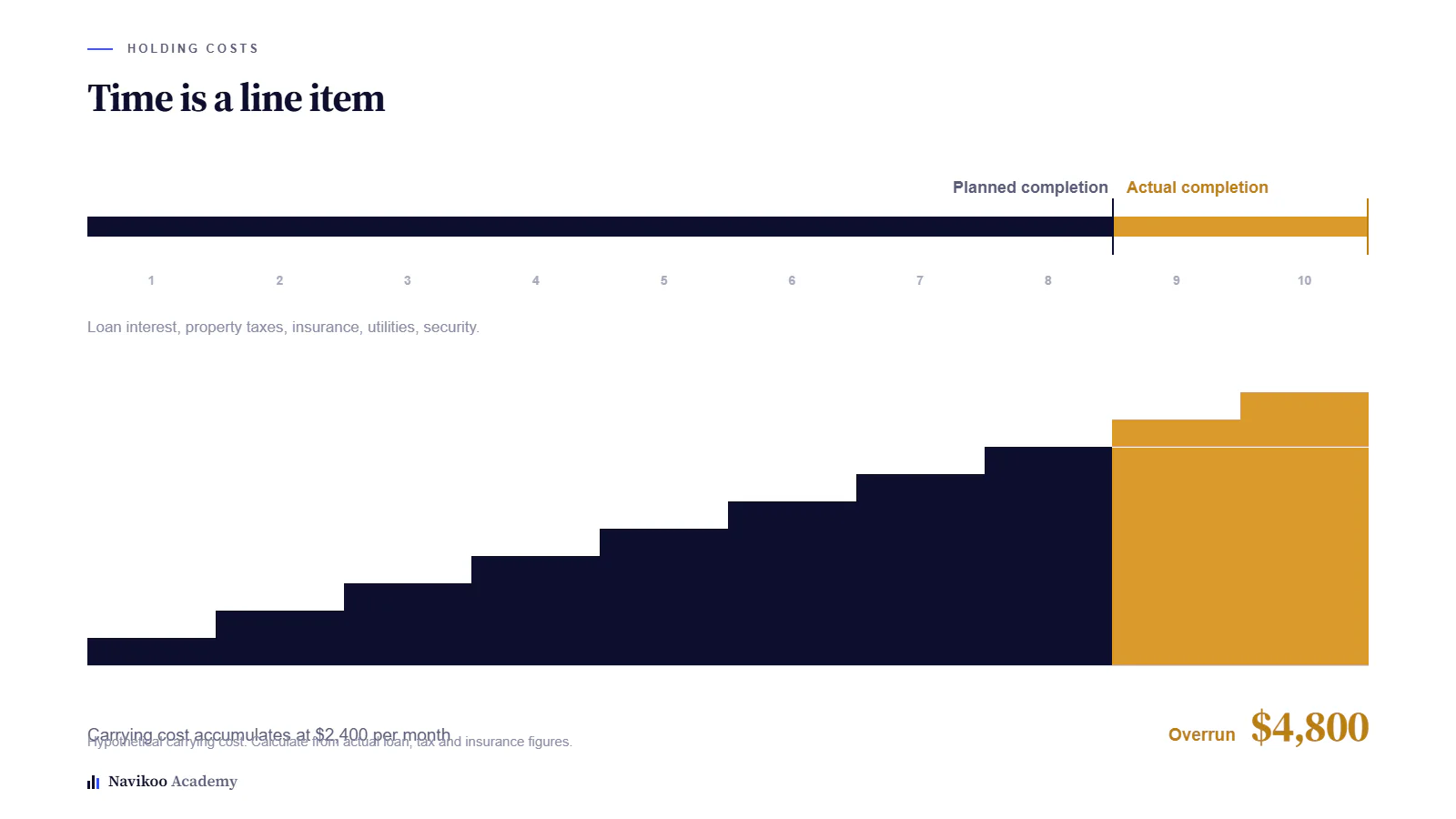
While a home sits under renovation it generates no rent and accrues holding expenses: loan interest, property taxes, insurance, utilities, and security. On financed acquisitions those carrying costs are meaningful, and every week of delay deducts directly from the return.
If carrying a hypothetical property runs $2,400 monthly, a two-month overrun adds $4,800 appearing nowhere on the contractor's bid. Actual carrying expenses depend on the specific loan, tax rate, and insurance, and should be calculated from real figures rather than assumed.
How Long Does a Typical Renovation Take?
Duration tracks scope rather than square footage, and the timeline drivers differ from the cost drivers.
Cosmetic renovations across multiple rooms move quickly because the work is sequential and predictable, one room after another. Larger renovations rarely behave that way. Projects requiring permits, inspections, or custom orders move slowly regardless of size, because the delays are administrative rather than physical. A custom cabinet lead time can hold up kitchen renovations for weeks while nothing happens on site.
The realistic approach asks each bidder for project timelines alongside pricing, then applies the same weighted logic used for contingency. Permit-dependent phases deserve more schedule cushion than paint.
How Do I Choose a Contractor?
The bid is not the product. The relationship is, and it determines whether the plan survives contact with the home.
Questions Worth Asking
These separate a remodeling contractor who finishes near budget from one who does not.
What is your current workload, and when could you start?
How do you handle discoveries outside the original scope?
What is the change order process, and how is pricing determined?
Who is on site daily, and are they employees or subcontractors?
Which parts of this scope carry the most uncertainty in your view?
The last one reveals the most. A contractor identifying the risky portions unprompted is applying the same predictability logic an investor should use. One calling the whole project straightforward either has not looked closely or is bidding to win rather than to build.
Five questions to ask a contractor, with what each answer reveals about the bid

Can I Get Financing for a Renovation?
Yes, through several routes, and the right one depends on whether the property is already owned.
Home Renovation Financing Options
Renovation loans for home renovation projects advance funds for acquisition and improvement together, releasing money in draws as work is completed and inspected.
Home equity loans and lines of credit let an investor tap home equity in one property to fund renovations on another. Common among investors holding appreciated real estate who want to redeploy home equity rather than sell, particularly for smaller remodeling jobs.
Short-term acquisition debt from private and hard money lenders typically funds rehab in draws, priced for speed and condition rather than borrower documentation. Refinancing into longer-term debt usually follows completion.
Cash and personal loans cover smaller scopes where financing costs would exceed the benefit.
Terms and eligibility vary considerably by lender, so specifics belong on a term sheet. What matters structurally is that draw-based lending reimburses completed work, meaning the investor funds each phase before repayment. That float is real working capital and belongs in the plan.

Where Renovation Budgets Go Wrong
Five patterns account for most failures, and they compound.
Pricing from averages. Covered at length above, and still the most common error in planning and budgeting a whole home remodel.
Scoping loosely. Ambiguity in a scope document always resolves in the contractor's favor, since they priced their own interpretation.
Ignoring hidden costs. Permits, drawings, dumpsters, and utilities are unglamorous and easy to omit. They are also unavoidable.
Applying one contingency to everything. The weighted approach costs nothing to implement and reserves capital where uncertainty actually lives.
Renovating past the exit. Finish levels should match what the market rewards. Premium upgrades in a modest rental produce expenses without corresponding rent, and the cost never comes back. Investors should allocate funds toward what the specific exit, resale or tenancy, actually pays for.

What to Verify Before Committing
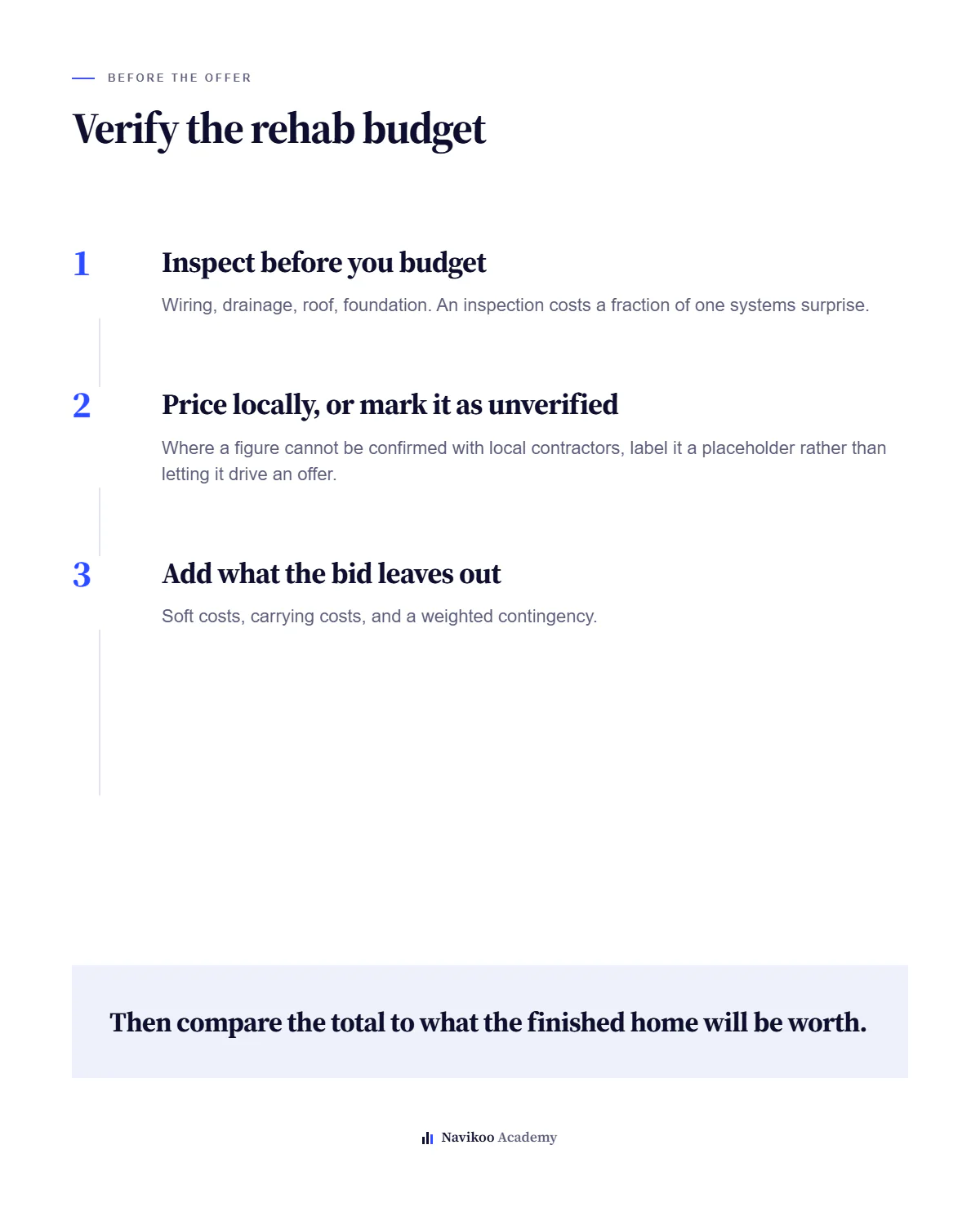
Three things deserve confirmation before a rehab number enters an offer.
Inspect the house before finalizing anything, with particular attention to electrical, plumbing, roof, and foundation. An inspection costs a fraction of what one systems surprise costs, and it converts the least predictable portion of the project into something closer to quotable.
Confirm every line with local pricing rather than published ranges for house renovation costs or remodeling costs generally. Where a figure cannot be verified locally, treat it as a placeholder and mark it as one, rather than letting an assumption harden into a number that drives an offer.
Add the soft expenses, the carrying costs, and a weighted contingency before comparing the total against what the finished home will be worth. A construction bid is not a project budget.
Investors wanting to see how renovation spending, timeline, and financing interact with the eventual return can model those variables together in Navikoo's analysis tools, which makes the sensitivity visible in a way a list of line items cannot.
The most common failure in planning home renovation spending is not arithmetic. It is confidence in a number nobody who would be responsible for delivering it ever priced.