After Repair Value (ARV) in Real Estate
Discover the key to maximizing your real estate profits with After Repair Value (ARV) insights. Learn how to boost your investment returns today!

After repair value is what a property should sell for once renovations are finished and it competes against every other updated property on the open market. Not what the property is worth today. Not what the seller wants. What a buyer will pay for the finished result.
ARV = Value of Comparable Renovated Properties, Adjusted for This Property
Every other number in a flip depends on this one. The bid, the financing, the return on the property, the decision to walk away. Which is why the most important thing to understand about ARV is that it is an estimate produced by judgment, not a measurement produced by arithmetic.
That distinction sounds academic until the math shows what a modest error does to a deal.
ARV Meaning, and Where the Estimate Actually Lives
The definition is straightforward: the projected market value of a property once repairs and home renovations are complete.
The difficulty is that no equation produces it. There is no ARV formula in the strict sense; the repair value formula every guide publishes is really an instruction to study comparable sales and adjust. Two competent real estate investors analyzing the same investment property can land $30,000 apart and both be defensible, because they weighted different comps or read the local real estate market differently.
This is why the figure deserves more skepticism than almost anything else in a real estate investment. A purchase price is a fact. A repair cost estimate is a bid from a contractor. The finished value is a forecast about how strangers will behave months from now.
The Importance of Getting It Right Early
An inflated estimate does not announce itself. It quietly raises the bid an investor is willing to make on a property, justifies a thinner margin, and survives until the property sits on the market at a price nobody will pay. Investors who calculate after repair value from a single comp rarely discover the problem in time.
By then the purchase price is fixed, the renovation money is spent, and the only remaining variable is how much value the investor gives back through price reductions.
Who Determines the ARV of a Property?
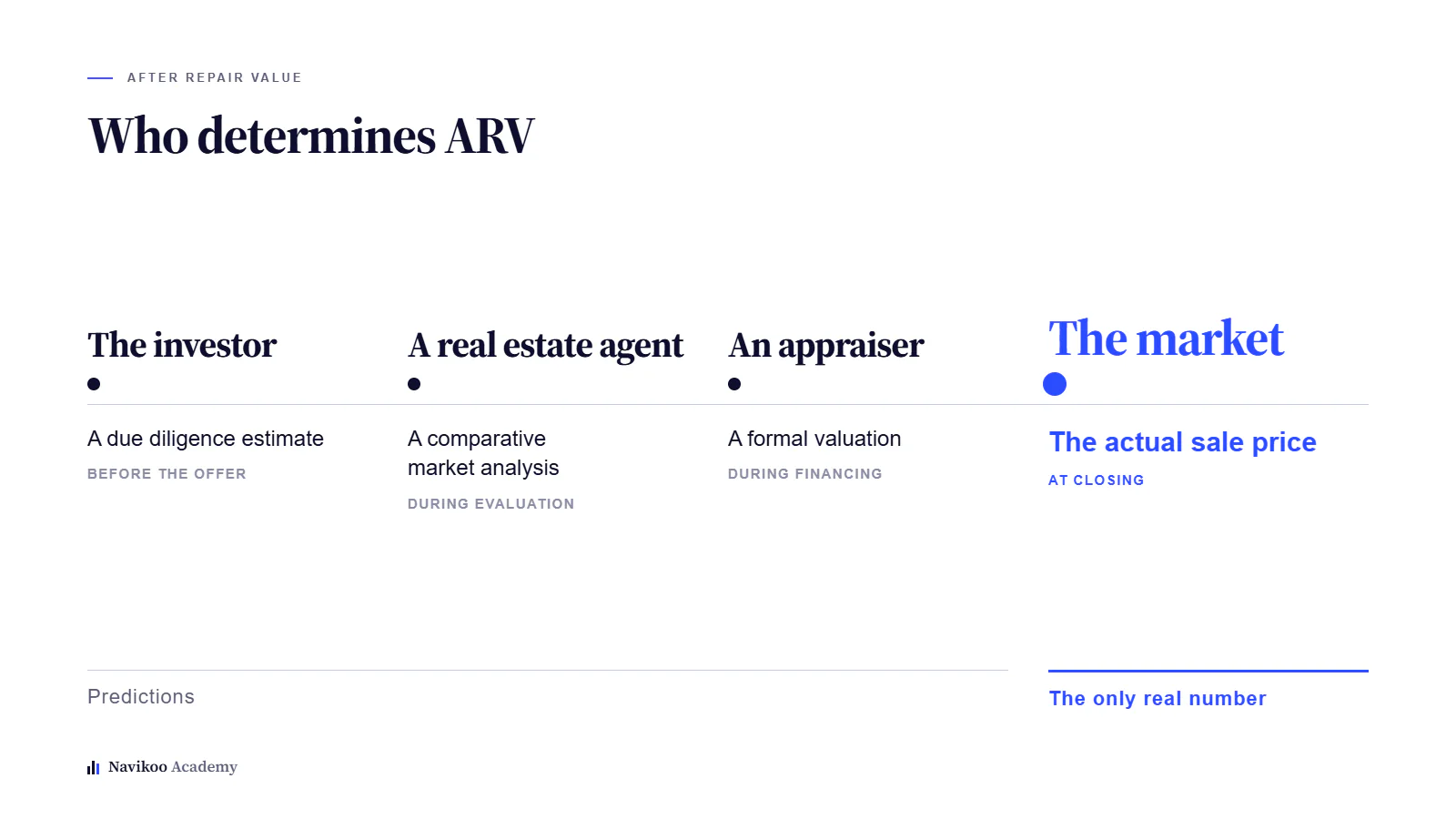
Several parties produce one, and they rarely agree.
The investor builds an estimate during due diligence, from comparable sales and working knowledge of the submarket.
A real estate agent prepares a comparative market analysis, which tends to be the fastest credible second opinion available. Real estate agents working the area daily often catch submarket boundaries a database misses.
A real estate appraiser produces a formal property valuation, usually ordered by lenders. Appraisers value assets by comparison, which is the same method an investor should use. This governs financing, and it is the number an investor cannot argue with after the fact.
The market determines it last, when the property sells.
Only the fourth is real. The first three predict it. Investors who treat a home appraisal as confirmation rather than as one more opinion have misunderstood what the document is.
How to Figure Out After Repair Value
The work is comp selection, adjustment, and reconciliation. Most errors happen in the first step.
Finding Comps That Support the Number
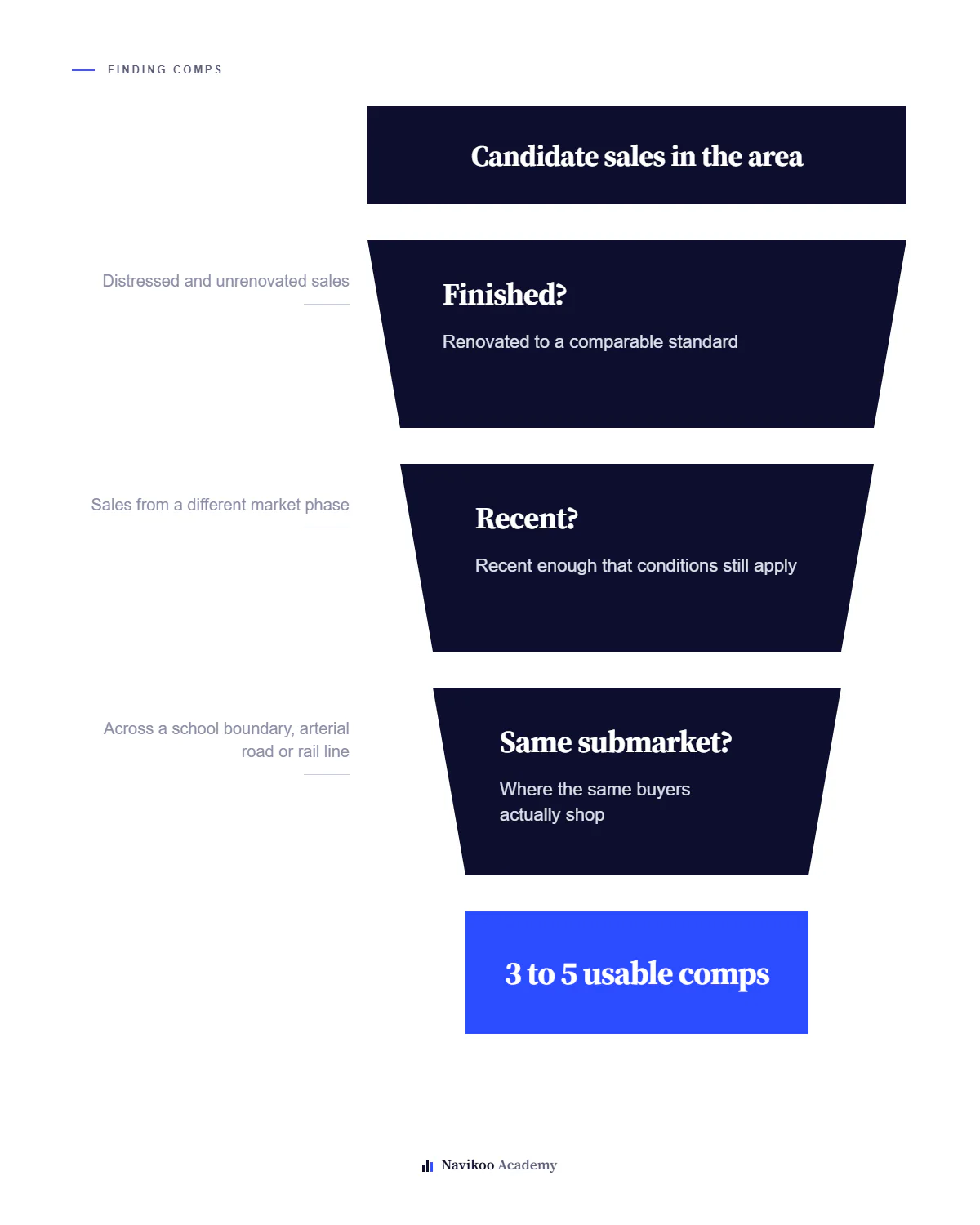
Comparable sales have to be finished properties, sold recently, in the same submarket. Each condition carries a trap.
Finished means renovated to a similar standard, with a comparable repair scope behind the photographs. A distressed property down the street describes current property value, not the market value after renovations. Mixing the two is the most common error in this entire exercise.
Recently means recent enough that the market has not moved underneath the data. Six months of real estate sales in a shifting market can describe conditions that no longer exist. This is how real estate works at the retail level: buyers compare finished homes against whatever else is available that week.
Same submarket is stricter than most investors apply. School boundaries, arterial roads, and the two sides of a rail line cut submarkets in ways a half-mile radius does not respect.
Three to five genuinely comparable properties support an expected value for the finished property. One does not, and neither does a list of twenty homes selected because they were nearby.
Key Factors That Require Adjustment
No two properties match exactly, so each comp gets adjusted toward the subject property. Square footage, lot size, garage, condition, and any structural difference the renovation will not change.
Why Bedrooms and Bathrooms Break the Linear Logic
Most adjustments scale smoothly. The number of bedrooms does not.
Buyers filter listings by bedroom and bathroom count before they ever see a photograph, so a three-bedroom property and a two-bedroom property of identical square footage sit in different search results. Those counts create step changes in value rather than gradual ones, which is why converting a den into a legitimate third bedroom sometimes returns far more than its renovation cost while a comparable spend on finishes returns almost nothing.
Adjustments should stay modest. A comp needing more than roughly 10% of total adjustment is telling you it was never a good comp. The instinct to adjust harder rather than search wider produces the confident, wrong number.
Reconciling to a Range Rather Than a Point
The output should be a range, then a chosen figure inside it with a stated reason.
An investor who concludes "the ARV sits between $385,000 and $415,000, and I will underwrite at $400,000 because three of the four strongest comps cluster there" has done real work. An investor who writes "$400,000" with no range has skipped the step where uncertainty becomes visible.
Do ARV Calculators Help?
An ARV calculator handles the arithmetic once the inputs exist. That is genuinely useful for speed, and worthless for accuracy. The same is true of any calculator an investor keeps bookmarked.
No repair value calculator selects comps, judges finish quality from listing photos, or knows that the property two streets over backs onto a commercial office building. Those judgments determine the answer. A calculator formats it.
The same caution applies to any tool producing a single confident figure. A number without a stated range is a number that has hidden its own uncertainty.
A Worked After Repair Value Example
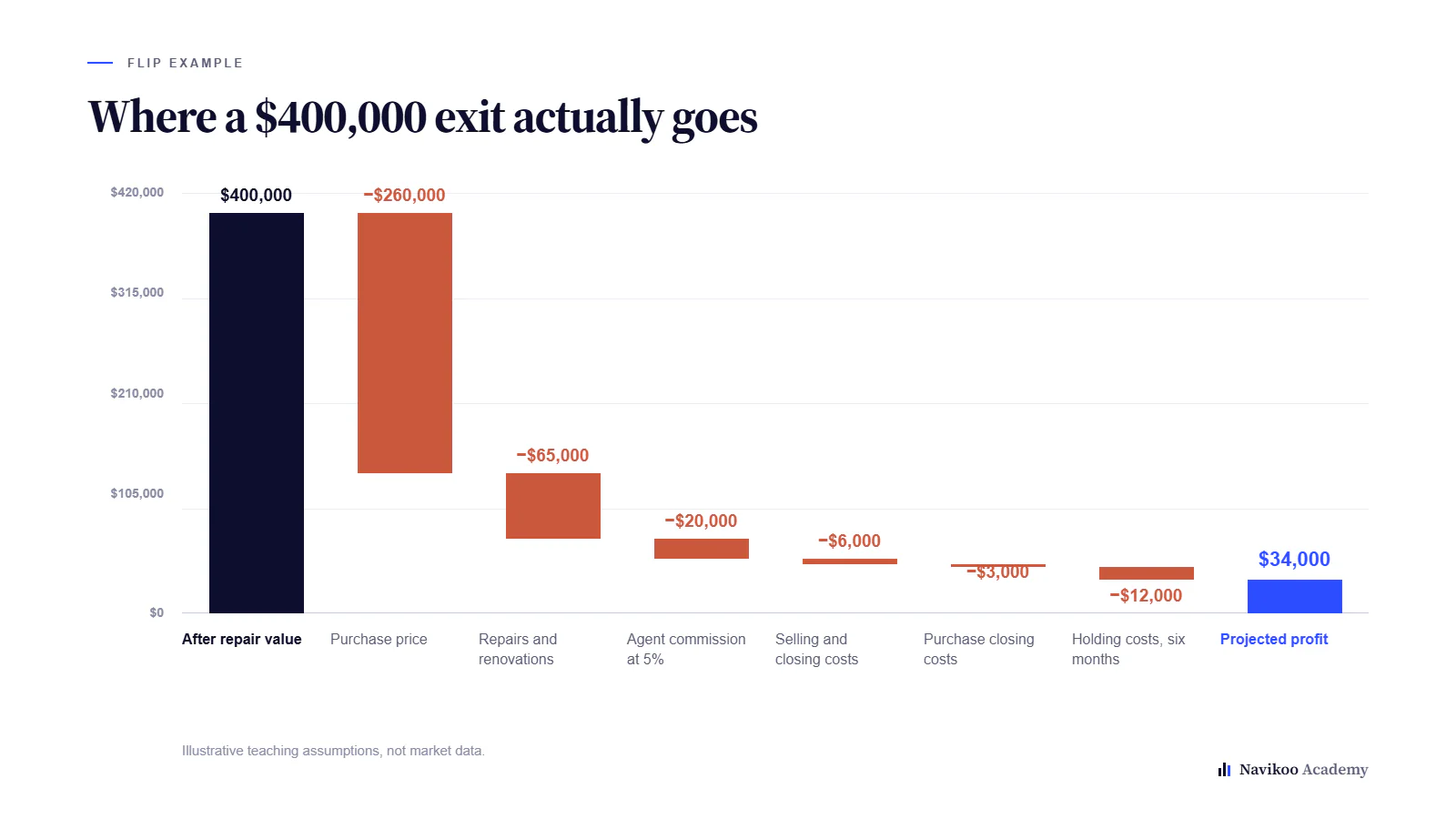
Consider a hypothetical three-bedroom, two-bath house of about 1,450 square feet. Renovated comparable properties in the same submarket support an ARV of $400,000. These figures are illustrative teaching assumptions rather than current market data.
Line item | Amount |
|---|---|
After repair value | $400,000 |
Purchase price | −$260,000 |
Repairs and renovations | −$65,000 |
Agent commission at 5% | −$20,000 |
Selling and closing costs | −$6,000 |
Purchase closing costs | −$3,000 |
Holding costs, six months | −$12,000 |
Projected profit | $34,000 |
Holding costs cover property taxes, insurance, utilities, HOA fees where they apply, and debt carry during the project. Thirty-four thousand dollars against a $400,000 exit is a margin near 8.5% of the finished value. Workable, and thin enough that the whole deal rests on the $400,000 being right.
Why Small ARV Errors Destroy Flip Profit
Here is the part that changes how careful investors treat this estimate.
Profit in a flip is a residual. Purchase price locks at closing. The costs of renovations largely commit once work begins. Holding costs run on a schedule. So when the selling price moves, nearly the entire movement lands on the bottom line.
Actual sale price | Variance from ARV | Profit | Change |
|---|---|---|---|
$420,000 | +5% | $53,000 | +56% |
$400,000 | Base case | $34,000 | — |
$380,000 | −5% | $15,000 | −56% |
$360,000 | −10% | −$4,000 | −112% |
A 5% error in the estimate moves the return by 56%. A 10% error erases it and produces a loss. The amplification factor runs roughly eleven to one, which is the single most useful fact here.
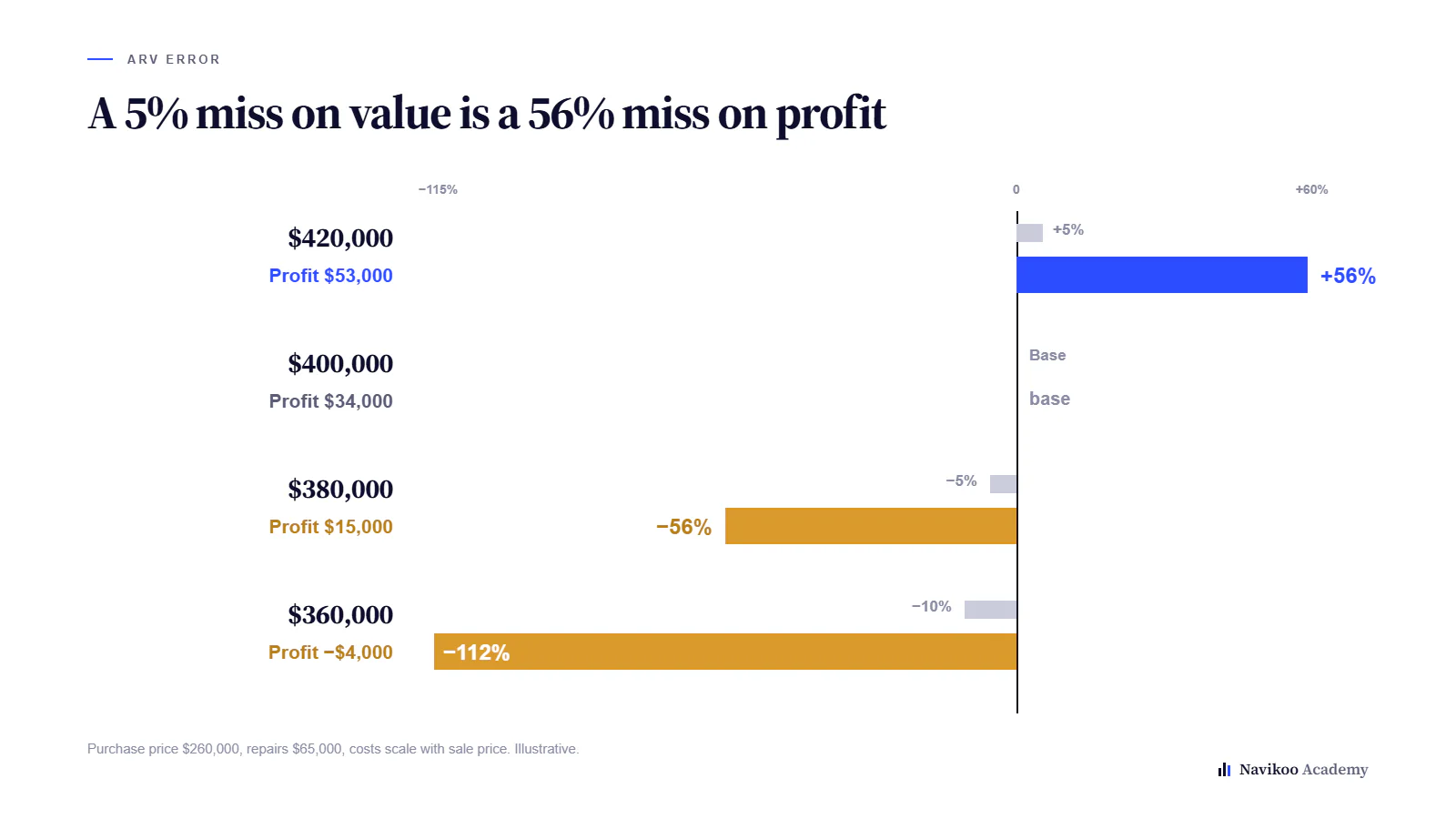
This asymmetry explains behavior that looks like excessive caution from outside. Experienced real estate investors underwrite at the conservative end of their range rather than the midpoint, not because they expect the low figure, but because being 5% optimistic costs roughly eleven times more than the error itself.
It also explains why cost overruns feel survivable while value misses do not. Raising the repair budget from $65,000 to $80,000, a 23% overrun, cuts the profit to $19,000. Painful, and the project survives. A 10% miss on after repair value does not leave that option.
What Does 70% of ARV Mean?
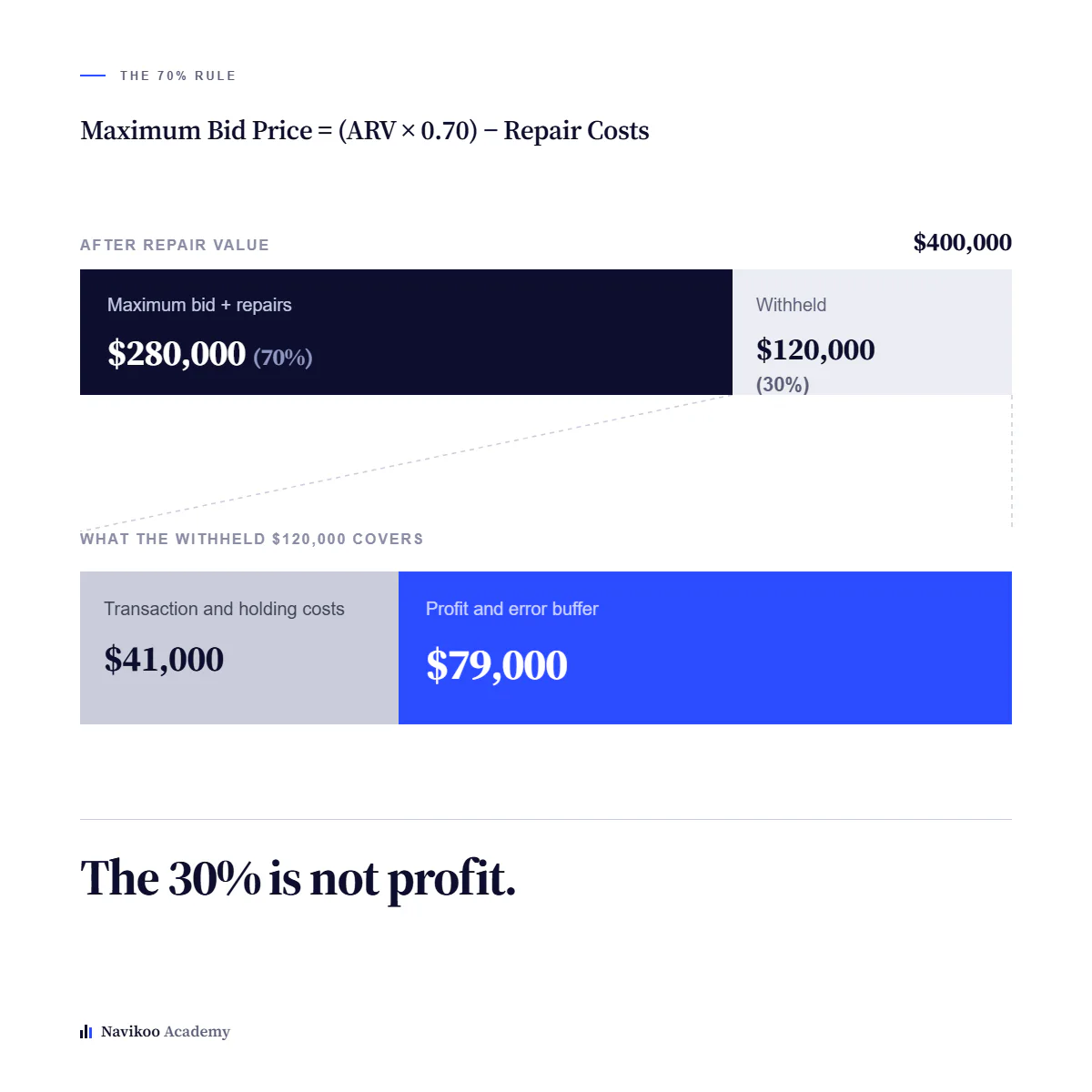
The 70% rule is the most quoted heuristic in house flipping:
Maximum Bid Price = (ARV × 0.70) − Repair Costs
Applied to the example, this formula permits $215,000. The property was purchased at $260,000, well beyond what the rule allows, and still projects a $34,000 profit. Both statements are true, and understanding why beats memorizing the rule.
What the 30% Haircut Actually Buys
The withheld 30% is not margin. It bundles three things, and separating them makes the rule intelligible.
At a $400,000 ARV, that haircut is $120,000. Roughly $41,000 covers commissions, closing on both ends, and six months of carry. The remaining $79,000 is margin and error buffer combined, near 20% of the finished value.
The rule is not claiming a flip should earn 30%. It says that after the costs nobody enjoys paying, an investor should target about a fifth of the finished value, with enough cushion that one soft comp does not turn the project into a loss.
Where the 70% Rule Stops Working
The rule assumes costs scale with price. They partly do and partly do not.
On a lower-priced property, the 30% buffer shrinks in absolute dollars while fixed costs — permits, insurance, utilities, closing fees, a contractor's minimum mobilization — hold steady. A $150,000 ARV yields a $45,000 haircut that fixed costs consume a large share of.
At the higher end the distortion inverts. On an $800,000 property the rule reserves $240,000, which can exceed what the risk warrants and push an investor to pass on deals competitors underwrite more precisely and win.
Treat it as a screening filter that eliminates obvious non-starters. Any property surviving it deserves a real profit analysis built from actual costs rather than a percentage of the value.
What Is Loan-to-ARV?
Real estate lenders funding renovation projects size debt against finished value rather than current value, since present condition is precisely what the borrower intends to change.
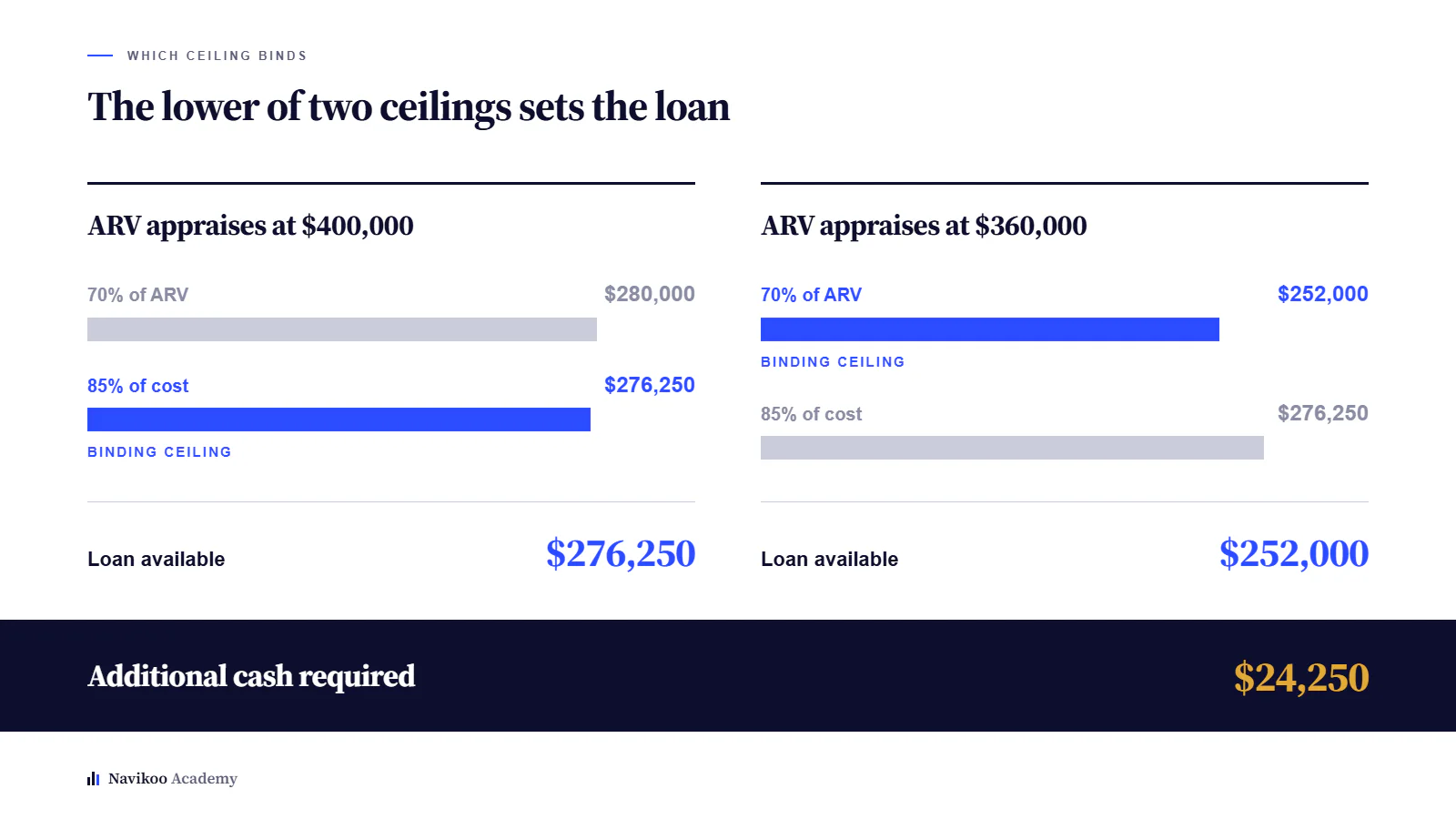
Loan-to-ARV expresses the advance as a share of the finished value. Most flip financing applies two ceilings at once: a portion of ARV and a portion of total project cost. The binding limit is whichever produces the smaller advance.
In the example, total cost is $325,000 — the $260,000 purchase plus $65,000 in repairs. A lender capping at 70% loan-to-ARV offers $280,000. The same lender capping at 85% of cost offers $276,250. The cost ceiling binds.
When the Appraisal Comes In Low
Suppose the lender's appraisal comes in at $360,000 instead of $400,000. The 70% ceiling drops to $252,000 and now binds instead of the cost ceiling. Required cash rises by $24,250 before a single board is replaced.
This is the practical reason valuation disputes matter before closing rather than after. An optimistic estimate does not merely shrink the projected return. It changes how much capital the property consumes, sometimes past what the investor has available.
What Are Some Common Mistakes While Calculating After Repair Value?
Four patterns account for most bad numbers.
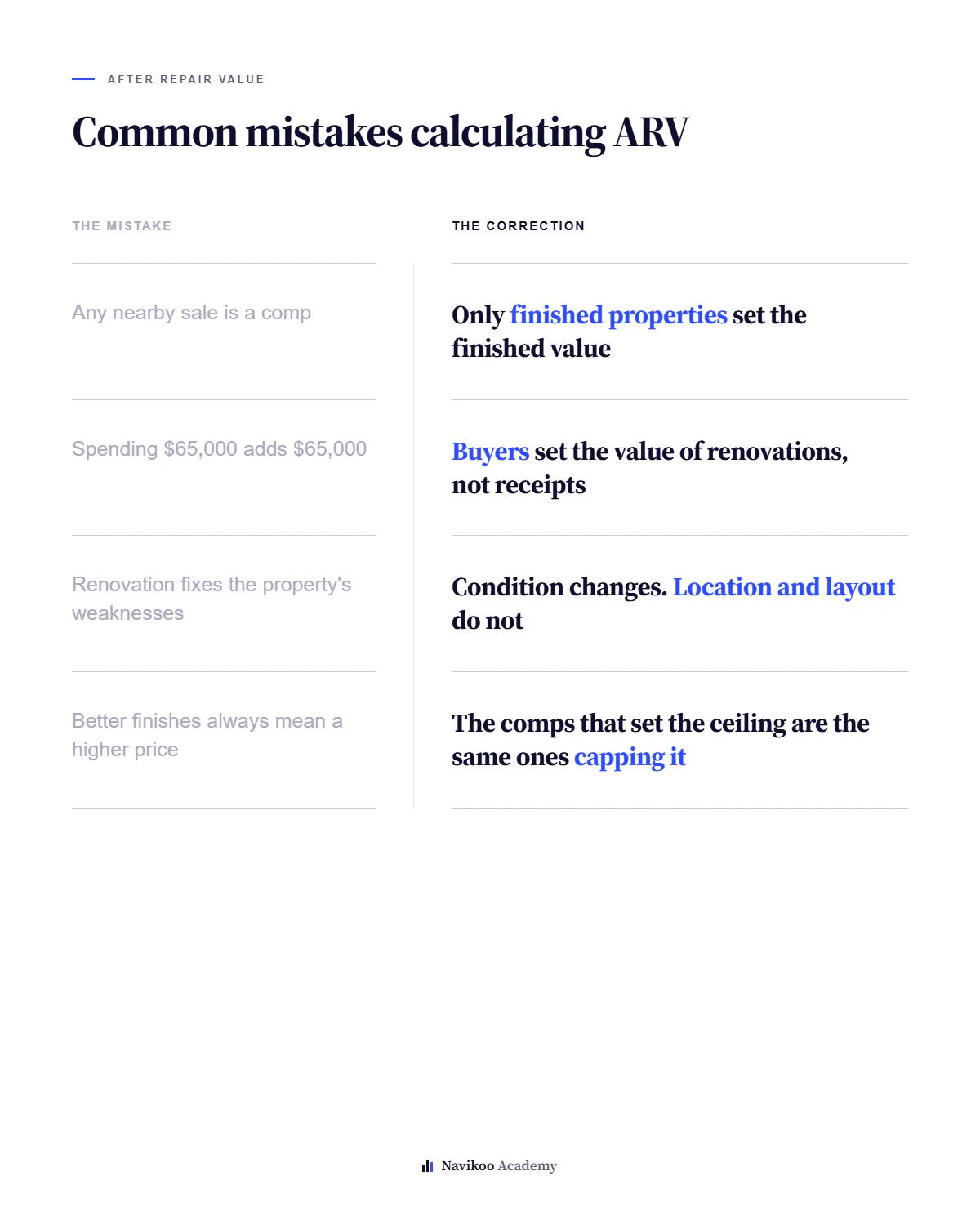
Using unrenovated comps. Pulling sold data without checking finish level produces a figure reflecting the neighborhood's distressed inventory rather than its retail market. Listing photos of each comparable property are the fastest check available.
Letting the budget set the value. Spending $65,000 does not add $65,000. Some remodels return more than their cost of repairs, some return less, and past a point the market refuses to pay more regardless of what was spent. The value of renovations is set by buyers, not by receipts, and market value follows demand rather than spend.
Ignoring what renovations cannot change. Capital improvements change condition, not location. A property does not move closer to good schools, gain a garage where there is no room, or quiet the road outside. That ceiling is real.
Renovating past the neighborhood. Finishing a property well above surrounding homes rarely produces resale prices to match. The comps setting the ARV are the same properties capping it.
What About Tax Implications?
Flip proceeds and long-term rental gains are not treated the same way, and the difference can be substantial enough to change which strategy suits a property. Treatment depends on holding period, entity structure, and jurisdiction, so the specifics belong with a tax professional rather than in a general guide. The practical point for underwriting is that a projected return on investment calculated before tax overstates what an investor keeps.
Two Properties, the Same ARV, Different Bids
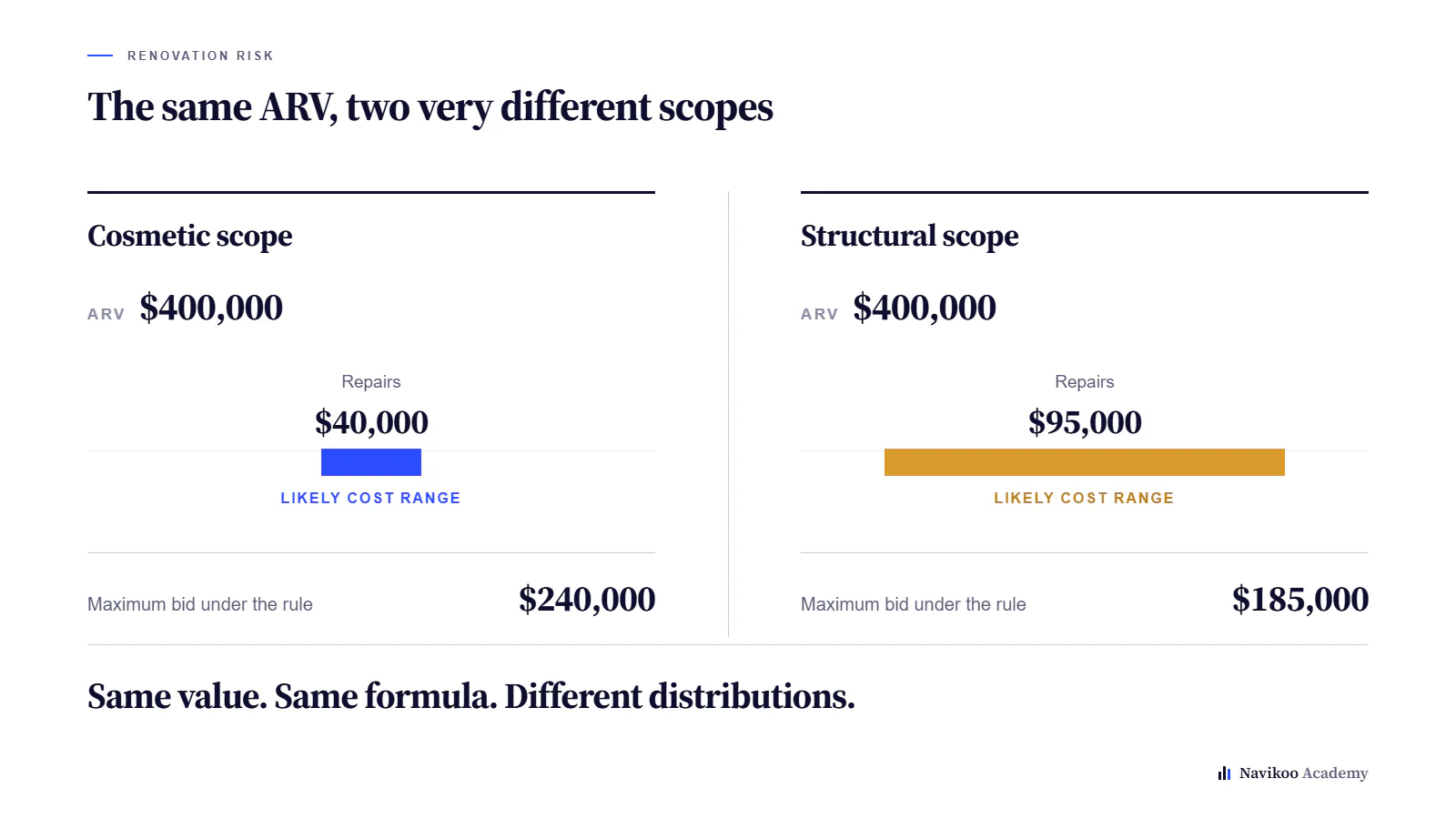
Two properties both support a $400,000 ARV. The first needs $40,000 of cosmetic work — paint, flooring, fixtures, a kitchen refresh. The second needs $95,000, including a roof, a panel upgrade, and repairs to structural damage found during inspection.
The rule allows $240,000 on the first and $185,000 on the second. Mechanically consistent. The two are not equally risky, and an investor should not feel equally comfortable at those numbers.
Cosmetic repair work overruns modestly. Structural repair work overruns badly, because opening a wall reveals what was behind it. The second property carries a wider distribution of outcomes on the cost side and a longer repair timeline, meaning more market exposure between purchase and sale.
Same value, same formula, genuinely different investment decisions.
After Repair Value for Rentals and the BRRRR Strategy
For a flip, the finished value is the whole question. For other approaches it is one input, and occasionally a distraction.
A real estate investor buying a rental property cares about the finished value mainly as it affects equity, and equity determines refinancing capacity. What determines whether that investment property works is rent, property maintenance, operating costs, and debt service — a cash flow analysis rather than a resale estimate.
Refinance-driven strategies sit between them. After repair value drives the proceeds, since the new advance is sized against the appraised value once renovations and improvements are complete. But the property still has to perform as a rental once the renovations are behind it. An investor optimizing purely for exit value can end up with a beautifully renovated property that appraises well and cash flows poorly.
For anyone building a real estate portfolio through this route, the finished value determines how much capital recycles into the next investment, which makes a conservative estimate more useful than a flattering one.
Tips for Verifying the Number Before You Commit
Before an estimate becomes the basis for an investment offer, four things deserve confirmation.
Verify that every comp used was a finished property by looking at listing photos rather than trusting square footage and sale price alone. Confirm the comps sit in the same submarket by the boundaries potential buyers actually respond to, not by radius. A fair value estimate depends far more on comp selection than on adjustment precision. Get a second read from real estate professionals transacting in that specific area, since a local realtor's sense of which streets are moving is information no dataset contains. And underwrite the low end of the range, because the amplification math punishes optimism far more than it rewards it.
Then run the deal at that conservative figure and see whether it still works. If a project only clears the bar at the top of the range, the honest description is that it does not clear the bar.
Investors who want to see how purchase price, renovation costs, holding period, and exit value move together can model those assumptions in Navikoo's investment tools, rather than testing one variable at a time, which is how optimistic underwriting in real estate investing usually survives longer than it should.
The figure worth distrusting first in real estate investing is the one that makes the deal work. That applies equally to homeowners weighing a pre-sale remodel and to any property owner deciding whether the potential value of the work justifies the spend. In a flip, that is almost always the after repair value, and it is almost always the number nobody verified independently.