What Every Real Estate Investor Should Have Before Buying a Property
Finding a property is only one part of real estate investing. Before buying, investors need a buy box, CRM, deal pipeline, strategy-specific calculators, reliable data, due diligence process, financing plan, and a way to track the portfolio after closing.

Most new investors think the first thing they need is a property.
It is not!
Before buying real estate, you need a simple system that helps you find opportunities, follow up with people, analyze deals, verify the numbers, close, and track what happens afterward.
Because in real estate, time kills deals and disorganization too.
A good opportunity can disappear because you forgot to call an agent back. A bad property can look attractive because the rent estimate was saved in one spreadsheet while the insurance quote sat in an email. A lender conversation can get lost in your text messages. Six months later, you may not even remember why you rejected a deal.
None of this requires expensive software or a complicated business.
But every investor should have a few things in place before the first serious offer.
The goal is simple:
Every lead has a home. Every deal has a next action. Every number has a source.

1. Start With a Buy Box Before You Start Browsing
Before opening Zillow, calling agents, or looking at off-market properties, decide what you are actually trying to buy.
Your buy box is a short set of rules that tells you whether a property deserves your time.
It can include:
market or neighborhoods;
property type;
price range;
number of units;
maximum rehab;
minimum rent;
minimum cash flow;
financing type;
investment strategy;
amount of cash available.
Someone looking for a long-term single-family rental should evaluate properties differently from an investor looking for a BRRRR project, a flip, or a four-unit building.
Without a buy box, almost every listing starts to look interesting.
And that is a problem.
If everything is a deal, nothing is a deal.
Your buy box does not need to be perfect. It will change as you learn the market. Its job is to stop you from spending an hour analyzing a property you already know does not fit your strategy.
Write Down Your Deal Breakers Too
Knowing what you do not want can save even more time.
Maybe you do not want properties in a flood zone. Maybe the building must have separate utilities. Maybe you will not buy something needing foundation work. Maybe you need at least $300 a month of projected cash flow after reserves.
Write those rules down.
The more decisions you make before seeing the property, the less emotion controls the decision after you see it.
2. Have One Place for Every Person You Meet
Real estate investing is not only about properties.
It is about people.
Agents send deals. Wholesalers send leads. Lenders provide financing. Contractors estimate repairs. Property managers tell you what a unit can rent for. Insurance agents provide quotes. Sellers call back weeks after the first conversation.
If those relationships live across your phone contacts, email, text messages, notebooks, and memory, follow-up becomes difficult very quickly.
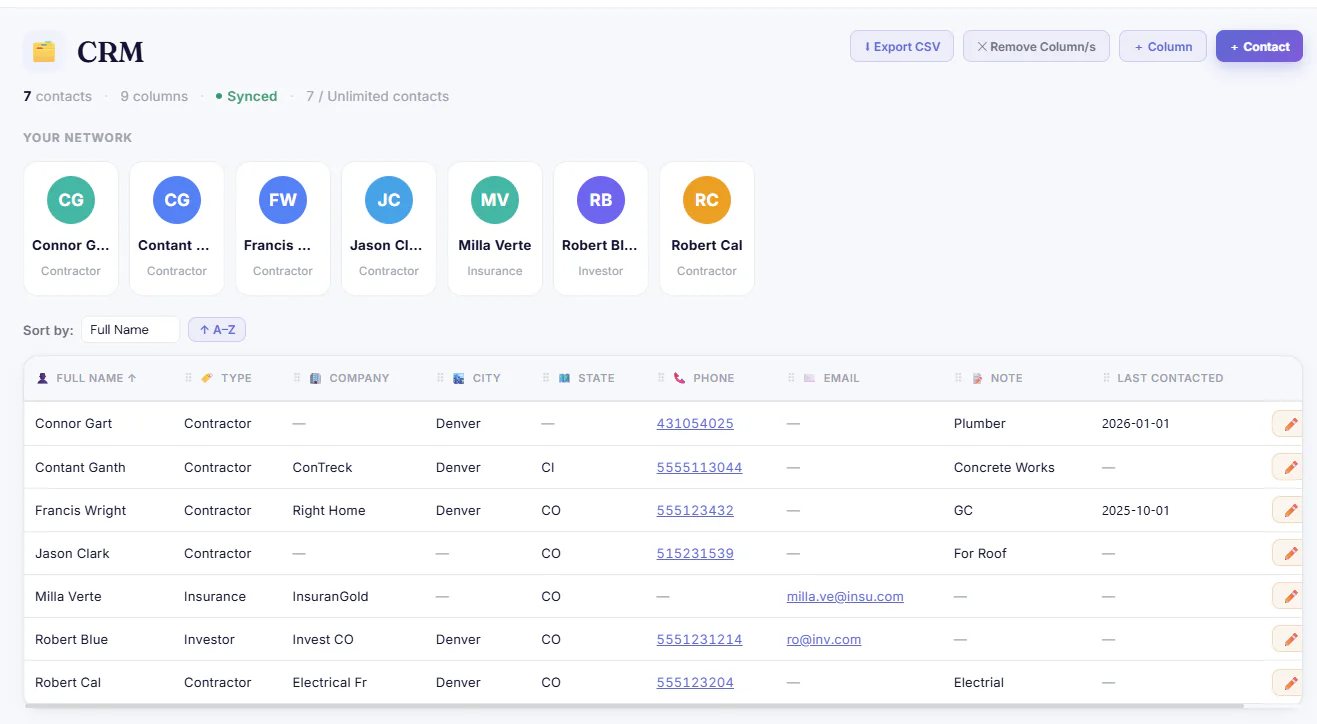
That is where a CRM, or customer relationship management system, becomes useful.
A real estate investor CRM should answer simple questions:
Who is this person?
What did we discuss?
Which property are they connected to?
What do I need to do next?
You do not need hundreds of CRM features on day one.
You need contact management, notes, reminders, and a clear next action - a few words.
For example:
Sarah — agent — Cincinnati
Last contact: November 16
Discussed: 4-unit property on Main Street
Next action: Call Friday after seller reviews offers
That simple record is already better than hoping you remember the conversation three days later.
If the follow-up lives only in your head, eventually it dies there.
A spreadsheet can work when you have five contacts. Once you have dozens of agents, lenders, contractors, sellers, buyers, and property managers, a CRM becomes less about software and more about protecting your time.
3. Every Deal Needs a Pipeline
A CRM organizes the people.
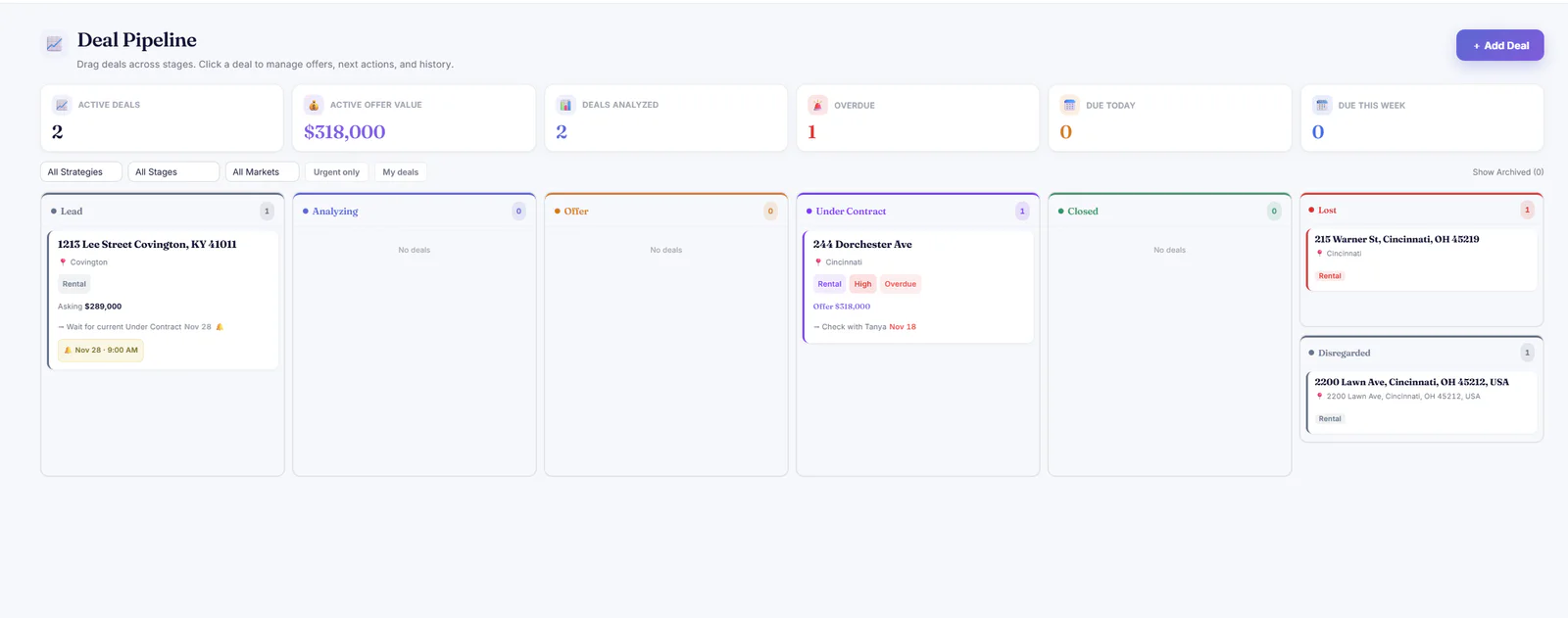
A deal pipeline organizes the opportunities.
These are related, but they are not the same thing.
Imagine you are reviewing 15 properties this month. Some are new leads. Four need more information. Three have been analyzed. Two offers were submitted. One is under contract. Several were rejected.
Without a pipeline, those deals become a collection of browser tabs and spreadsheets.
A simple real estate pipeline can look like:
New Lead
→ Needs Review
→ Analyzing
→ Offer Submitted
→ Under Contract
→ Due Diligence
→ Closed
or
→ Lost / Rejected
Every property should also have a next action and a date.
That is the important part.
A deal sitting in “Analyzing” for three weeks without a next action is not really in a pipeline. It is forgotten.
Every deal needs a next action—or it is already becoming a dead deal.
Track Why You Rejected Deals
Do not delete rejected properties.
Keep the reason.
Examples:
Price too high
Rent too low
Insurance too expensive
Foundation concern
Seller rejected offer
DSCR too low
Rehab exceeded budget
Six months later, that information becomes useful data.
You may notice that most properties in one neighborhood fail because taxes are too high. Or that your offers repeatedly miss by only 3% to 5%. Or that one agent consistently sends properties that match your criteria.
Deal management becomes more useful over time because you are no longer making every decision from scratch.
4. Use the Right Calculator for the Strategy
A calculator should not tell you whether you like a property.
It should tell you whether the assumptions work.
And different strategies need different math.
Long-Term Rental
A rental analysis should include:
purchase price;
down payment;
interest rate;
rent;
vacancy;
property taxes;
insurance;
maintenance;
property management;
utilities paid by the owner;
HOA;
capital expenditure reserves.
From those numbers you can review cash flow, cap rate, cash-on-cash return, NOI, and debt coverage.
BRRRR
A BRRRR analysis needs more than rental cash flow.
You also need:
purchase price;
rehab budget;
after-repair value;
financing during renovation;
expected rent;
refinance value;
refinance LTV;
new loan amount;
cash left in the deal.
Fix and Flip
For a flip, monthly rental cash flow is much less important.
You care about:
purchase price;
rehab;
financing costs;
holding costs;
selling costs;
expected resale value;
project timeline;
profit;
return on cash invested.
The mistake is using one generic calculator for every property.
The strategy decides the calculator—not the other way around.
Use the Same Underwriting Rules Every Time
Consistency matters.
If you assume 5% vacancy on one rental and 0% on another because you like the second property more, you are not comparing deals.
The same goes for repairs, maintenance, management, and reserves.
Set reasonable assumptions before you fall in love with the property.
Then change them only when you have evidence.
A calculator does not remove judgment.
It makes your assumptions visible.
5. Know Where Your Numbers Came From
A beautifully formatted analysis is useless if the inputs are wrong.
This is where real estate deal analysis becomes less about formulas and more about data quality.
For every important number, know the source.
Rent
Did the rent come from:
a seller's pro forma?
a signed lease?
a rent roll?
nearby rental comps?
a property manager?
an online estimate?
Those are not the same quality of information.
Property Value
Is the value based on:
recent comparable sales?
asking prices?
an automated estimate?
an appraisal?
the seller's opinion?
Operating Costs
Where did you get:
property taxes?
insurance?
utilities?
HOA fees?
maintenance history?
management fees?
A seller may tell you insurance is $2,000 a year. If your actual quote is $4,500, the seller's number no longer matters.
Good analytics cannot rescue bad data.
You do not need a data science team.
You need a habit:
Source → assumption → calculation → decision.
If you later change the assumption, you should be able to see why.
6. Have a Due Diligence Checklist Before You Are Under Contract
The worst time to create a due diligence process is after the clock has already started.
Before investing, create a standard checklist.
For a rental property that may include:
inspection;
roof;
sewer;
foundation;
HVAC;
electrical;
plumbing;
insurance;
title;
survey;
flood zone;
leases;
rent roll;
tenant deposits;
utility responsibility;
property taxes;
permits;
zoning;
HOA documents;
financing;
appraisal.
Not every deal needs every item.
But the checklist should exist before the property does.
That way, when you go under contract, you are executing a process instead of trying to remember one.
Due diligence should be boring. Surprises should not be.
Keep the Documents With the Deal
The inspection report should not live in one folder while the lender quote lives in email and the insurance estimate sits in a text message.
Each property should have one place where you can find the important documents.
That can include:
Offer
Purchase contract
Inspection
Quotes
Lease
Rent roll
Insurance
Loan terms
Appraisal
Closing documents
Photos
If you cannot find an important number or document in 30 seconds, your system needs work.
7. Know the Financing Before You Need the Financing
Do not wait until you find the perfect property to start calling lenders.
Know your financing options before making serious offers.
That means understanding:
how much you can borrow;
required down payment;
current rate range;
reserves;
DSCR requirements;
LTV limits;
closing costs;
seasoning rules;
whether renovation costs can be financed;
how long approval usually takes.
Different strategies may also require different lenders.
The lender for a stabilized rental may not be the right lender for a BRRRR project. The cheapest rate may not be the best option if the loan does not fit the property or the timeline.
You do not need one lender.
You need a small lender list with notes about what each one is good at.
Then when a deal appears, you already know who to call.
Financing should be part of underwriting—not a problem you solve after the offer is accepted.
8. Plan How You Will Track the Property After Closing
A lot of investors build a great acquisition process and then stop tracking the deal once they own it.
But closing is not the finish line.
It is the day the assumptions become real.
A portfolio tracker should help you compare what you expected with what actually happened.
At minimum, track:
purchase price;
current estimated value;
mortgage balance;
interest rate;
monthly rent;
vacancy;
operating expenses;
monthly cash flow;
NOI;
major repairs;
lease expiration;
insurance;
property taxes.
Over time, you can also track return on equity, debt coverage, rent growth, and whether the property is performing better or worse than your original underwriting.
That feedback is valuable.
Maybe you always underestimate repairs.
Maybe your property manager is consistently leasing units above your assumptions.
Maybe insurance in one market keeps rising faster than rents.
The portfolio teaches you how to analyze the next deal better.
The deal does not end at closing. The data starts getting better.
The Investor System in One Simple Workflow
You do not need ten disconnected tools.
You need one clear process:
1. Lead enters the CRM
Who sent it? Who owns it? Who needs a follow-up?
2. Property enters the deal pipeline
Where is it in the process? What happens next?
3. Run the correct analysis
Rental? BRRRR? Flip? Multifamily?
4. Verify the data
Rent comps, recent sales, taxes, insurance, rehab, financing.
5. Complete due diligence
Confirm the assumptions while you still have contractual options.
6. Close the deal
Store the final documents and actual loan terms.
7. Track the property
Compare actual results with the original underwriting.
Then repeat.
That is the real benefit of having a system before investing.
You spend less time looking for information and more time deciding what to do with it.
Before You Buy Your First—or Next—Property
You do not need the most expensive CRM.
You do not need advanced predictive analytics.
You do not need a complicated dashboard with 100 metrics.
You need a system you will actually use.
Before investing, make sure you can answer:
What am I looking for?
Where do my contacts live?
Where do my deals live?
How do I analyze each strategy?
Where did my assumptions come from?
What do I check before closing?
Who can finance the deal?
How will I track it after closing?
If those answers are clear, you are already operating differently from someone who simply opens listings and hopes to recognize a good deal.
Real estate rewards patience, good numbers, and good decisions.
But it also rewards organization.
You can make more money. You cannot make more time. Build the system before you need it.