Multifamily Property: Where the Four-Unit Line Sits and Why It Changes Everything
Discover how to unlock the full potential of multifamily properties with expert tips and strategies. Maximize your investment today!

A multifamily property contains more than one residential unit within the same property. A duplex qualifies. So can a 200-unit apartment community. That wide range is useful for classification, but not especially useful for an investor trying to understand how a property will actually be financed or valued.
In U.S. real estate finance, unit count becomes particularly important around the four-unit threshold. Properties with one to four residential units generally remain within residential mortgage frameworks. At five units and above, financing typically shifts toward commercial multifamily underwriting, where the property's income plays a much larger role.
A fourplex and a five-unit building can therefore sit on the same street, collect similar rents, and still require different approaches to financing, appraisal, leverage, and exit planning.
What Is a Multifamily Property?
Multifamily housing includes residential properties designed for multiple households living in separate dwelling units. Each unit ordinarily has its own living area, kitchen, bathroom, and entrance or dedicated access.
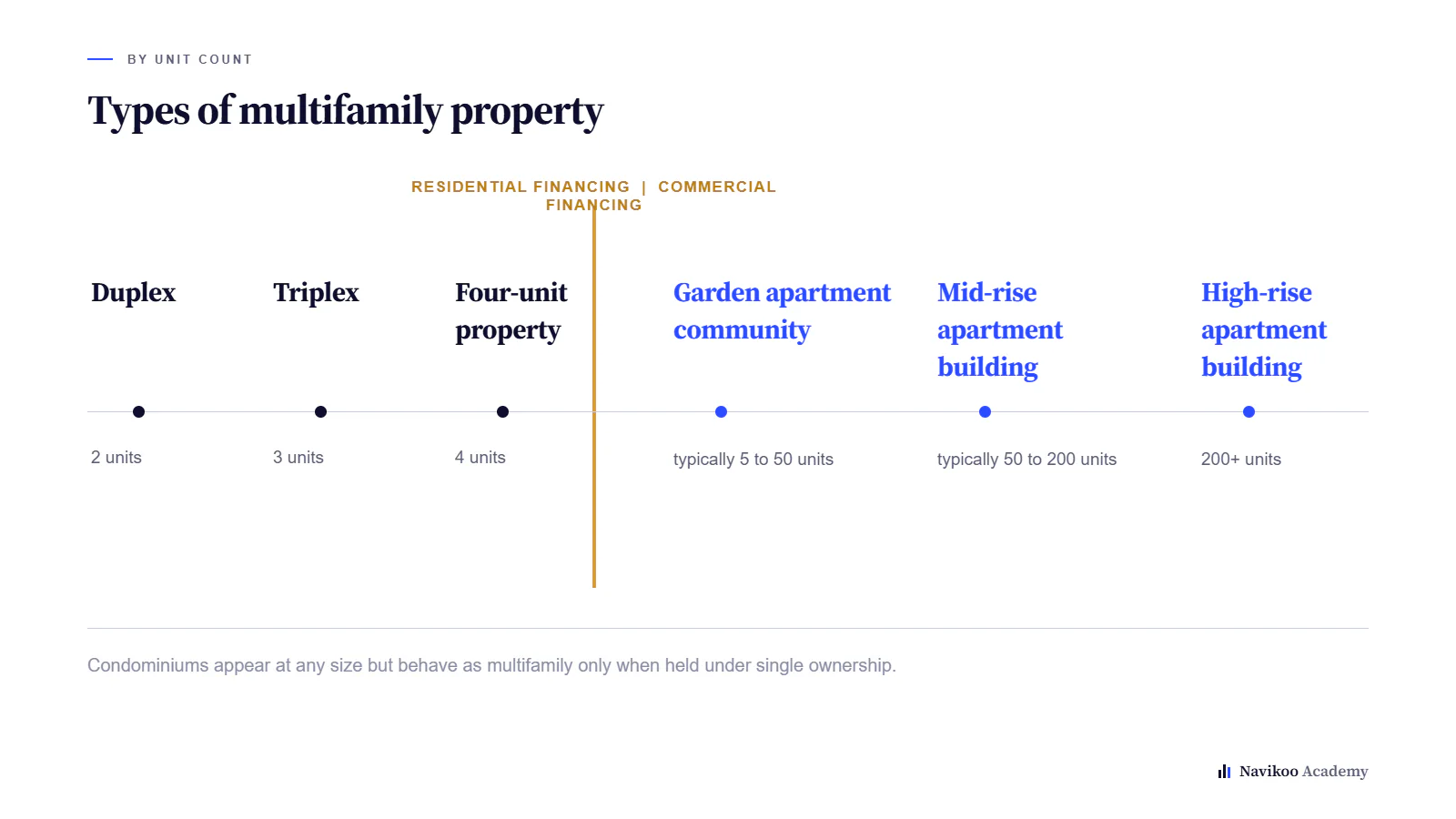
The category includes everything from duplexes and triplexes to large apartment communities.
Ownership structure also matters. A building may physically contain dozens of apartments while individual units are separately owned as condominiums. For an investor evaluating the entire property, that ownership structure is fundamentally different from buying one building under common ownership and operating all of its units as rentals.
The American Housing Survey and other national housing datasets track residential properties by structure type, illustrating how broad the multifamily category becomes once buildings move beyond detached single-family housing.
Zoning Definitions and Lender Definitions Differ
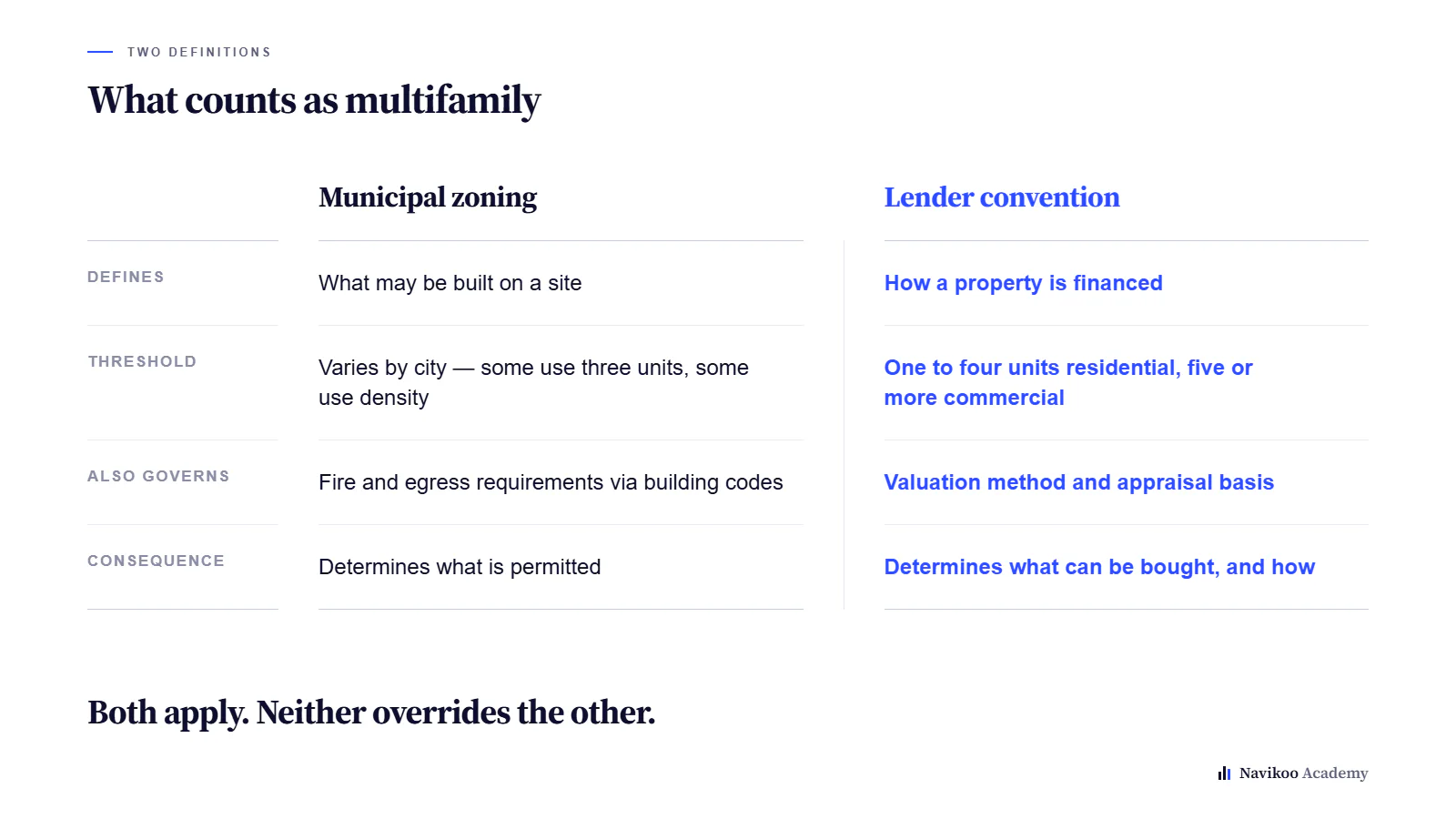
A city may use “multifamily” differently from a lender.
Municipal zoning codes classify properties for land-use purposes. One city may distinguish duplexes from multifamily buildings, while another may use density, unit count, lot configuration, or a combination of factors. Building and fire codes can introduce additional requirements depending on occupancy and construction.
Mortgage lending uses a different framework.
For many U.S. lending programs, properties containing one to four residential units fall within residential lending conventions, while properties with five or more units are generally treated as commercial multifamily.
A triplex can therefore be considered multifamily under local zoning while still qualifying for residential mortgage financing.
Investors need both definitions. Zoning determines what legally exists or may be built. Lending standards determine how the acquisition can be financed.
How Many Units Make a Property Commercial Multifamily?
Five units is the commonly used dividing line in U.S. mortgage finance.
The change is more significant than the addition of one extra tenant. Financing and underwriting begin to rely more heavily on the property's operating performance.
What Changes at Five Units
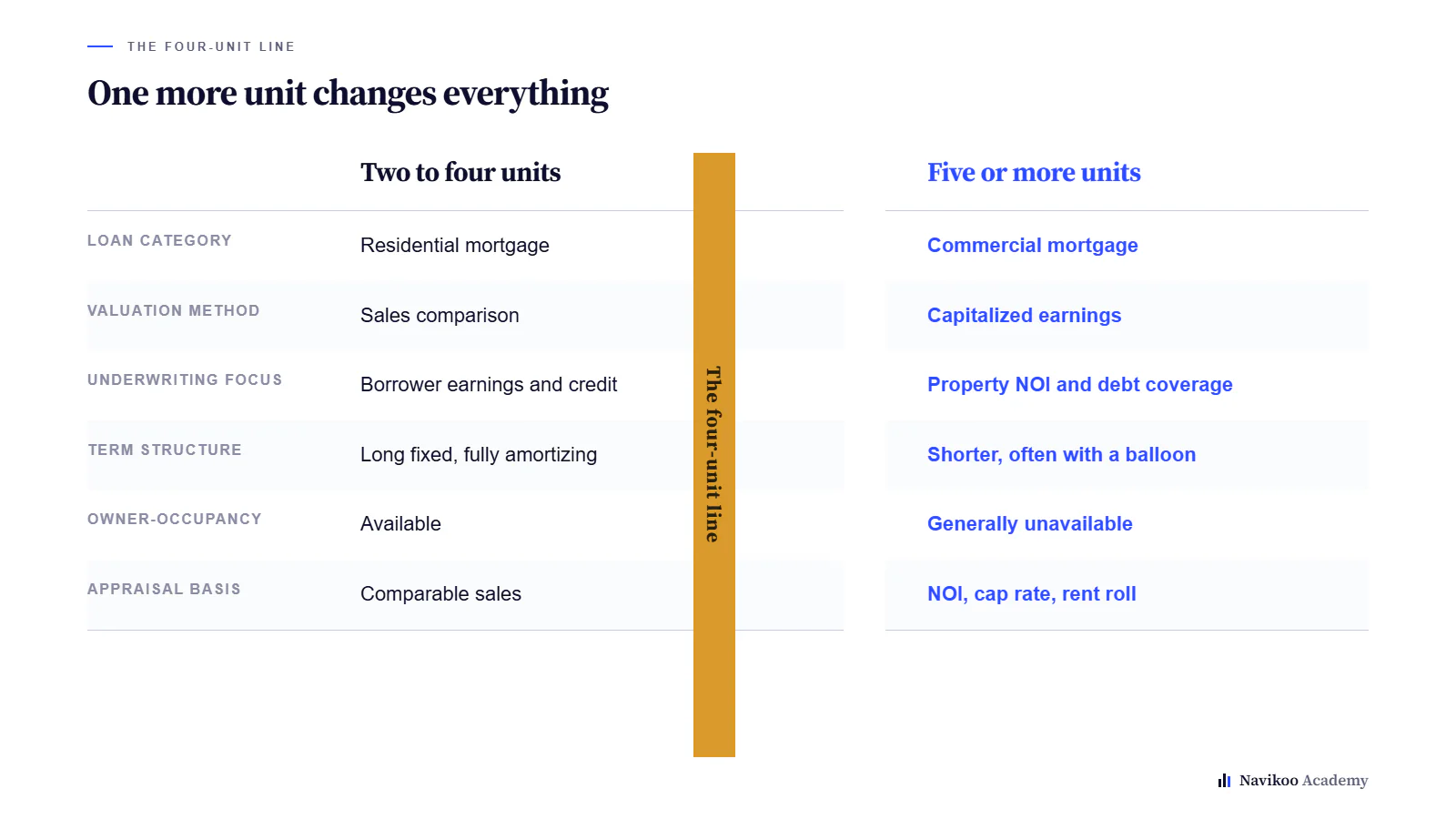
Factor | Two to four units | Five or more units |
|---|---|---|
Typical loan category | Residential mortgage | Commercial multifamily loan |
Appraisal emphasis | Comparable residential sales often carry substantial weight | Income approach typically becomes more important |
Underwriting emphasis | Borrower finances, credit and property characteristics | Property NOI, DSCR, borrower strength and asset quality |
Loan structure | Long-term fixed-rate options are widely available | Terms vary; shorter fixed periods and balloon structures are more common |
Owner-occupancy programs | May be available depending on loan program | Generally not structured as owner-occupied residential financing |
Income analysis | Relevant, but not always the primary valuation driver | Rent roll, operating statement, NOI and market cap rates become central |
The valuation difference deserves careful interpretation rather than a rigid rule.
A two- to four-unit property's appraisal will often place significant weight on recent comparable sales. Income can still matter, particularly for an investment property, but comparable residential transactions remain important.
For a five-plus-unit building, the income approach becomes much more central. An appraiser or investor examines the property's net operating income and considers the capitalization rates supported by comparable multifamily transactions in that market.
Comparable properties still matter on both sides of the line. What changes is how heavily the property's own operating performance influences the valuation.
The Common Categories
Multifamily housing comes in several forms. For investors, the useful differences involve financing, maintenance, tenant concentration, common-area obligations, and management complexity.
Duplex
A duplex contains two residential units, commonly arranged side by side or one above the other.
Duplexes are a common entry point into small multifamily investing because they retain access to residential financing while allowing rental income from more than one household. Some buyers also occupy one unit and rent the other, depending on the financing program and property.
Operationally, a duplex remains relatively close to single-family ownership. There are only two leases to manage, although one vacancy still removes half of the property's rental income.
Triplex and Four-Unit Properties
Triplexes and four-unit properties add more income streams without crossing into five-plus-unit commercial multifamily financing.
That combination makes the fourplex particularly interesting. It provides four sources of rent while remaining within the one-to-four-unit residential lending category used by many lenders.
Vacancy also becomes less concentrated. One empty unit in a fourplex removes roughly one-quarter of scheduled rent rather than all of it, although the actual financial effect depends on operating costs and debt service.
Garden Apartment Communities
Garden-style apartments are generally low-rise buildings spread across a larger site, often with surface parking, landscaping, sidewalks, and other shared exterior areas.
For an investor, those shared spaces create operating responsibilities that do not exist to the same degree in a small duplex or fourplex. Landscaping, parking areas, exterior lighting, drainage, roofs across multiple structures, and common-area maintenance all affect the expense budget.
Their economics therefore depend on much more than rent per unit.
Mid-Rise and High-Rise Apartment Buildings
As buildings become taller and more complex, shared systems become a larger part of operations.
Elevators, structured parking, common areas, access systems, fire protection, mechanical equipment, amenity spaces, and on-site staffing can materially change operating expenses.
At this scale, the investment behaves increasingly like an operating business. Revenue remains important, but controlling expenses, tenant turnover, concessions, maintenance, and capital projects becomes just as important to long-term performance.
Townhouses and Condo Properties
Townhouses and condominiums require an ownership distinction.
A row of townhouses under common ownership and operated as rentals can function as a multifamily investment. Individually deeded townhouses or condominium units may look similar physically, but the ownership, financing, HOA structure, and exit options are different.
For investment analysis, the legal ownership structure matters more than how the property looks from the street.
A Worked Comparison: Four Units Against Five
Consider two hypothetical properties in the same market.
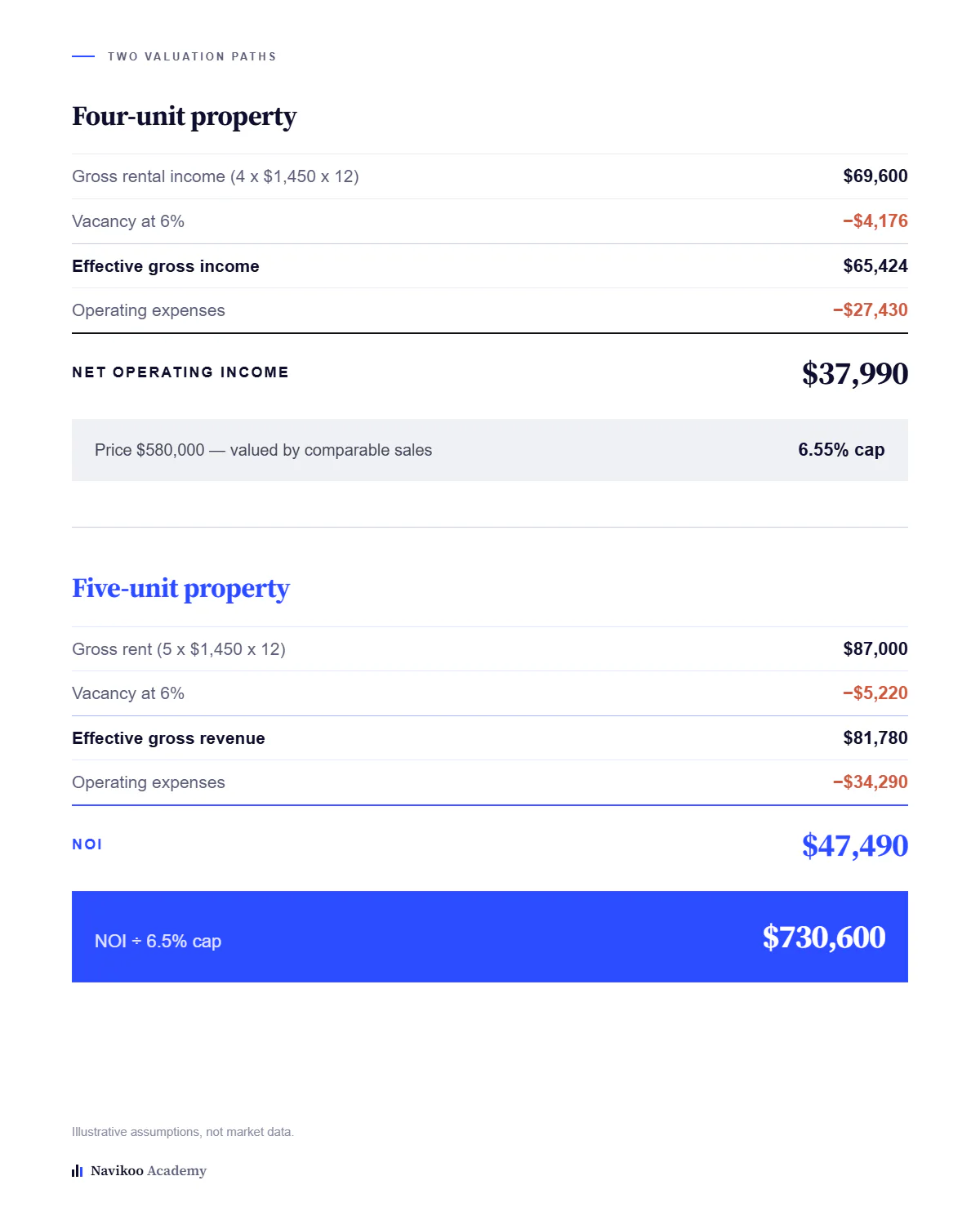
Both rent for $1,450 per unit per month, assume 6% vacancy, and use similar per-unit operating assumptions. The figures are educational examples rather than current market benchmarks.
The Four-Unit Property
Item | Annual Amount |
|---|---|
Gross rental income (4 × $1,450 × 12) | $69,600 |
Vacancy at 6% | −$4,176 |
Effective gross income | $65,424 |
Operating expenses | −$27,430 |
Net operating income | $37,994 |
At a hypothetical purchase price of $580,000, the property produces a cap rate of approximately:
$37,994 ÷ $580,000 = 6.55%
An investor can certainly calculate the property's income return, but a residential appraisal on a four-unit property will generally still look closely at comparable sales of similar small multifamily properties.
The Five-Unit Property
Item | Annual Amount |
|---|---|
Gross rental income (5 × $1,450 × 12) | $87,000 |
Vacancy at 6% | −$5,220 |
Effective gross revenue | $81,780 |
Operating expenses | −$34,290 |
Net operating income | $47,490 |
If investors in that submarket are valuing comparable properties around a 6.5% cap rate, an income-based estimate would be:
$47,490 ÷ 0.065 ≈ $730,600
That figure is still tied to the market. The cap rate itself comes from how comparable assets are trading, and an appraisal may consider additional evidence.
The important change is that the building's own operating income now has a much more direct relationship with its valuation.
How Value Gets Created Above Four Units
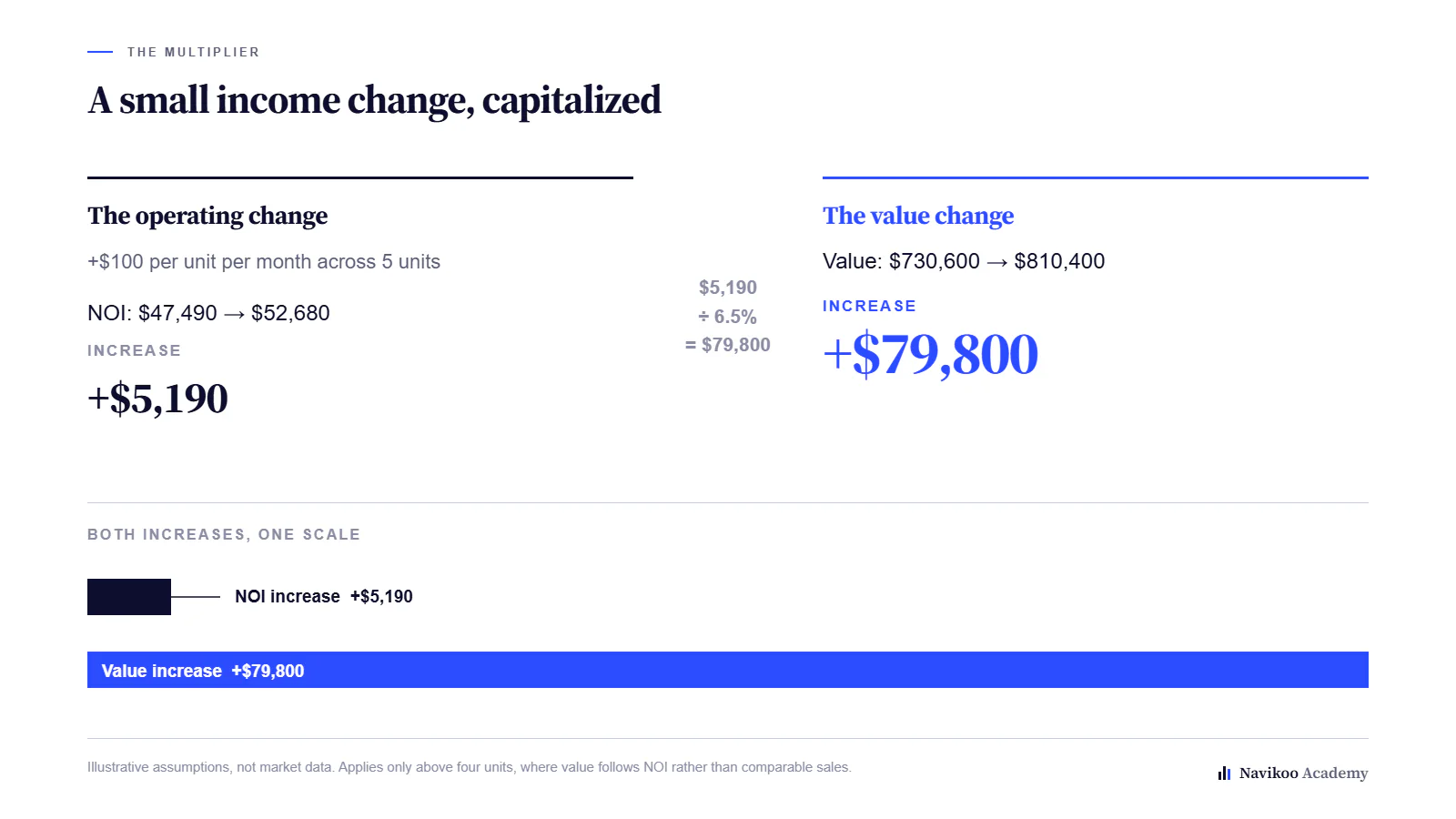
For five-plus-unit multifamily, improvements to recurring NOI can translate directly into changes in value.
Suppose better leasing and operations add $5,190 of sustainable annual NOI to the five-unit property.
NOI would rise from:
$47,490 to $52,680
At the same hypothetical 6.5% market cap rate:
$52,680 ÷ 0.065 ≈ $810,500
The difference is roughly $79,900 of indicated value.
This is why investors in commercial multifamily pay so much attention to rent growth, vacancy, management efficiency, utility recovery, and recurring operating expenses. A durable improvement to NOI can affect value by a multiple of the annual savings or revenue increase.
The relationship also works in reverse.
If recurring insurance, taxes, utilities, or other operating expenses rise permanently, NOI falls. At a constant market cap rate, that lower income supports a lower valuation.
A fourplex can benefit from stronger rents and better operations too. The difference is that comparable residential sales often exert more influence on its appraisal, so the translation from additional NOI to appraised value is less direct.
What Is the 1% Rule for Multifamily?
The 1% rule is a screening heuristic that compares monthly gross rent with purchase price.
A property satisfies the rule when:
Monthly Rent ≥ 1% of Purchase Price
The hypothetical fourplex collects:
4 × $1,450 = $5,800 per month
Against a $580,000 price:
$5,800 ÷ $580,000 = 1.0%
It meets the rule exactly.
Why the Rule Travels Badly
The 1% rule sees gross rent and purchase price. It sees almost nothing between them.
That limitation becomes particularly relevant when comparing multifamily properties with different expense structures.
One building may include:
owner-paid water and sewer
trash service
common-area electricity
landscaping
snow removal
professional management
shared mechanical systems
Another may shift more utilities to tenants and require much less common-area maintenance.
Both could satisfy the same rent-to-price rule while producing very different NOI.
In the hypothetical fourplex, operating expenses consume a meaningful portion of effective revenue. Another property with the same gross rent and purchase price could perform materially better or worse depending on its taxes, insurance, utilities, maintenance, and management.
The 1% rule can narrow a long list of properties quickly. It cannot replace an operating statement.
How Much Money Do You Need to Buy a Multifamily House?
Unit count can materially change the equity required to acquire a property because the available financing changes.
Two to Four Units
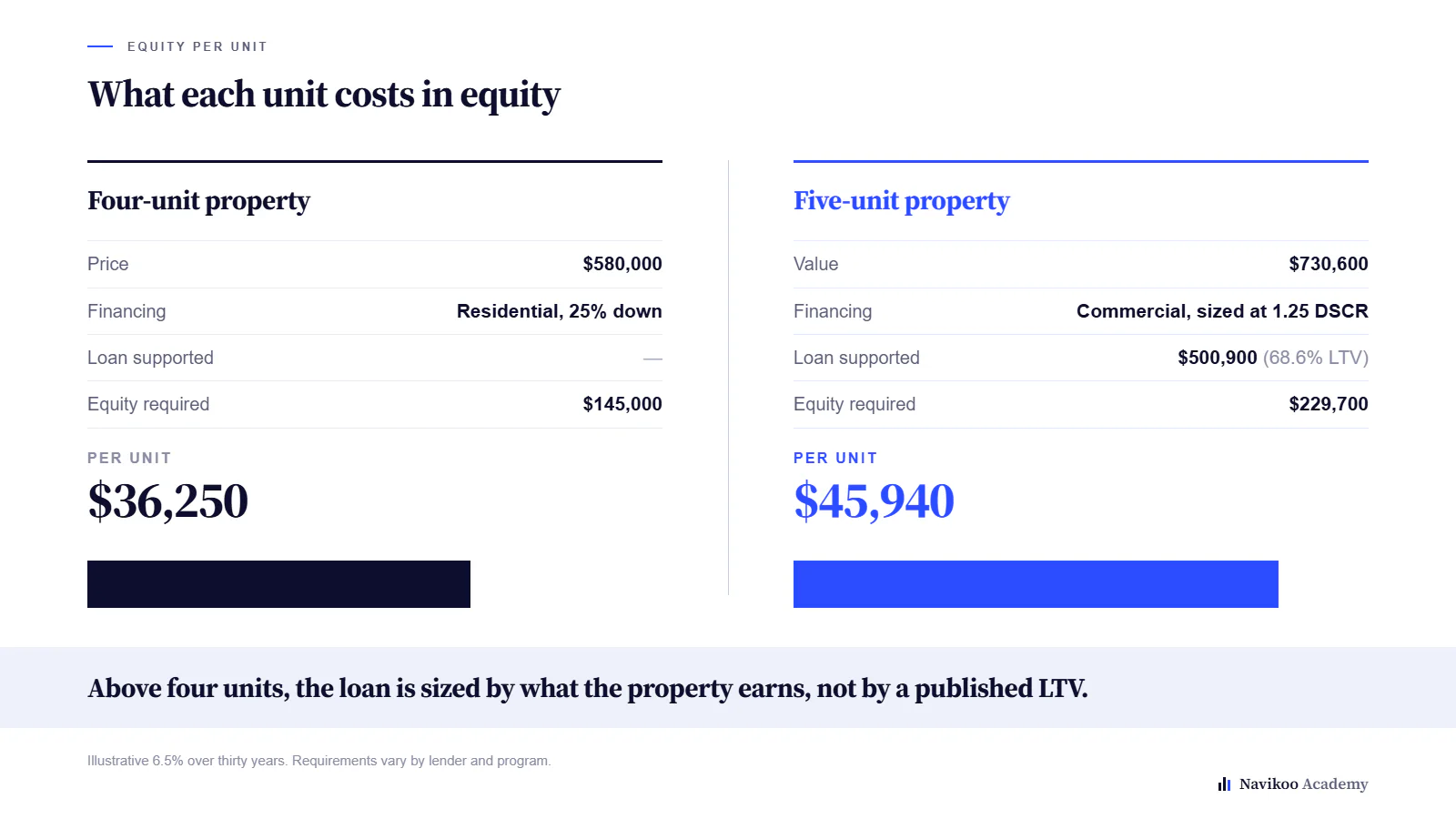
Consider the hypothetical $580,000 fourplex.
If an investor uses a loan requiring 25% down, the equity contribution would be:
$580,000 × 25% = $145,000
That works out to:
$36,250 of acquisition equity per unit
before closing costs and reserves.
This is only an illustration. Actual down-payment requirements depend on the lender, loan type, borrower, occupancy, property characteristics, and current underwriting standards.
Owner-occupants may have access to different residential programs with lower equity requirements, which is one reason duplexes, triplexes, and four-unit properties are often considered by investors willing to live in one unit.
Five Units and Above
Commercial multifamily lenders frequently consider both loan-to-value limits and the property's ability to support debt.
Use the hypothetical five-unit property's NOI of $47,490.
If a lender requires an illustrative 1.25 DSCR, maximum annual debt service would be:
$47,490 ÷ 1.25 = $37,992
At an illustrative 6.5% interest rate with 30-year amortization, that debt service supports a loan of roughly $500,900.
Relative to the hypothetical $730,600 value:
$500,900 ÷ $730,600 ≈ 68.6% LTV
The equity requirement would therefore be approximately:
$730,600 − $500,900 = $229,700
or about:
$45,940 per unit
before closing costs and lender reserves.
The example shows how DSCR can become a binding constraint even when a lender might otherwise permit greater leverage.
Residential and commercial borrowing costs are not interchangeable. Freddie Mac publishes residential mortgage rate data through its Primary Mortgage Market Survey, while commercial multifamily loans are quoted according to their own term, leverage, borrower, property, and market characteristics.
Is Multifamily Better Than Single Family?
The answer depends on what an investor wants from the property and which risks they are prepared to manage.
Where Multifamily Performs Better
The first advantage is diversification of rental income.
If a single-family rental becomes vacant, scheduled rental income falls to zero until another tenant moves in.
If one unit in a fourplex is vacant, three other tenants may still be paying rent.
Larger multifamily properties can also create efficiencies in shared expenses. One roof, one parcel, centralized management, common landscaping, and shared infrastructure may serve multiple units.
Those efficiencies should not be assumed automatically. Elevators, common spaces, staffing, amenities, security systems, and more complex mechanical equipment can add expenses as properties grow.
For five-plus-unit properties, investors also gain a more direct opportunity to influence value through NOI. Improving operations can matter not only for cash flow but also for the property's income-based valuation.
Where Family Homes Perform Better
Single-family homes generally have a broader potential buyer pool because investors compete with owner-occupants.
That can improve exit liquidity, particularly in neighborhoods with strong homeowner demand.
Operations are also simpler. One lease, fewer common systems, no shared hallways, and limited common-area expenses make a single-family rental easier to understand and manage.
Appreciation is often influenced heavily by owner-occupant demand and comparable home sales rather than solely by an investment property's income.
An investor choosing between the two is therefore comparing different operating models, not simply different unit counts.
What Are the Disadvantages of Multifamily Homes?
Multifamily ownership adds layers of operating and financing complexity that become more important as unit count rises.
Management Intensity
More units create more leases, more tenant communication, more turnover, and more maintenance activity.
A professional manager may charge a percentage of collected rents or use another fee structure depending on the market and level of service. Investors who self-manage avoid that direct expense but take on the work themselves.
The financial model should account for management realistically even when the current owner does not use a management company, especially if the investment is being evaluated as something that should operate independently of the buyer's personal labor.
Exit Liquidity
The buyer pool changes as properties become larger.
A duplex or fourplex may attract both local investors and, in some cases, owner-occupants.
A commercial multifamily property is generally purchased by investors evaluating the rent roll, NOI, condition, financing, and expected return.
A narrower buyer pool does not automatically mean poor liquidity, but weak operating performance can become especially visible during a sale because prospective buyers will rebuild the numbers themselves.
Refinance Risk
Commercial multifamily loans may have different term structures from long-term residential mortgages.
Some loans amortize over a longer period but mature earlier, creating a balloon balance that must be refinanced or repaid.
If interest rates rise, NOI declines, or lender requirements tighten before maturity, the replacement loan may be smaller than expected.
That can require additional equity even when the property has continued operating.
Investors should therefore evaluate not only today's payment but also the refinancing structure built into the debt.
Where Multifamily Numbers Usually Break
Seller projections deserve reconstruction before they enter an investor's underwriting.
Three assumptions are especially worth testing:
Vacancy.
Compare the seller's assumption with actual occupancy history and realistic market conditions.
Management.
A self-managing owner may show no management expense. A buyer planning to use professional management should include one.
Reserves and recurring capital needs.
Roofs, HVAC systems, common areas, parking surfaces, unit turns, and other major items do not arrive as smooth monthly expenses, but ignoring them does not make them disappear.
In commercial multifamily, these assumptions matter twice: first because they affect cash flow, and second because sustainable NOI influences value.
Consider a simplified example.
If recurring management expense is understated by $6,000 per year, sustainable NOI is also overstated by $6,000.
At a hypothetical 6.5% cap rate:
$6,000 ÷ 0.065 ≈ $92,300
That does not mean every $6,000 expense change automatically moves a sale price by exactly $92,300. Cap rates, buyer expectations, property condition, and market conditions can change.
It does show why relatively modest recurring expense assumptions deserve careful attention when an asset is valued primarily from income.
Common Questions Worth Asking Before an Offer
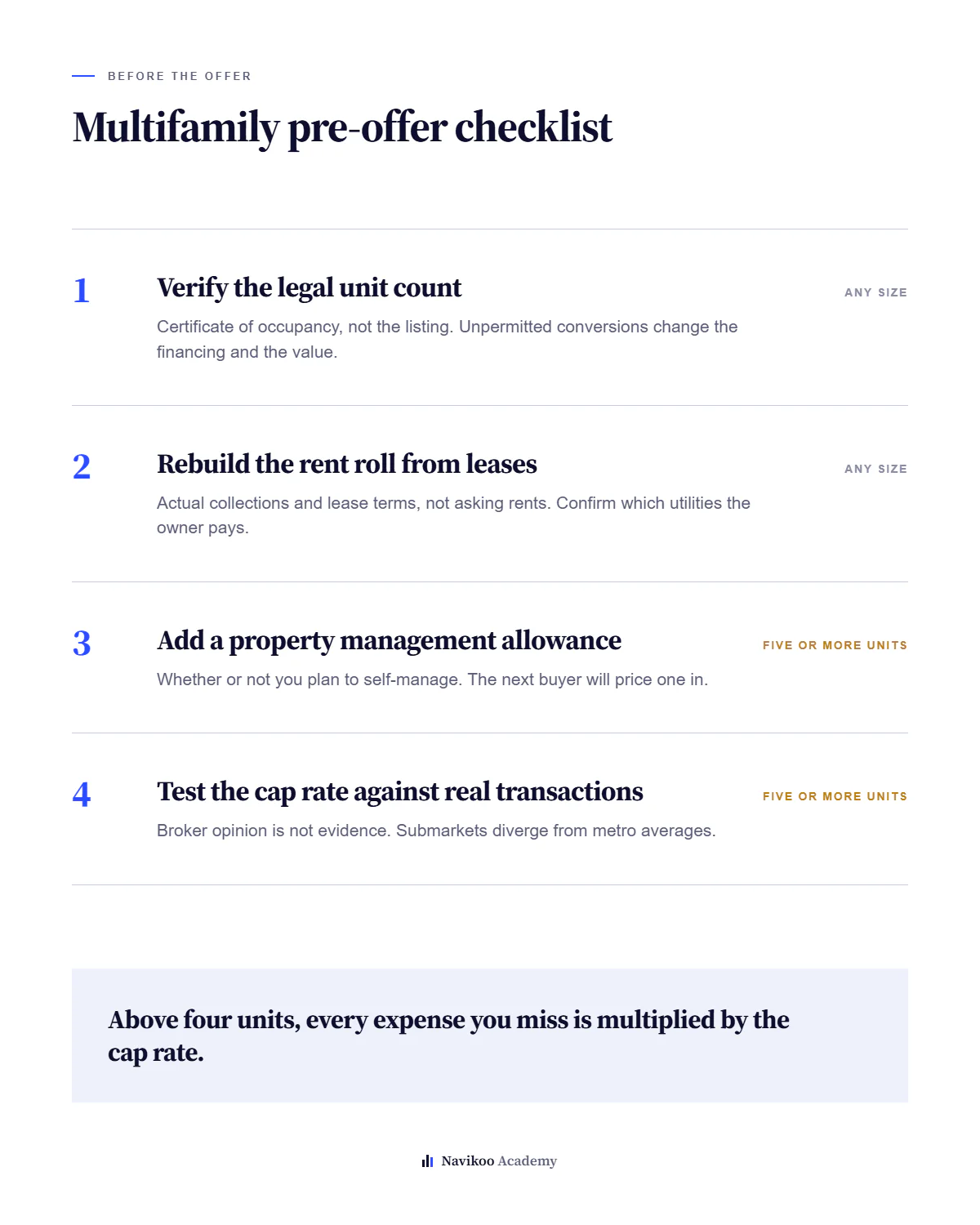
Start by confirming the legal unit count.
The listing may describe five units, but the certificate of occupancy, zoning records, permits, or other municipal documents may tell a different story. An unauthorized conversion can affect financing, insurance, appraisal, and the legality of collecting rent from the additional unit.
Then verify income.
Review actual leases and the current rent roll rather than relying only on asking rents or a seller's pro forma. Note lease expiration dates, concessions, delinquency, month-to-month tenants, and units currently below or above market rent.
Utilities deserve their own review. Determine exactly which services are paid by the owner and which are paid directly by tenants. Water, sewer, trash, common electricity, gas, and heating arrangements can create meaningful differences between buildings with similar rents.
For five-plus-unit properties, examine the cap-rate assumption as well. Broker guidance is useful, but recent transactions involving genuinely comparable assets provide better context. Cushman & Wakefield's U.S. Multifamily MarketBeat reports can provide broader market context, while individual neighborhoods and smaller properties may trade differently from metro-level averages.
Finally, test the financing before treating the purchase price as workable. A lender's DSCR requirement, amortization, reserves, and maximum leverage can change the equity requirement substantially.
Investors who want to compare how rent, vacancy, expenses, financing, and building size affect a deal can model those assumptions in Navikoo's analysis tools before deciding which segment of multifamily fits the strategy.
Moving from four units to five is a small physical change with a surprisingly large financial consequence. Understanding that shift before shopping helps an investor compare properties using the financing and valuation framework that actually applies to each one.